


Battery Cell Balancing in BMS Explained for Beginners

Battery Cell Balancing in BMS Explained: Complete Beginner Guide
Battery cell balancing in BMS explained simply means keeping all battery cells at almost the same voltage level during charging and discharging. This process helps improve battery safety, performance, and lifespan.
In modern battery packs, especially lithium-ion and LiFePO4 battery packs, a Battery Management System is very important. It monitors every cell and protects the battery pack from overcharging, over-discharging, overheating, and voltage imbalance.
In this beginner-friendly guide from DiySmartLab.com, you will learn what battery cell balancing is, why it is important, how it works, and where it is used.
What Is Battery Cell Balancing in BMS?
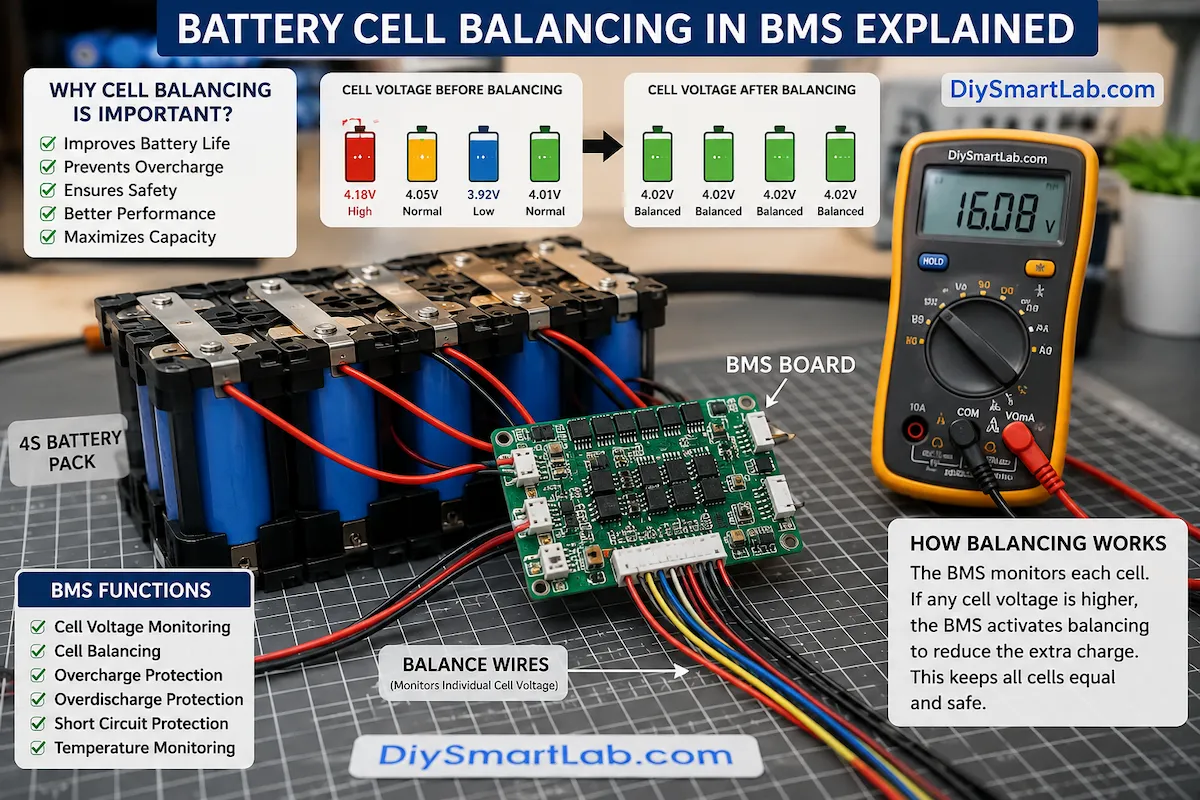
Battery cell balancing is the process of equalizing the voltage of all cells inside a battery pack. A BMS performs this process to make sure that no cell becomes too high or too low compared to other cells.
For example, a 4S lithium battery pack has four cells connected in series. Ideally, all four cells should charge and discharge equally. However, in real life, each cell behaves slightly differently.
| Cell Number | Voltage Before Balancing | Status |
|---|---|---|
| Cell 1 | 3.95V | Normal |
| Cell 2 | 4.10V | High |
| Cell 3 | 3.90V | Low |
| Cell 4 | 4.00V | Normal |
Here, Cell 2 has a higher voltage than the others. If charging continues, Cell 2 may overcharge first. Therefore, the BMS balances the cells to prevent damage.
Why Is Battery Cell Balancing Important?
Battery cell balancing is important because battery cells are never perfectly identical. Even if all cells come from the same brand and batch, small differences still exist.
These differences can become bigger after many charge and discharge cycles. As a result, one cell may reach full charge earlier than others. Also, one cell may become empty earlier during discharge.
Main Reasons for Cell Imbalance
- Small manufacturing differences between cells
- Different internal resistance values
- Uneven temperature inside the battery pack
- Different aging speed of each cell
- Improper charging or discharging
- Weak or damaged cells inside the pack
Without balancing, the battery pack may lose capacity quickly. In serious cases, it may also become unsafe.
Features of Battery Cell Balancing in BMS
A good BMS with cell balancing offers many useful features. These features help protect the battery pack and improve reliability.
- Monitors individual cell voltage
- Balances high-voltage cells
- Protects cells from overcharging
- Protects cells from over-discharging
- Improves battery pack capacity usage
- Increases battery lifespan
- Reduces battery heating problems
- Improves safety in lithium battery packs
Working Principle of Battery Cell Balancing in BMS
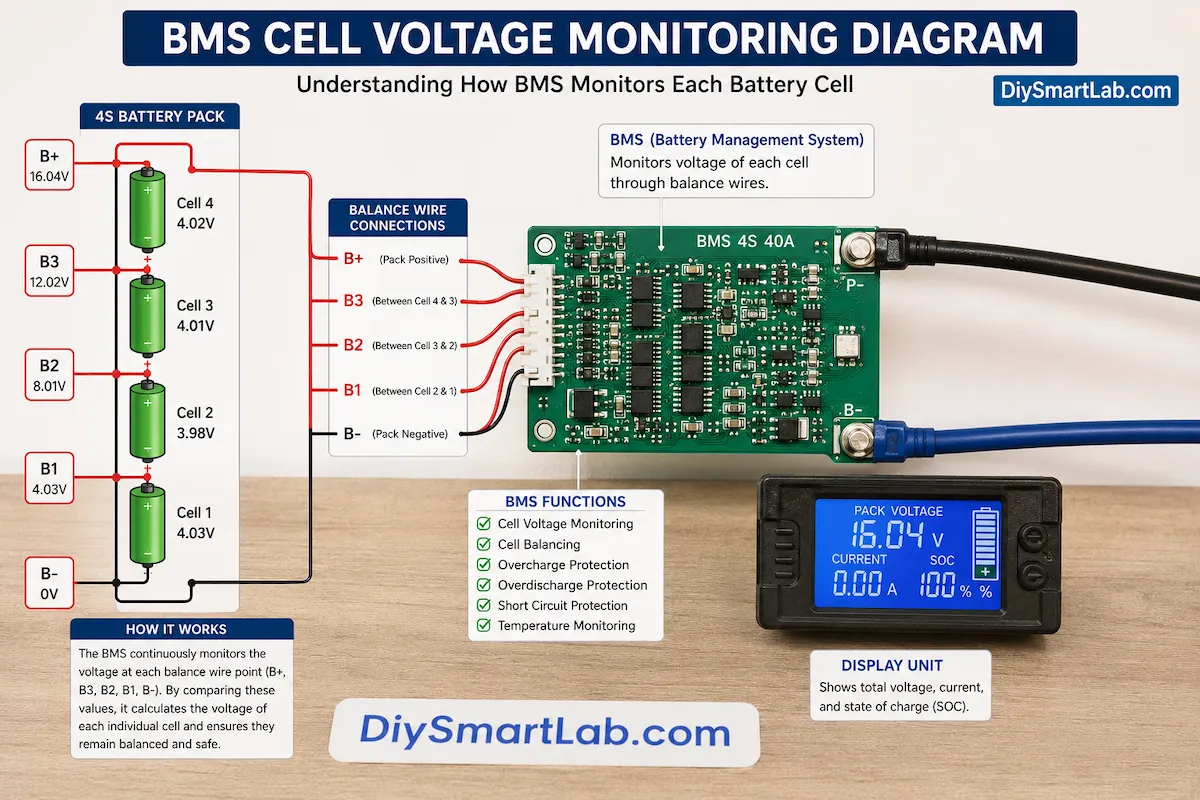
The working principle of battery cell balancing in BMS is simple. The BMS continuously measures the voltage of each cell. When it finds that one cell voltage is higher than others, it starts balancing.
The BMS does not allow one cell to become dangerously high. Instead, it reduces or redistributes the extra energy from the high-voltage cell.
Step-by-Step Working
- The BMS measures the voltage of each battery cell.
- It compares all cell voltages.
- It detects the cell with higher voltage.
- It activates the balancing circuit.
- The high-voltage cell loses extra charge or shares energy.
- All cells reach a more equal voltage level.
This process keeps the battery pack stable and safe.
Types of Battery Cell Balancing
There are mainly two types of battery cell balancing used in BMS circuits:
- Passive cell balancing
- Active cell balancing
Passive Cell Balancing
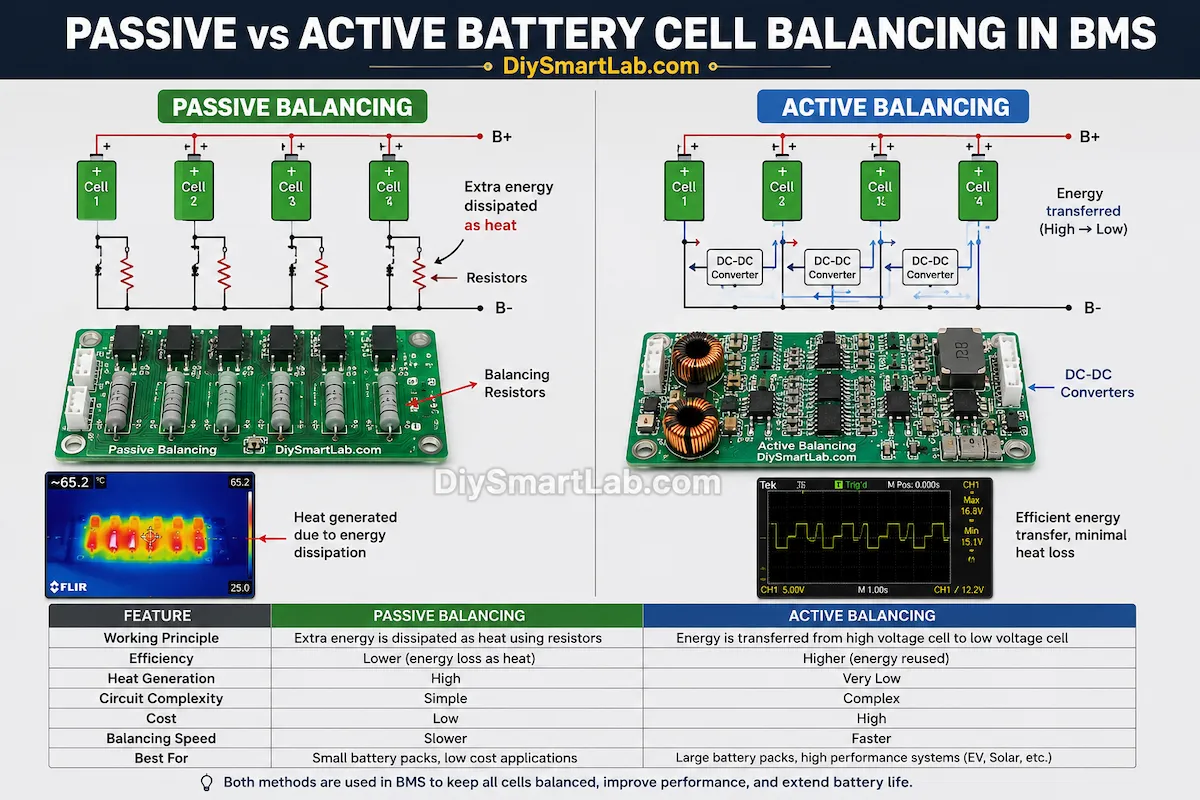
Passive cell balancing is the most common and low-cost method. In this method, the BMS removes extra energy from high-voltage cells through resistors.
The extra energy becomes heat. Therefore, passive balancing is simple but less efficient.
| Feature | Passive Balancing |
|---|---|
| Cost | Low |
| Circuit Complexity | Simple |
| Efficiency | Lower |
| Energy Handling | Extra energy converts into heat |
| Common Use | Small and medium battery packs |
Active Cell Balancing
Active cell balancing is a more advanced method. In this method, energy from a high-voltage cell transfers to a low-voltage cell or back to the battery pack.
This method wastes less energy. However, it needs a more complex circuit and costs more.
| Feature | Active Balancing |
|---|---|
| Cost | High |
| Circuit Complexity | Complex |
| Efficiency | Higher |
| Energy Handling | Energy transfers between cells |
| Common Use | EVs, solar storage, large battery systems |
Components Required for Battery Cell Balancing Circuit
A battery cell balancing circuit can be simple or advanced depending on the BMS type. However, most BMS circuits use some common components.
| Component | Purpose |
|---|---|
| Battery Cells | Store electrical energy |
| BMS IC | Measures and controls cell voltage |
| Balancing Resistors | Discharge high-voltage cells in passive balancing |
| MOSFETs | Switch balancing paths on and off |
| NTC Sensor | Monitors battery temperature |
| Protection MOSFETs | Control charging and discharging path |
| PCB | Holds and connects all components |
| Connector Wires | Connect each cell to the BMS |
Circuit Explanation of Battery Cell Balancing in BMS
In a BMS circuit, each battery cell connects to the BMS through balance wires. These wires help the BMS measure individual cell voltage.
For example, in a 3S lithium battery pack, the BMS needs four balance connections. These points are B-, B1, B2, and B+.
3S Battery Pack Example
| Connection Point | Meaning |
|---|---|
| B- | Battery pack negative terminal |
| B1 | Positive terminal of Cell 1 |
| B2 | Positive terminal of Cell 2 |
| B+ | Battery pack positive terminal |
The BMS reads voltage between these points. Then it calculates the voltage of each cell separately.
If one cell voltage becomes higher than the balancing threshold, the BMS turns on a small MOSFET. This MOSFET connects a resistor across that cell. As a result, extra charge slowly drains from that cell.
This process continues until the cell voltage becomes closer to the other cells.

Battery Cell Balancing Example
Let us understand battery cell balancing with a simple 4S battery pack example.
| Cell | Before Balancing | After Balancing |
|---|---|---|
| Cell 1 | 4.05V | 4.02V |
| Cell 2 | 4.18V | 4.03V |
| Cell 3 | 4.01V | 4.01V |
| Cell 4 | 4.00V | 4.01V |
In this example, Cell 2 has a higher voltage. Therefore, the BMS balances Cell 2. After balancing, all cells become close to each other.
Applications of Battery Cell Balancing in BMS
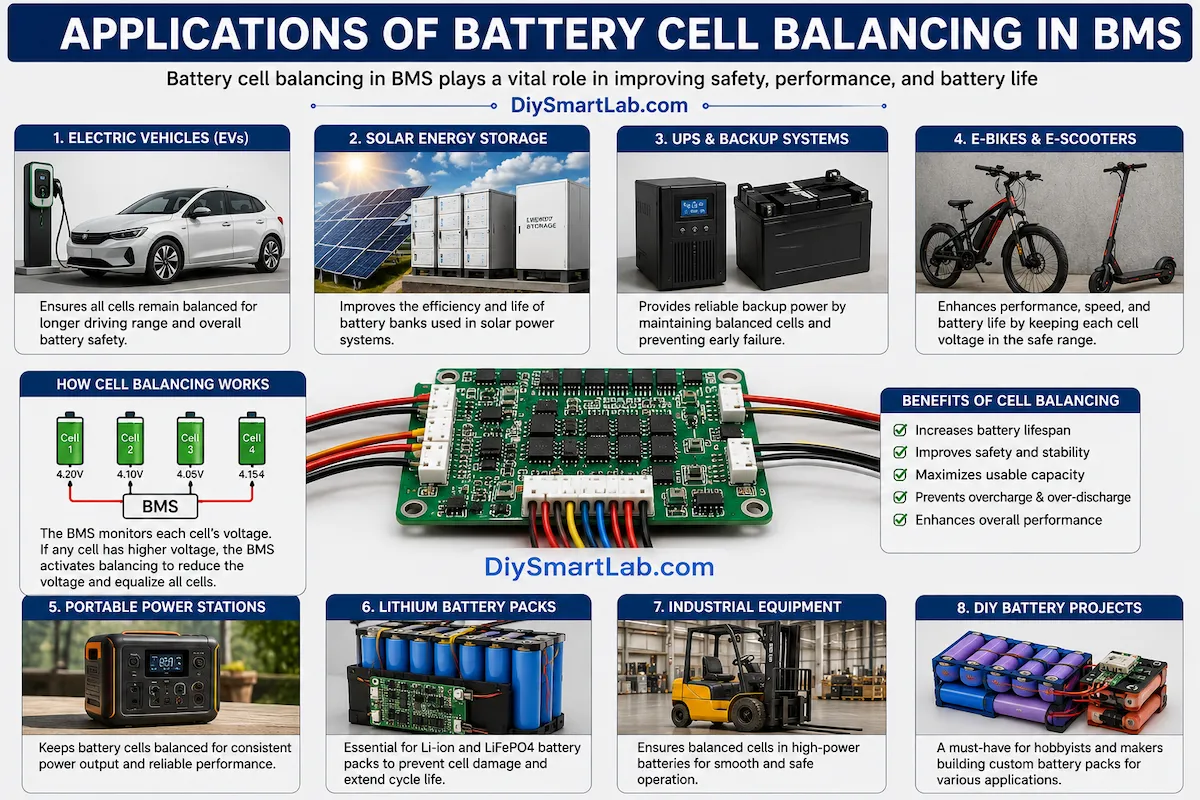
Battery cell balancing is used in many modern battery-powered systems. It is especially important where lithium battery packs are used.
- Electric vehicles
- Solar energy storage systems
- Inverter battery packs
- LiFePO4 battery packs
- Lithium-ion battery packs
- E-bikes and e-scooters
- Portable power stations
- UPS systems
- Power tools
- DIY battery projects
Advantages of Battery Cell Balancing in BMS
Battery cell balancing provides many benefits. It makes the battery pack safer, more stable, and more useful for long-term operation.
- Improves battery pack safety
- Increases battery lifespan
- Improves usable battery capacity
- Prevents cell overcharging
- Prevents weak cell stress
- Improves charging efficiency
- Reduces battery pack failure risk
- Supports stable performance
Disadvantages of Battery Cell Balancing
Although cell balancing is very useful, it also has some limitations.
- Passive balancing wastes some energy as heat
- Active balancing circuits are expensive
- Balancing takes time
- Poor quality BMS boards may balance slowly
- Wrong BMS wiring can damage the battery pack
- Balancing cannot repair a damaged cell
Passive vs Active Cell Balancing Comparison
| Point | Passive Balancing | Active Balancing |
|---|---|---|
| Working Method | Burns extra energy as heat | Transfers energy between cells |
| Cost | Low | High |
| Efficiency | Lower | Higher |
| Circuit Design | Simple | Complex |
| Best For | Small battery packs | Large battery packs |
| Common Use | DIY packs, small BMS boards | EVs, solar storage, industrial systems |
How to Know If a Battery Pack Needs Balancing
You can identify cell imbalance by checking individual cell voltages. If the difference between cells is high, balancing is required.
Common Signs of Cell Imbalance
- Battery pack charges too quickly
- Battery pack discharges too quickly
- One cell reaches full voltage earlier
- One cell drops voltage faster
- BMS cuts off charging early
- BMS cuts off output even when pack voltage looks normal
- Battery backup time becomes low
For lithium battery packs, you should always use a proper BMS. Also, avoid charging multi-cell lithium packs without protection.
Important Safety Tips
Battery packs can store a lot of energy. Therefore, safety is very important when working with BMS circuits.
- Always use the correct BMS for your battery chemistry.
- Do not mix old and new cells in the same pack.
- Use cells with similar capacity and internal resistance.
- Connect balance wires carefully.
- Never short-circuit battery terminals.
- Use proper insulation between cells.
- Do not charge damaged or swollen cells.
- Use a proper lithium battery charger.
FAQs About Battery Cell Balancing in BMS
What is battery cell balancing in BMS?
Battery cell balancing in BMS is the process of keeping all cells inside a battery pack at nearly equal voltage. It helps improve safety, capacity, and battery life.
Why is cell balancing needed in lithium batteries?
Cell balancing is needed because lithium cells do not charge and discharge exactly equally. Without balancing, one cell may overcharge or over-discharge before the others.
What is passive cell balancing?
Passive cell balancing removes extra charge from high-voltage cells using resistors. The extra energy converts into heat.
What is active cell balancing?
Active cell balancing transfers energy from high-voltage cells to low-voltage cells. It is more efficient but also more expensive.
Can a BMS repair a bad battery cell?
No, a BMS cannot repair a damaged cell. It can only monitor, protect, and balance cells within safe limits.
Is cell balancing necessary for LiFePO4 batteries?
Yes, cell balancing is important for LiFePO4 batteries, especially in multi-cell battery packs used in solar systems, EVs, and inverter applications.
Conclusion
Battery cell balancing in BMS explained in simple words means keeping every battery cell at a similar voltage level. This process protects the battery pack from imbalance, overcharging, and early failure.
A BMS checks individual cell voltage and balances high-voltage cells when needed. Passive balancing is simple and affordable, while active balancing is more efficient and suitable for large battery systems.
If you are building a lithium-ion or LiFePO4 battery pack for any DIY electronics project, always use a good quality BMS with cell balancing. For more beginner-friendly electronics guides, keep learning with DiySmartLab.com.