
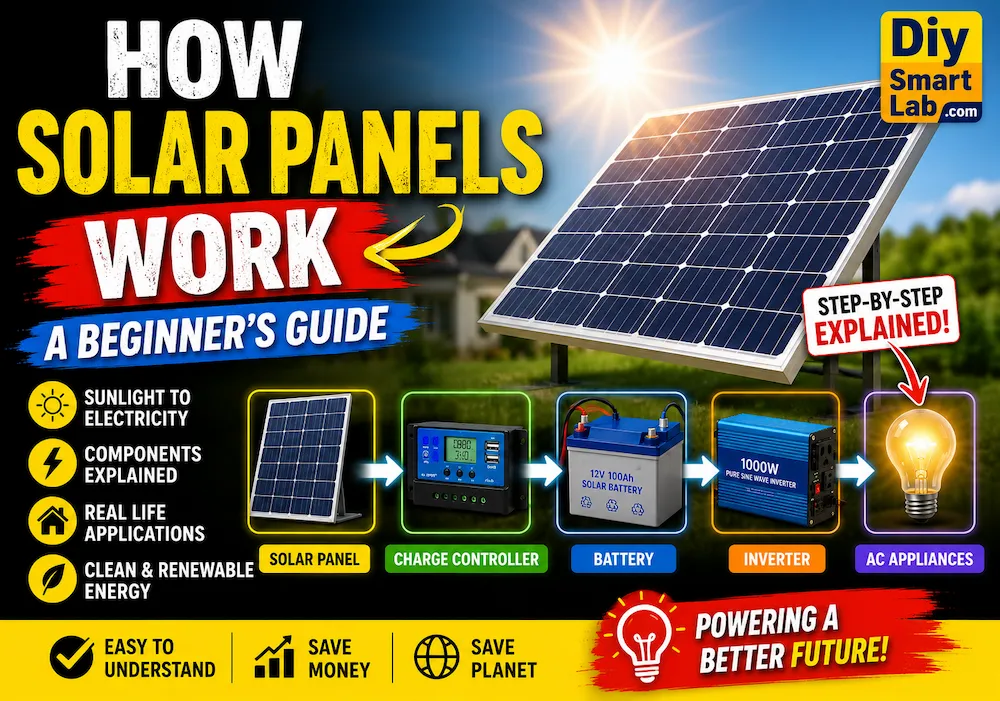

How Solar Panels Work: A Beginner’s Guide
Solar energy is becoming one of the most popular sources of electricity worldwide. Today, homeowners, businesses, and industries are using solar power to reduce electricity bills and decrease dependence on traditional energy sources.
However, many beginners still wonder how solar panels work. How can sunlight generate electricity? What happens inside a solar panel? And what components are required in a solar power system?
In this beginner-friendly guide from DiySmartLab.com, you will learn everything about solar panel technology in simple language. We will cover the working principle, components, circuit explanation, applications, advantages, disadvantages, and frequently asked questions.
What Is a Solar Panel?
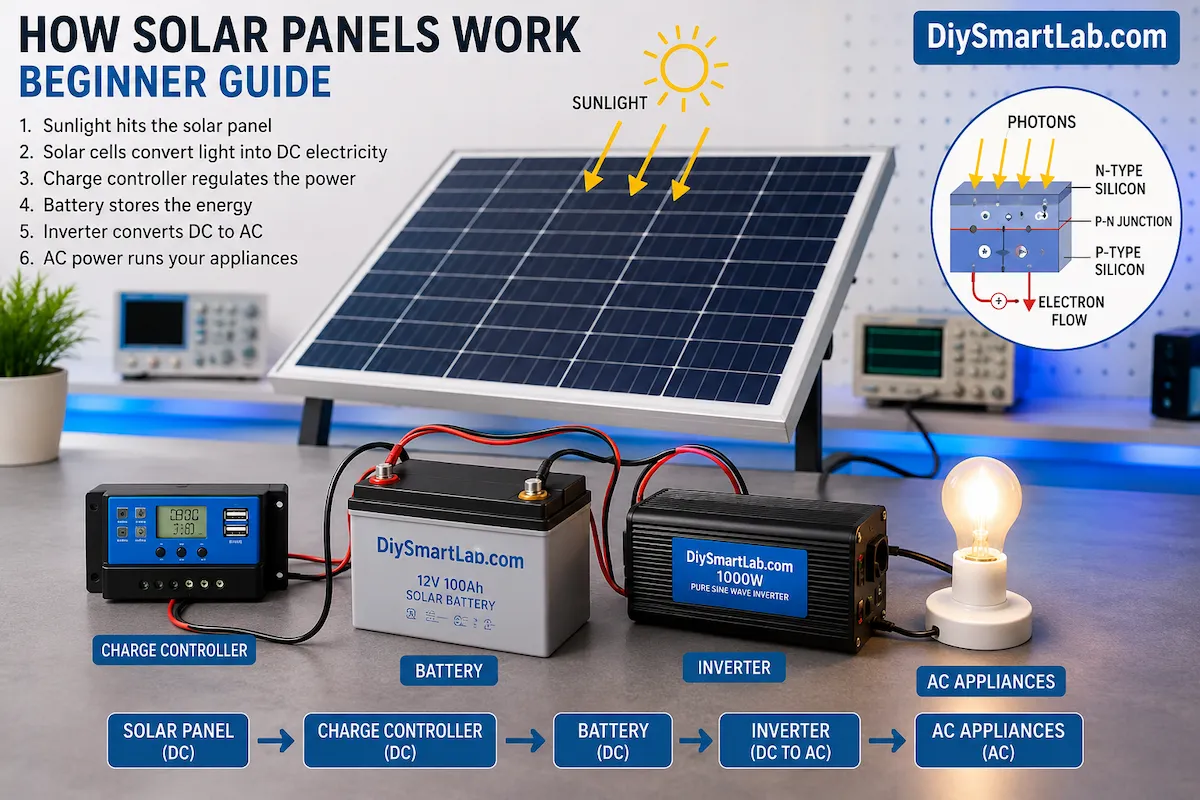
A solar panel is a device that converts sunlight into electrical energy using photovoltaic (PV) cells.
When sunlight strikes the surface of a solar panel, the photovoltaic cells generate direct current (DC) electricity. This electricity can then be stored in batteries or converted into alternating current (AC) using an inverter.
As a result, solar panels provide clean and renewable energy without producing pollution.
Main Features of Solar Panels
- Generate electricity from sunlight
- Renewable and eco-friendly energy source
- Low maintenance requirements
- Long operational lifespan
- Reduce electricity bills
- Suitable for homes and industries
- Can work with battery storage systems
- Silent operation
How Solar Panels Work
The basic principle behind solar panels is known as the photovoltaic effect.
When sunlight reaches a photovoltaic cell, photons transfer their energy to electrons inside the semiconductor material. Consequently, these electrons begin to move and create an electric current.
This electrical current flows through conductors and becomes usable electricity.
Step-by-Step Working Process
- Sunlight falls on the solar panel.
- Photovoltaic cells absorb light energy.
- Electrons become energized.
- Electron movement generates DC electricity.
- The inverter converts DC into AC.
- Electrical appliances use the generated power.
- Extra power can be stored in batteries or sent to the grid.
Photovoltaic Effect Explained
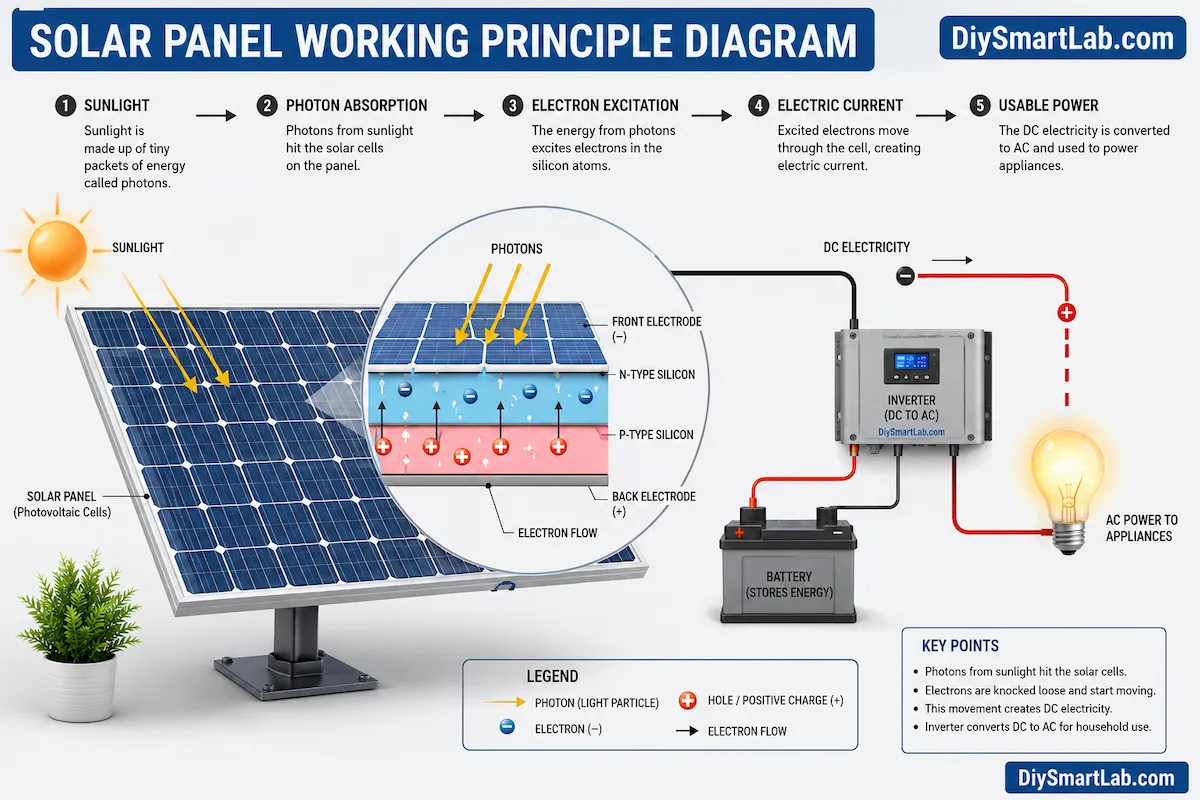
The photovoltaic effect is the core technology used in solar panels.
Solar cells are usually made from silicon semiconductor material. Silicon contains atoms with electrons that can move when exposed to sunlight.
As sunlight hits the solar cell:
- Photons transfer energy to electrons.
- Electrons break free from atoms.
- An electric field guides electron movement.
- The movement creates electrical current.
This process happens instantly whenever sunlight is available.
Components Required in a Solar Power System
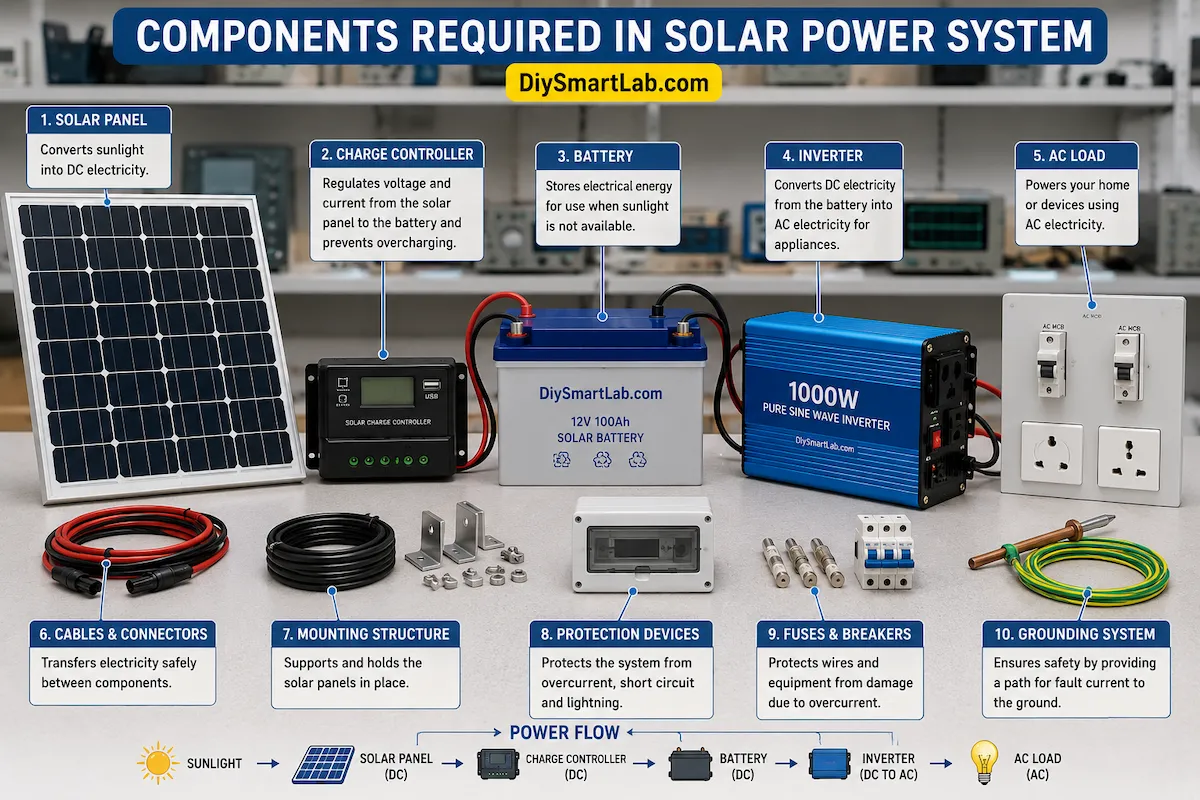
A complete solar power system requires several components besides the solar panel itself.
| Component | Purpose |
|---|---|
| Solar Panel | Converts sunlight into electricity |
| Charge Controller | Protects and manages battery charging |
| Battery | Stores electrical energy |
| Solar Inverter | Converts DC to AC power |
| Cables and Connectors | Transfer electricity between devices |
| Mounting Structure | Supports solar panels |
| Protection Devices | Ensure system safety |
Types of Solar Panels
1. Monocrystalline Solar Panels
- Highest efficiency
- Long lifespan
- Better low-light performance
- More expensive
2. Polycrystalline Solar Panels
- Lower manufacturing cost
- Moderate efficiency
- Popular for residential systems
3. Thin-Film Solar Panels
- Lightweight design
- Flexible installation options
- Lower efficiency
- Suitable for specific applications
| Panel Type | Efficiency | Cost | Lifespan |
|---|---|---|---|
| Monocrystalline | High | High | 25+ Years |
| Polycrystalline | Medium | Medium | 20-25 Years |
| Thin Film | Low | Low | 10-20 Years |
Circuit Explanation of a Solar Power System
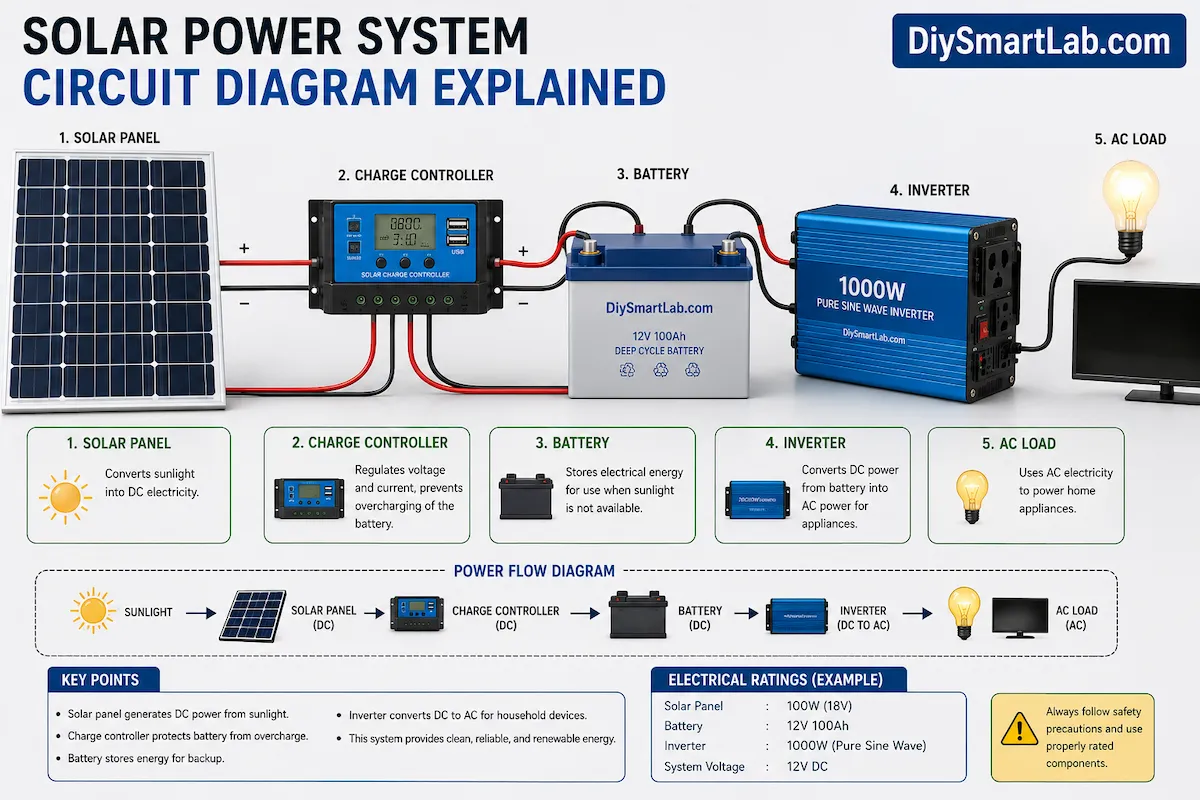
The electrical connection of a basic solar power system is simple to understand.
The solar panel generates DC voltage when exposed to sunlight. This DC power is then connected to a charge controller.
The charge controller regulates voltage and protects the battery from overcharging.
Next, the battery stores the generated energy.
Finally, the inverter converts DC power into AC power so that household appliances can operate normally.
Basic Connection Flow
Solar Panel → Charge Controller → Battery → Inverter → AC Load
How Much Electricity Can a Solar Panel Generate?
The output power depends on several factors.
- Panel wattage rating
- Sunlight intensity
- Installation angle
- Weather conditions
- Panel efficiency
- Geographical location
| Panel Rating | Average Daily Energy |
|---|---|
| 100W | 400–500 Wh |
| 200W | 800–1000 Wh |
| 400W | 1600–2000 Wh |
| 550W | 2200–2750 Wh |
Applications of Solar Panels
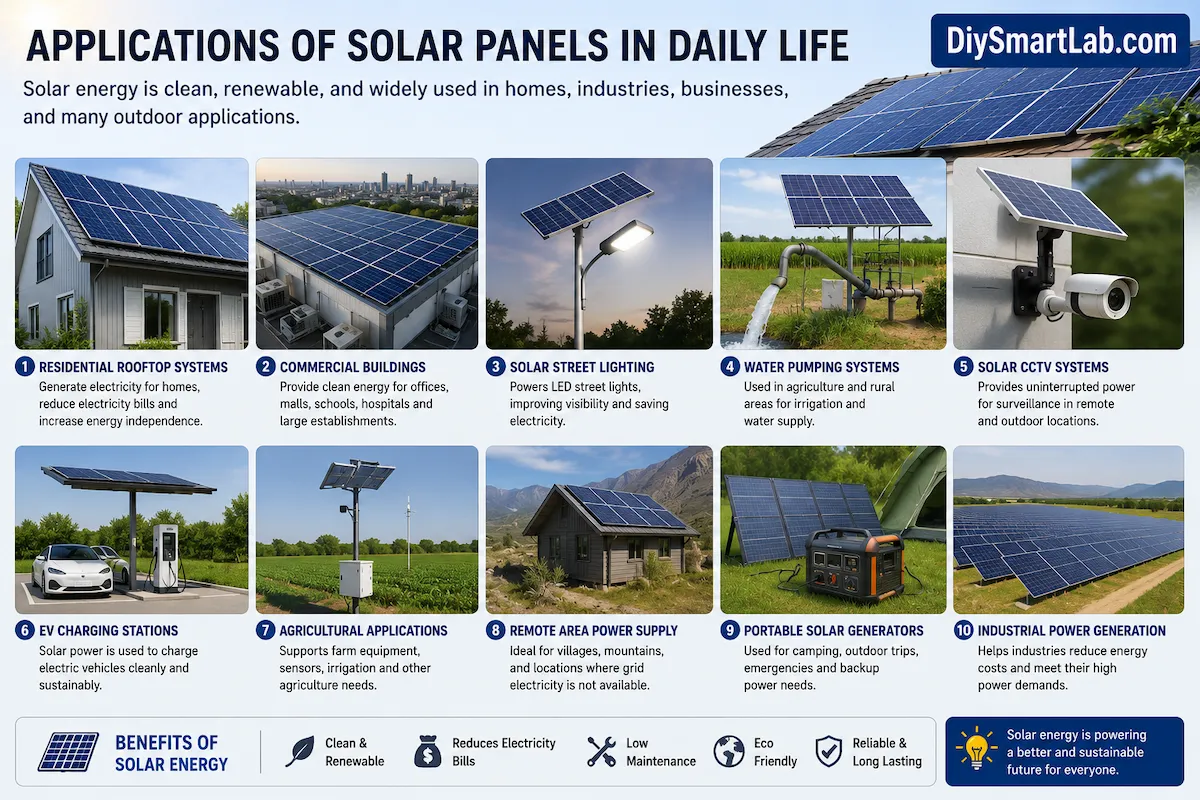
Solar energy is used in many industries and daily-life applications.
- Residential rooftop systems
- Commercial buildings
- Solar street lighting
- Water pumping systems
- Solar-powered CCTV systems
- Electric vehicle charging stations
- Agricultural irrigation systems
- Remote communication stations
- Portable solar generators
- Industrial power generation
Advantages of Solar Panels
- Renewable energy source
- Reduces electricity bills
- Environment friendly
- Low maintenance cost
- Long operational life
- Energy independence
- Silent operation
- Suitable for remote locations
Disadvantages of Solar Panels
- High initial installation cost
- Depends on sunlight availability
- Reduced output during cloudy weather
- Requires installation space
- Battery systems increase overall cost
- Efficiency decreases over time
Common Myths About Solar Panels
Myth 1: Solar Panels Only Work in Hot Weather
Solar panels work using sunlight, not heat. Therefore, they can generate electricity even during cold weather.
Myth 2: Solar Panels Require Constant Maintenance
In reality, solar panels require very little maintenance. Occasional cleaning is usually enough.
Myth 3: Solar Panels Stop Working on Cloudy Days
Solar panels still produce electricity on cloudy days. However, the output is lower.
FAQs About How Solar Panels Work
Do solar panels work at night?
No. Solar panels require sunlight to generate electricity. However, batteries can provide stored energy during nighttime.
Can solar panels power an entire house?
Yes. A properly sized solar system can power an entire home.
How long do solar panels last?
Most quality solar panels last between 25 and 30 years.
Do solar panels need batteries?
Not always. Grid-tied systems can operate without batteries.
Can solar panels work during rain?
Yes. They continue generating electricity, although the output is reduced.
Are solar panels environmentally friendly?
Yes. Solar energy produces clean electricity without emitting greenhouse gases during operation.
Conclusion
Understanding how solar panels work is easier than many beginners think. Solar panels use the photovoltaic effect to convert sunlight into electricity. This electricity can power homes, businesses, agricultural systems, and many other applications.
Although solar systems require an initial investment, they provide long-term savings and environmental benefits. As solar technology continues to improve, solar energy will play an even bigger role in the future of electricity generation.
We hope this beginner-friendly guide from DiySmartLab.com helped you understand how solar panels work and why they are becoming one of the most important renewable energy technologies in the world.