

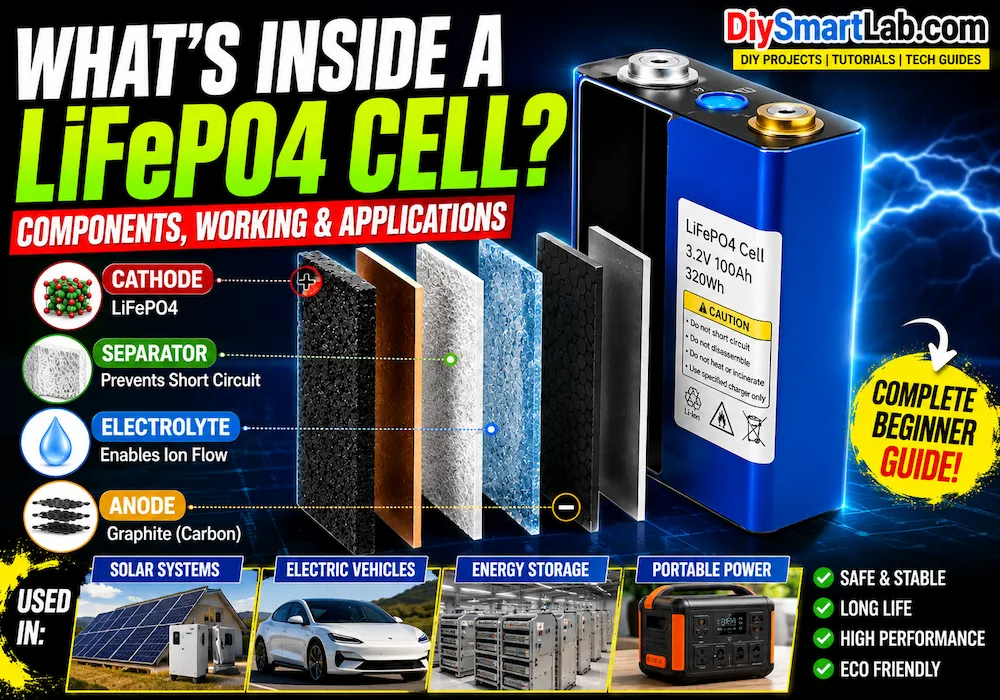
What’s Inside a LiFePO4 Cell? Components, Working Principle & Applications

What’s Inside a LiFePO4 Cell? Complete Beginner Guide
LiFePO4 batteries are becoming very popular in solar systems, electric vehicles, power backup systems, and DIY electronics projects. But many beginners still have one common question: what’s inside a LiFePO4 cell and how does it work?
In this detailed beginner-friendly guide from DiySmartLab.com, you will learn the internal structure of a LiFePO4 cell, its main parts, working principle, charging process, discharging process, circuit explanation, advantages, disadvantages, applications, and FAQs.
This article explains everything in simple language. So, even if you are new to batteries and electronics, you can understand how a LiFePO4 cell stores and delivers electrical energy.
What Is a LiFePO4 Cell?
A LiFePO4 cell is a rechargeable lithium battery cell. The full form of LiFePO4 is Lithium Iron Phosphate.
It is a type of lithium-ion battery, but it uses lithium iron phosphate as the positive electrode material. Because of this chemistry, LiFePO4 batteries are safer, more stable, and longer-lasting than many common lithium-ion batteries.
A single LiFePO4 cell normally has a nominal voltage of around 3.2V. When fully charged, it reaches about 3.65V. When discharged, it should not go below its safe cutoff voltage.
Because of its strong safety and long cycle life, LiFePO4 battery technology is widely used in modern energy storage systems.
Why Are LiFePO4 Cells Popular?
LiFePO4 cells are popular because they offer a good balance of safety, performance, and long life.
Unlike some other lithium batteries, LiFePO4 cells are less likely to overheat. They also have a lower risk of fire when used with proper protection circuits.
This makes them a great choice for beginners, DIY makers, solar users, and electronics hobbyists.
Main Reasons for Popularity
- They are safer than many other lithium battery types.
- They have a long cycle life.
- They support stable voltage output.
- They work well in solar and backup power systems.
- They need very little maintenance.
- They are suitable for high-current applications.
- They are commonly used with BMS protection circuits.
Basic Specifications of a LiFePO4 Cell
Before understanding what is inside a LiFePO4 cell, it is important to know its basic electrical specifications.
| Parameter | Typical Value |
|---|---|
| Battery Chemistry | Lithium Iron Phosphate |
| Short Name | LiFePO4 or LFP |
| Nominal Voltage | 3.2V |
| Full Charge Voltage | 3.65V |
| Recommended Cutoff Voltage | Around 2.5V to 2.8V |
| Cycle Life | Usually 2000+ cycles |
| Safety Level | Very High |
| Common Use | Solar, EV, UPS, DIY Projects |
What’s Inside a LiFePO4 Cell?
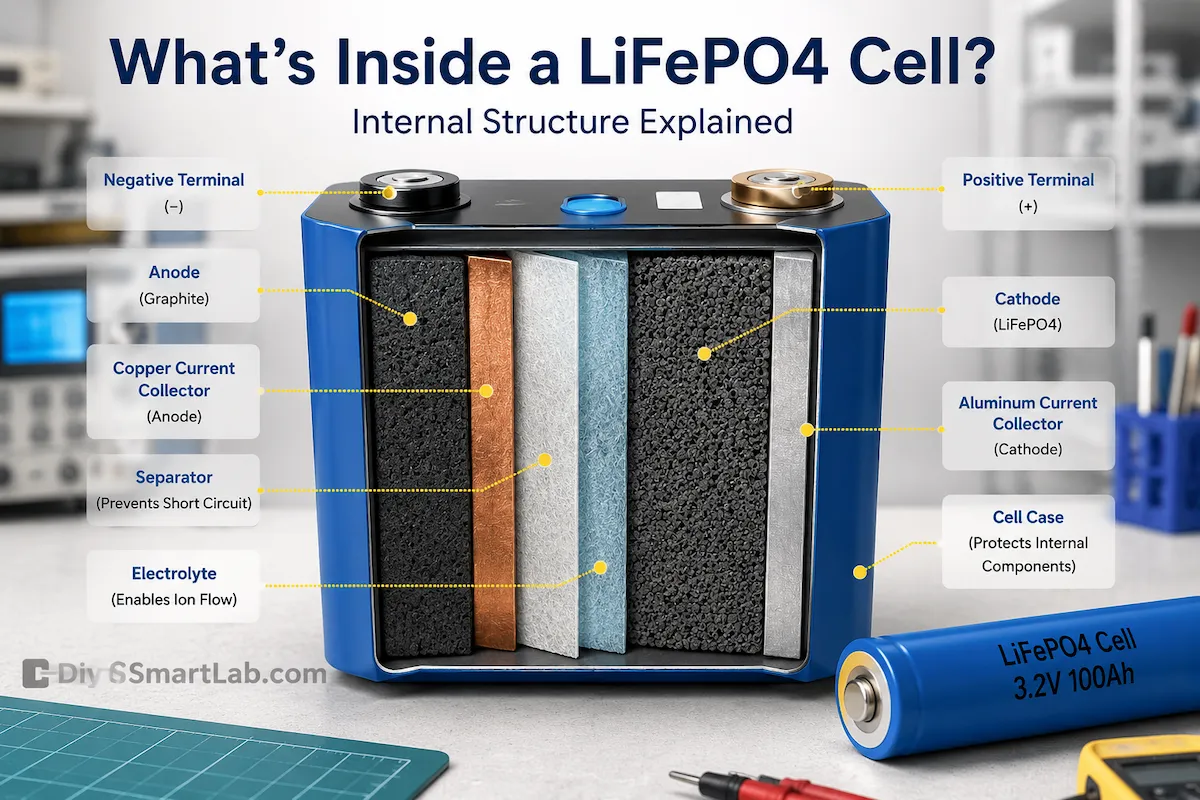
From the outside, a LiFePO4 cell may look like a simple metal box, cylinder, or pouch. However, inside the cell, many layers and materials work together to store energy.
The main internal parts of a LiFePO4 cell are:
- Cathode
- Anode
- Electrolyte
- Separator
- Current collectors
- Cell casing
- Safety vent or pressure protection system
- Terminals
Each part has a special job. Together, these parts allow lithium ions to move inside the battery while electrons flow through the external circuit.
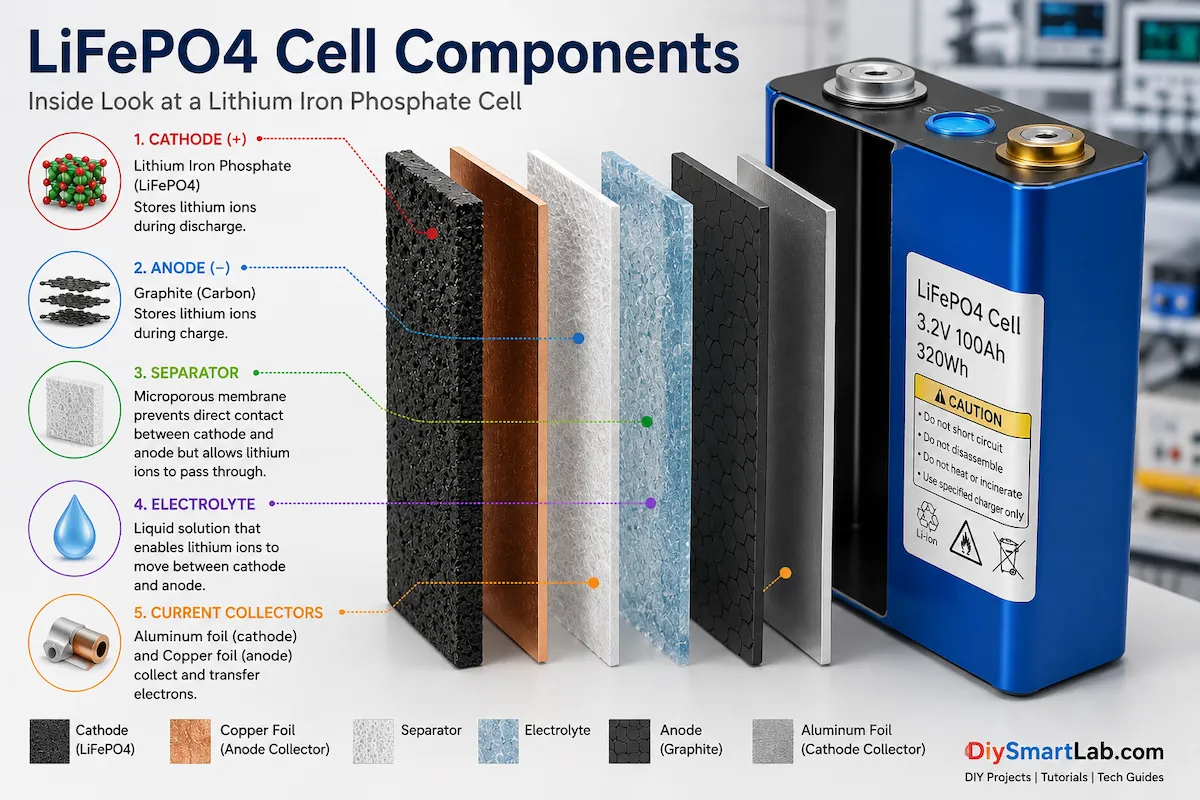
1. Cathode: The Positive Electrode
The cathode is the positive electrode of a LiFePO4 cell.
In this battery, the cathode material is Lithium Iron Phosphate. This material gives the battery its name.
The cathode plays a major role in battery safety, voltage, and cycle life.
Function of the Cathode
The cathode stores lithium ions when the battery is discharged. During charging, lithium ions leave the cathode and move toward the anode.
During discharging, lithium ions return to the cathode.
This movement of lithium ions creates the energy storage and release process.
Why Lithium Iron Phosphate Is Special
Lithium iron phosphate is very stable compared to many other lithium battery materials.
Because of this stable structure, LiFePO4 cells can handle heat better. They also have a lower risk of thermal runaway.
This is one of the biggest reasons why LiFePO4 batteries are considered safe.
Benefits of LiFePO4 Cathode
- High thermal stability
- Long battery life
- Better safety
- Stable discharge voltage
- Lower fire risk
- Good performance for energy storage
2. Anode: The Negative Electrode
The anode is the negative electrode of the LiFePO4 cell.
Most LiFePO4 cells use graphite carbon as the anode material.
Graphite is used because it can store lithium ions between its carbon layers during charging.
Function of the Anode
During charging, lithium ions move from the cathode to the anode.
These ions enter the graphite layers and remain stored there until the battery is used.
During discharge, the lithium ions leave the anode and move back to the cathode.
You can imagine the anode as a temporary storage area for lithium ions.
Why Graphite Is Used
Graphite is lightweight, stable, and suitable for repeated charging and discharging.
It also supports smooth lithium-ion movement. This helps the battery work efficiently for many cycles.
3. Electrolyte: The Ion Transport Medium
The electrolyte is a special liquid or gel-like chemical inside the LiFePO4 cell.
Its main job is to allow lithium ions to move between the cathode and anode.
However, the electrolyte does not allow electrons to pass directly through it.
This is very important. Because electrons cannot move through the electrolyte, they travel through the external circuit instead. This external electron flow powers your device.
Simple Explanation
Inside the cell, lithium ions move through the electrolyte.
Outside the cell, electrons move through wires and the connected load.
Together, these two movements create useful electrical energy.
4. Separator: The Safety Barrier
The separator is a thin porous film placed between the cathode and anode.
It is one of the most important safety parts inside the battery.
The separator keeps the positive and negative electrodes apart. This prevents an internal short circuit.
At the same time, it allows lithium ions to pass through.
Why the Separator Is Important
If the cathode and anode touch each other directly, the cell can short circuit. This can cause heat, damage, swelling, or failure.
Therefore, the separator acts like a protective wall inside the battery.
It blocks the electrodes but allows ion movement.
5. Current Collectors
Current collectors are thin metal foils inside the LiFePO4 cell.
They collect and transfer electrical current from the active materials to the battery terminals.
| Battery Side | Current Collector Material | Function |
|---|---|---|
| Cathode Side | Aluminum Foil | Collects current from positive electrode |
| Anode Side | Copper Foil | Collects current from negative electrode |
These collectors are very thin, but they are very important for battery performance.
6. Cell Casing
The cell casing protects the internal materials from dust, moisture, air, and mechanical damage.
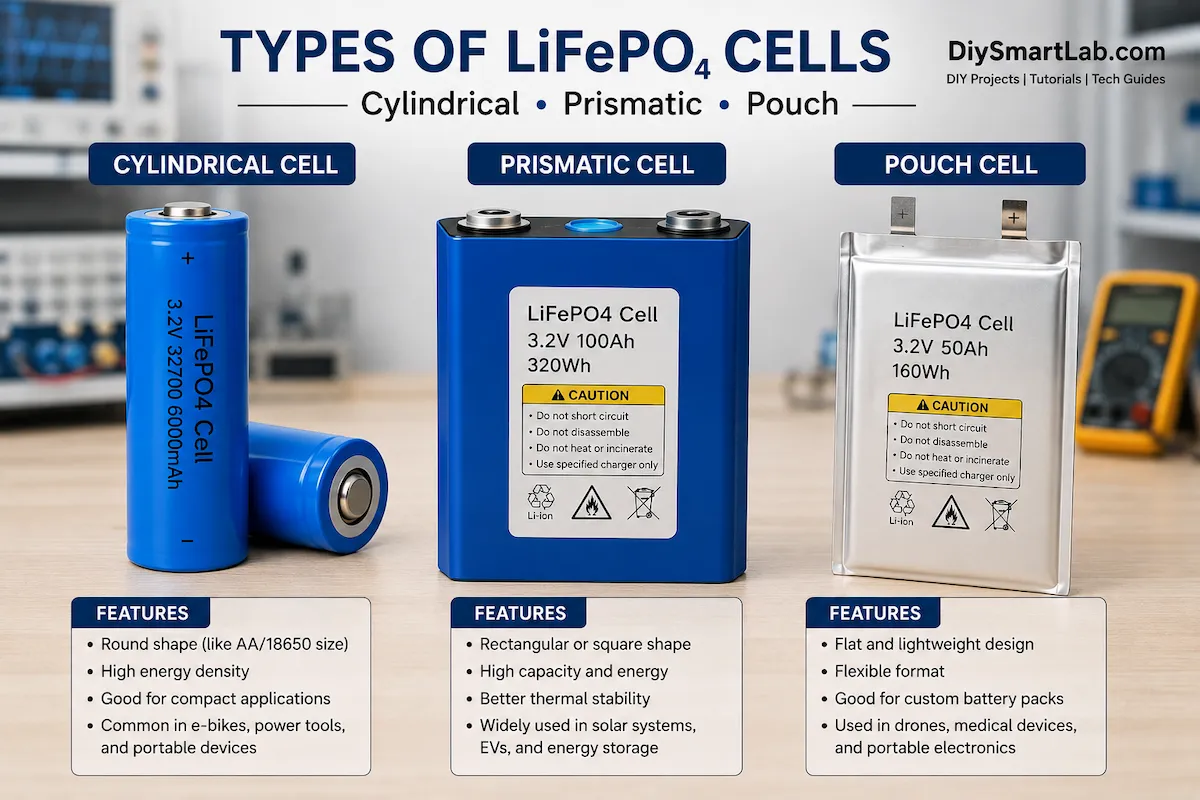
LiFePO4 cells come in different shapes. Therefore, the case design may change depending on the battery type.
Common LiFePO4 Cell Types
- Cylindrical Cell: Round metal body, similar to common battery shapes.
- Prismatic Cell: Rectangular metal case, widely used in solar and EV battery packs.
- Pouch Cell: Flat flexible pouch design, lightweight and compact.
7. Battery Terminals
Battery terminals are the external connection points of the LiFePO4 cell.
They allow the battery to connect with a charger, load, inverter, BMS, or circuit.
Every cell has two terminals:
- Positive terminal (+)
- Negative terminal (-)
Correct polarity is very important. If you connect the battery incorrectly, it can damage the circuit or battery protection system.
Part 1 Summary
In this first part, you learned what a LiFePO4 cell is and what is inside a LiFePO4 cell. You also learned about the cathode, anode, electrolyte, separator, current collectors, casing, and terminals.
In Part 2, we will continue with the complete working principle of LiFePO4 cells, charging process, discharging process, chemical reaction, components required for a basic LiFePO4 battery system, and circuit explanation.
How Does a LiFePO4 Cell Work?
Now that you understand what is inside a LiFePO4 cell, let’s learn how it actually works.
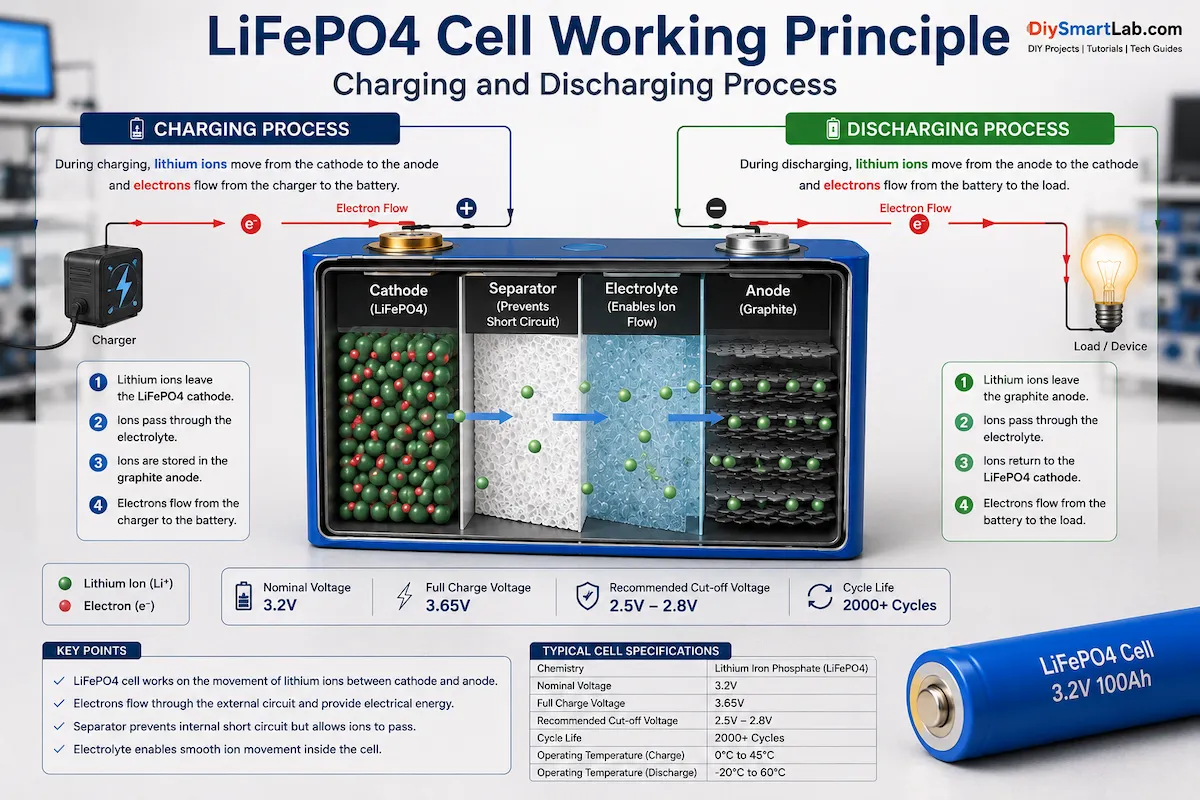
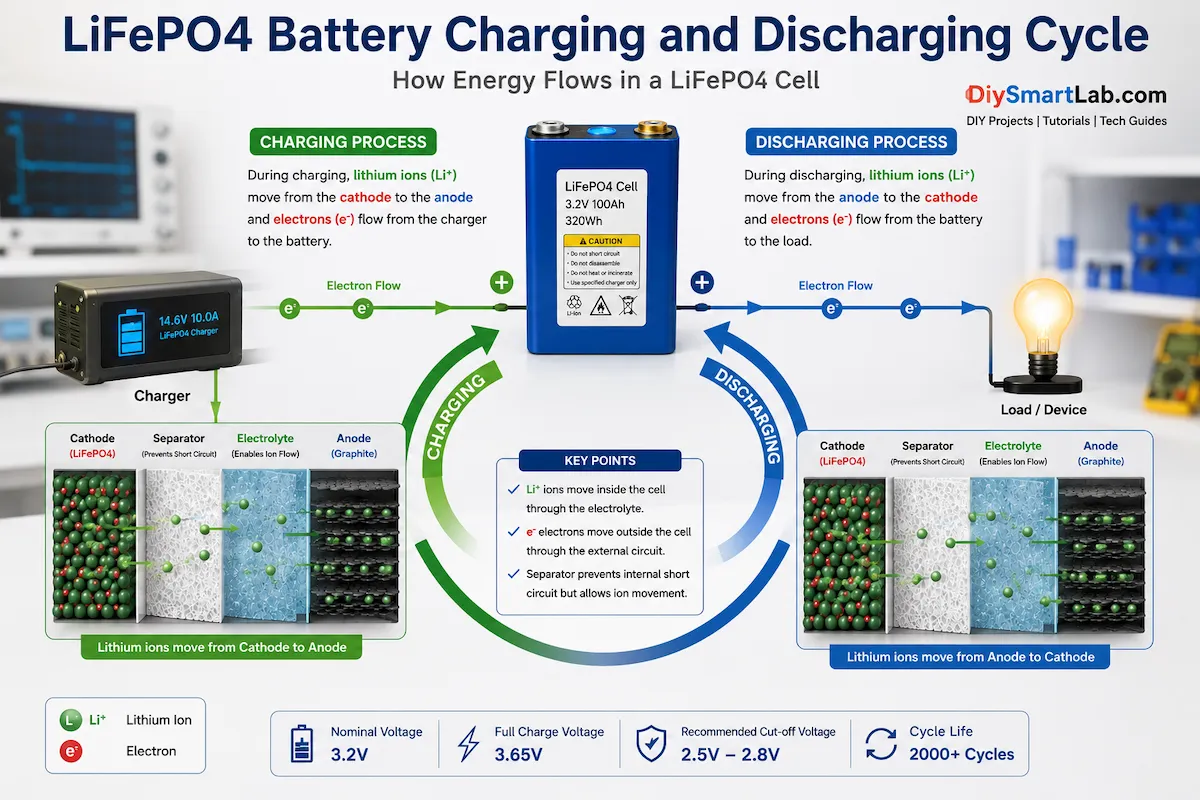
The working principle of a LiFePO4 battery is based on the movement of lithium ions between the cathode and anode.
Whenever the battery is charged or discharged, lithium ions travel back and forth between these two electrodes.
At the same time, electrons flow through the external circuit and provide electrical power to connected devices.
Charging Process of a LiFePO4 Cell
When a charger is connected to a LiFePO4 battery, electrical energy enters the cell.
This energy forces lithium ions to leave the cathode and move toward the anode.
The ions travel through the electrolyte and become stored inside the graphite layers of the anode.
As more ions move to the anode, the battery stores more energy.
Step-by-Step Charging Process
- The charger supplies electrical energy.
- Lithium ions leave the LiFePO4 cathode.
- The ions move through the electrolyte.
- The ions reach the graphite anode.
- The graphite stores the lithium ions.
- The battery gradually becomes charged.
When the battery reaches approximately 3.65V per cell, it is considered fully charged.
What Happens to Electrons During Charging?
While lithium ions move inside the battery, electrons travel through the external charging circuit.
These electrons combine with lithium ions at the anode and help store energy inside the battery.
This process continues until the charger stops supplying current.
Discharging Process of a LiFePO4 Cell
Discharging happens when a load such as a light, inverter, motor, or electronic circuit is connected to the battery.
Now the stored energy begins to flow out of the cell.
Lithium ions leave the anode and move back toward the cathode.
At the same time, electrons travel through the external circuit and power the connected device.
Step-by-Step Discharging Process
- A load is connected to the battery.
- Lithium ions leave the graphite anode.
- The ions move through the electrolyte.
- The ions return to the LiFePO4 cathode.
- Electrons flow through the external circuit.
- The load receives electrical energy.
This process continues until the battery reaches its safe discharge voltage.
Why Discharging Produces Electricity
During discharge, electrons cannot travel through the electrolyte.
Therefore, they must flow through the external circuit.
This electron movement creates electric current.
The connected device uses this current to operate.
Simple Working Principle Example
Imagine a water tank system.
The charger acts like a water pump. It moves water into a storage tank.
Similarly, charging moves lithium ions into the anode.
When you need energy, the stored water flows out and powers equipment.
Likewise, lithium ions move back to the cathode during discharge and provide electrical energy.
This simple process repeats thousands of times throughout the battery’s life.
LiFePO4 Cell Chemical Reactions
Every battery works because of chemical reactions.
LiFePO4 batteries are no different.
Inside the cell, lithium ions move between the cathode and anode while reversible chemical reactions occur.
During Charging
The lithium iron phosphate material releases lithium ions.
The simplified reaction is:
LiFePO4 → FePO4 + Li+
The released lithium ions move toward the graphite anode.
During Discharging
The lithium ions return from the anode to the cathode.
The reaction becomes:
FePO4 + Li+ → LiFePO4
Because these reactions are reversible, the battery can be recharged thousands of times.
Energy Flow Inside a LiFePO4 Cell
| Process | Lithium Ion Movement | Electron Movement |
|---|---|---|
| Charging | Cathode → Anode | From Charger |
| Discharging | Anode → Cathode | To Load |
Components Required for a Basic LiFePO4 Battery System
A complete LiFePO4 battery system requires more than just the battery cell.
Additional protection and charging components are also needed.
| Component | Purpose |
|---|---|
| LiFePO4 Cell | Stores electrical energy |
| Battery Management System (BMS) | Protects battery |
| LiFePO4 Charger | Charges battery safely |
| Fuse | Short-circuit protection |
| Wiring | Power connection |
| Load Device | Consumes electrical energy |
What Is a Battery Management System (BMS)?
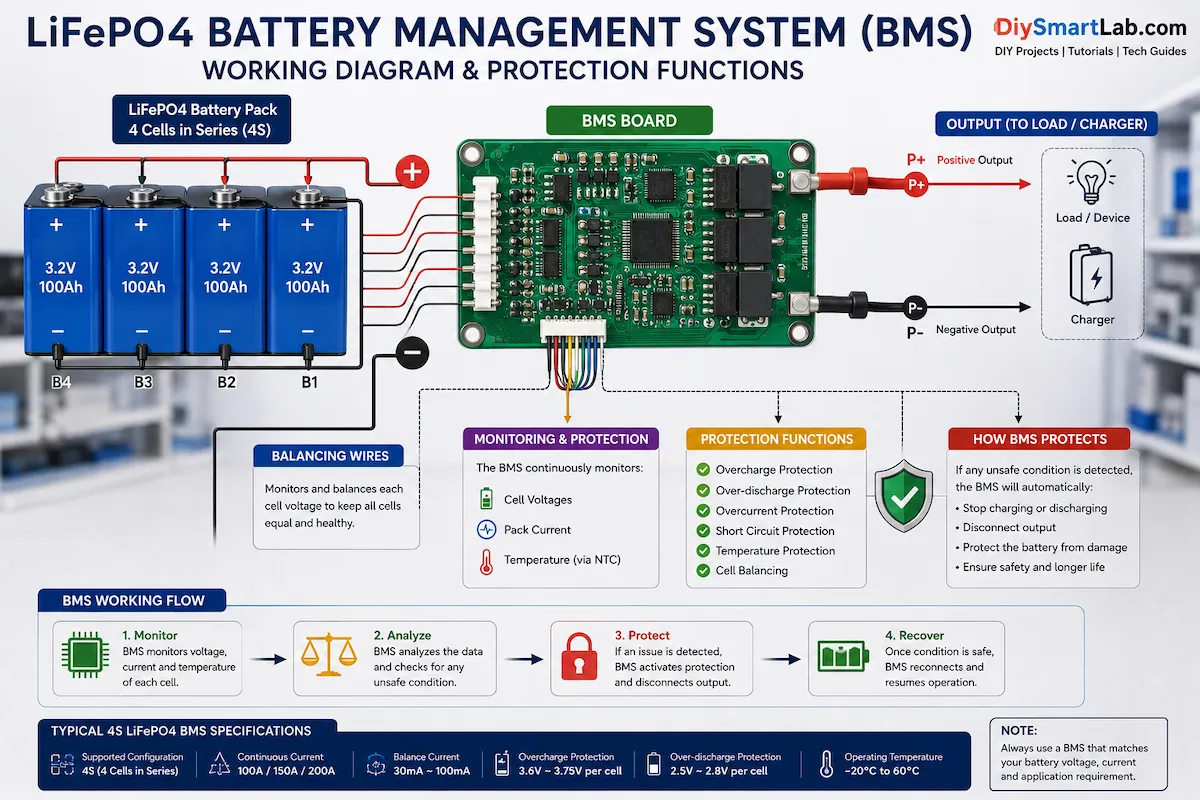
The Battery Management System, commonly called BMS, is the safety controller of a LiFePO4 battery pack.
Almost all modern LiFePO4 battery packs use a BMS.
The BMS constantly monitors voltage, current, and temperature.
If an unsafe condition occurs, the BMS disconnects the battery automatically.
Main Functions of a BMS
- Overcharge protection
- Over-discharge protection
- Overcurrent protection
- Short-circuit protection
- Temperature monitoring
- Cell balancing
Circuit Explanation of a LiFePO4 Battery System
A basic LiFePO4 battery circuit is quite simple.
The battery cell connects to a BMS module. The BMS then connects to the charger and the load.
During charging, the charger sends energy through the BMS to the battery.
The BMS monitors the charging process and stops unsafe conditions.
During discharge, electrical energy flows from the battery through the BMS and then to the load.
If voltage becomes too low or current becomes too high, the BMS disconnects the output.
This protection helps increase battery lifespan and safety.
Basic Circuit Flow
Charger → BMS → LiFePO4 Battery → BMS → Load
This arrangement is commonly found in solar batteries, portable power stations, electric bikes, UPS systems, and DIY energy storage projects.
Why LiFePO4 Batteries Last So Long
One major advantage of LiFePO4 chemistry is its long cycle life.
The internal crystal structure remains very stable during charging and discharging.
As a result, the battery experiences less stress compared to many other lithium battery types.
This stability allows thousands of charge-discharge cycles before noticeable capacity loss occurs.
Part 2 Summary
In this section, you learned how a LiFePO4 cell works, how charging and discharging occur, the chemical reactions involved, the role of the BMS, and the basic battery circuit explanation.
In Part 3, we will cover applications, advantages, disadvantages, LiFePO4 vs lithium-ion comparison, safety features, FAQs, conclusion, SEO meta details, FAQ schema, and Article schema markup.
Applications of LiFePO4 Batteries
Today, LiFePO4 batteries are used in many industries because of their excellent safety, long lifespan, and stable performance.
From small DIY projects to large energy storage systems, LiFePO4 technology has become one of the most trusted battery solutions.

Popular Applications
- Solar energy storage systems
- Home backup power systems
- Electric vehicles (EVs)
- Electric scooters and e-bikes
- Portable power stations
- Marine batteries
- RV and camper batteries
- UPS systems
- Telecommunication backup systems
- DIY electronics projects
- Robotics projects
- Industrial energy storage solutions
Advantages of LiFePO4 Cells
LiFePO4 batteries offer many advantages compared to traditional lead-acid batteries and several other lithium battery chemistries.
1. Excellent Safety
The lithium iron phosphate chemistry is highly stable. Therefore, the risk of thermal runaway is much lower.
This makes LiFePO4 one of the safest lithium battery technologies available today.
2. Very Long Lifespan
Most LiFePO4 batteries can easily achieve between 2,000 and 6,000 charge cycles.
Premium cells may even exceed this range under proper operating conditions.
3. Stable Output Voltage
Unlike some battery types, LiFePO4 cells maintain a stable voltage throughout most of their discharge cycle.
This provides reliable performance for electronic devices and power systems.
4. Fast Charging Capability
LiFePO4 batteries can accept relatively high charging currents.
As a result, charging times are often shorter than lead-acid batteries.
5. Low Maintenance
These batteries require very little maintenance during their operational life.
There is no need for water refilling or routine electrolyte checks.
6. Environmentally Friendly
LiFePO4 batteries contain fewer hazardous materials than many traditional battery technologies.
This makes them a more environmentally friendly option.
7. Lightweight Design
Compared to lead-acid batteries with similar capacity, LiFePO4 batteries are significantly lighter.
This makes them ideal for portable and mobile applications.
Advantages Summary Table
| Advantage | Benefit |
|---|---|
| High Safety | Lower fire risk |
| Long Cycle Life | Reduced replacement cost |
| Fast Charging | Less downtime |
| Stable Voltage | Reliable performance |
| Low Maintenance | Easy ownership |
| Light Weight | Portable applications |
Disadvantages of LiFePO4 Cells
Although LiFePO4 batteries offer many benefits, they also have some limitations.
1. Higher Initial Cost
The purchase price of LiFePO4 batteries is usually higher than lead-acid batteries.
However, their longer lifespan often compensates for the higher upfront cost.
2. Lower Energy Density Than Some Lithium Chemistries
Some lithium-ion chemistries provide higher energy density.
This means they can store slightly more energy in the same size.
3. Requires Proper Charging Equipment
LiFePO4 batteries require dedicated charging profiles.
Using the wrong charger can reduce performance and lifespan.
4. Reduced Performance in Extreme Cold
Charging efficiency can decrease in very cold environments.
Many battery packs include temperature protection to solve this issue.
Disadvantages Summary Table
| Disadvantage | Impact |
|---|---|
| Higher Cost | More initial investment |
| Lower Energy Density | Larger size in some cases |
| Special Charger Required | Additional equipment |
| Cold Temperature Limits | Reduced charging efficiency |
LiFePO4 vs Traditional Lithium-Ion Battery
Many beginners confuse LiFePO4 batteries with standard lithium-ion batteries.
Although both technologies use lithium ions, there are significant differences.
| Feature | LiFePO4 | Traditional Li-Ion |
|---|---|---|
| Safety | Excellent | Moderate |
| Cycle Life | 2000–6000+ | 500–1500 |
| Thermal Stability | Very High | Lower |
| Nominal Voltage | 3.2V | 3.6–3.7V |
| Fire Risk | Very Low | Higher |
Frequently Asked Questions (FAQs)
What is inside a LiFePO4 cell?
A LiFePO4 cell contains a lithium iron phosphate cathode, graphite anode, electrolyte, separator, current collectors, casing, and terminals.
How does a LiFePO4 cell work?
It works by moving lithium ions between the cathode and anode during charging and discharging cycles.
Why are LiFePO4 batteries safer?
The lithium iron phosphate chemistry provides excellent thermal stability and reduces the risk of thermal runaway.
How long does a LiFePO4 battery last?
Most LiFePO4 batteries last between 2,000 and 6,000 charge cycles. Some premium batteries can last even longer.
Can LiFePO4 batteries be used for solar systems?
Yes. LiFePO4 batteries are one of the most popular choices for solar energy storage systems.
Do LiFePO4 batteries need a BMS?
Yes. A Battery Management System is highly recommended to protect the battery from unsafe operating conditions.
Conclusion
Now you know exactly what’s inside a LiFePO4 cell and how it works.
A LiFePO4 battery contains several carefully designed components including the cathode, anode, electrolyte, separator, current collectors, and protective casing. Together, these components allow lithium ions to move safely between electrodes and store energy efficiently.
The working principle is simple yet powerful. During charging, lithium ions move from the cathode to the anode. During discharge, they move back to the cathode while electrons flow through the external circuit and provide useful electrical energy.
Because of its excellent safety, long lifespan, stable voltage, and low maintenance requirements, LiFePO4 technology has become one of the best battery solutions available today.
Whether you are building a solar energy storage system, a backup power solution, or a DIY electronics project, LiFePO4 batteries offer outstanding performance and reliability.
At DiySmartLab.com, we recommend LiFePO4 batteries for modern energy storage applications because they combine safety, efficiency, and durability in one advanced technology.



Excellent