
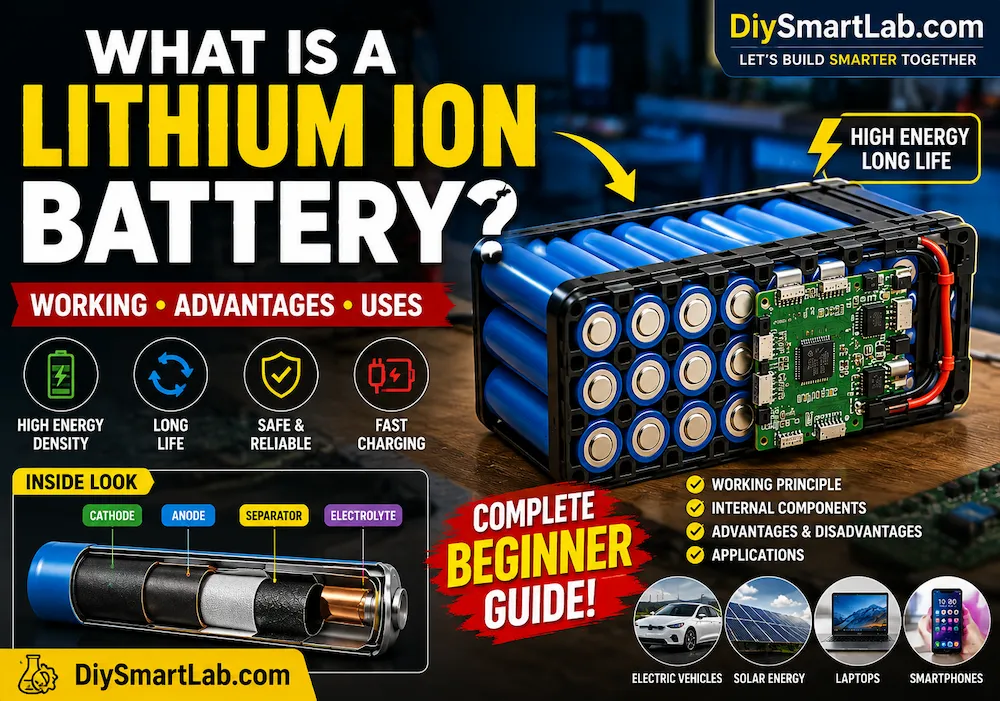
What Is a Lithium-Ion Battery? Working, Advantages & Uses Explained

What Is a Lithium-Ion Battery? Working Principle, Advantages, Uses & Complete Beginner Guide
Lithium-ion batteries are everywhere today. From smartphones and laptops to electric vehicles and solar energy systems, these batteries power many of the devices we use daily. Due to their high energy density, lightweight design, and long lifespan, lithium-ion batteries have become the most popular rechargeable battery technology in the world.
In this beginner-friendly guide from DiySmartLab.com, you will learn what a lithium-ion battery is, how it works, its internal components, advantages, disadvantages, applications, and much more.
What Is a Lithium-Ion Battery?
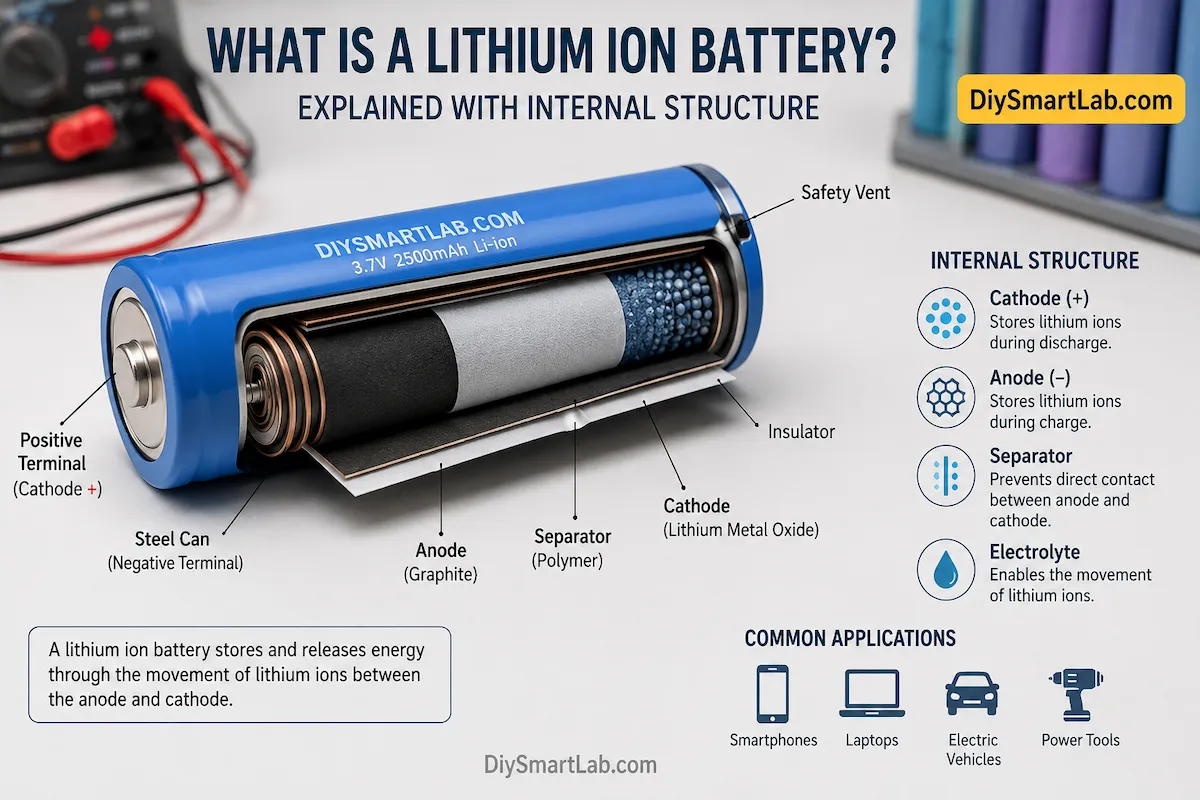
A lithium-ion battery is a rechargeable battery that stores and releases electrical energy through the movement of lithium ions between two electrodes.
Unlike traditional disposable batteries, a lithium-ion battery can be charged hundreds or even thousands of times. Therefore, it is widely used in portable electronics, electric vehicles, power tools, drones, and renewable energy storage systems.
During charging, lithium ions move from the positive electrode to the negative electrode. During discharge, the ions move back and generate electricity.
History of Lithium-Ion Batteries
The development of lithium-ion battery technology started in the 1970s. However, commercial lithium-ion batteries became widely available in the early 1990s.
Since then, battery technology has improved significantly. Modern lithium-ion batteries offer higher capacity, better safety, and longer service life than earlier rechargeable battery technologies.
| Year | Development |
|---|---|
| 1970s | Initial lithium battery research |
| 1980s | Rechargeable lithium battery concepts developed |
| 1991 | First commercial lithium-ion battery launched |
| 2000s | Widespread use in laptops and smartphones |
| 2010s-Present | Mass adoption in electric vehicles and solar storage |
Main Features of Lithium-Ion Batteries
- Rechargeable battery technology
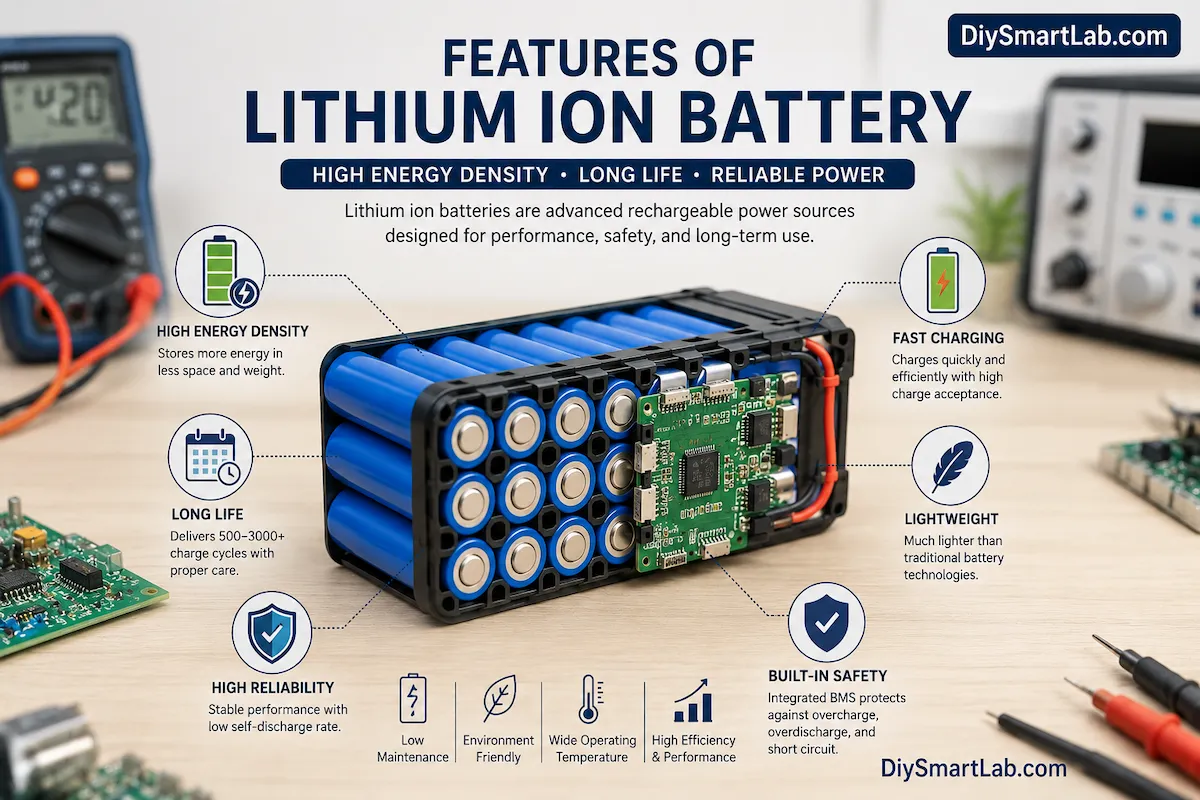
- High energy density
- Lightweight construction
- Low self-discharge rate
- Long cycle life
- Fast charging capability
- No memory effect
- Available in many shapes and sizes
- Suitable for portable devices and electric vehicles
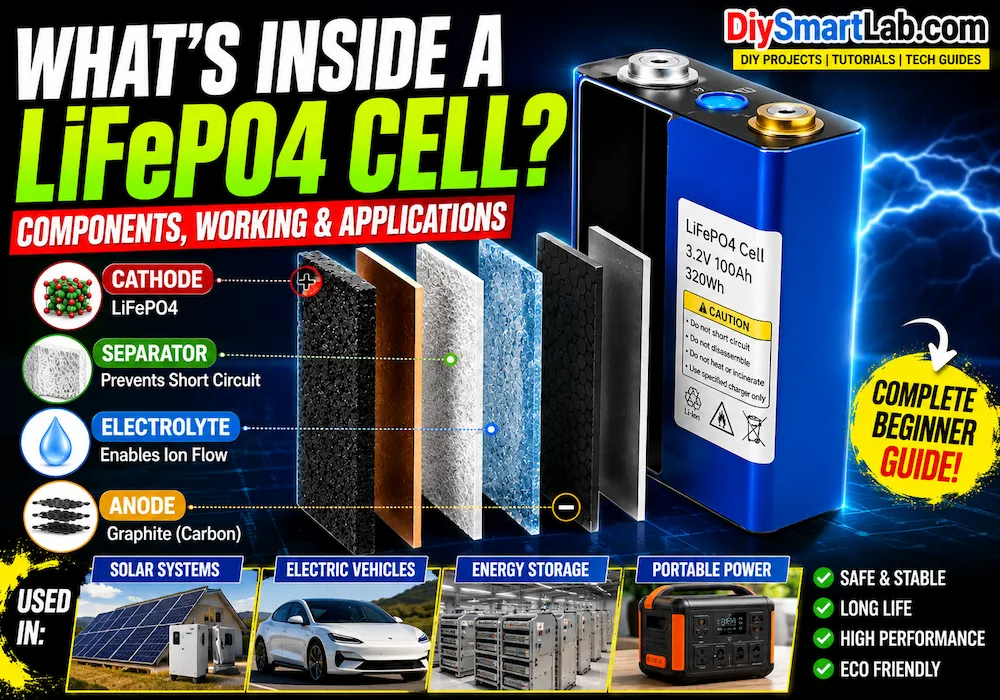
Components Required Inside a Lithium-Ion Battery
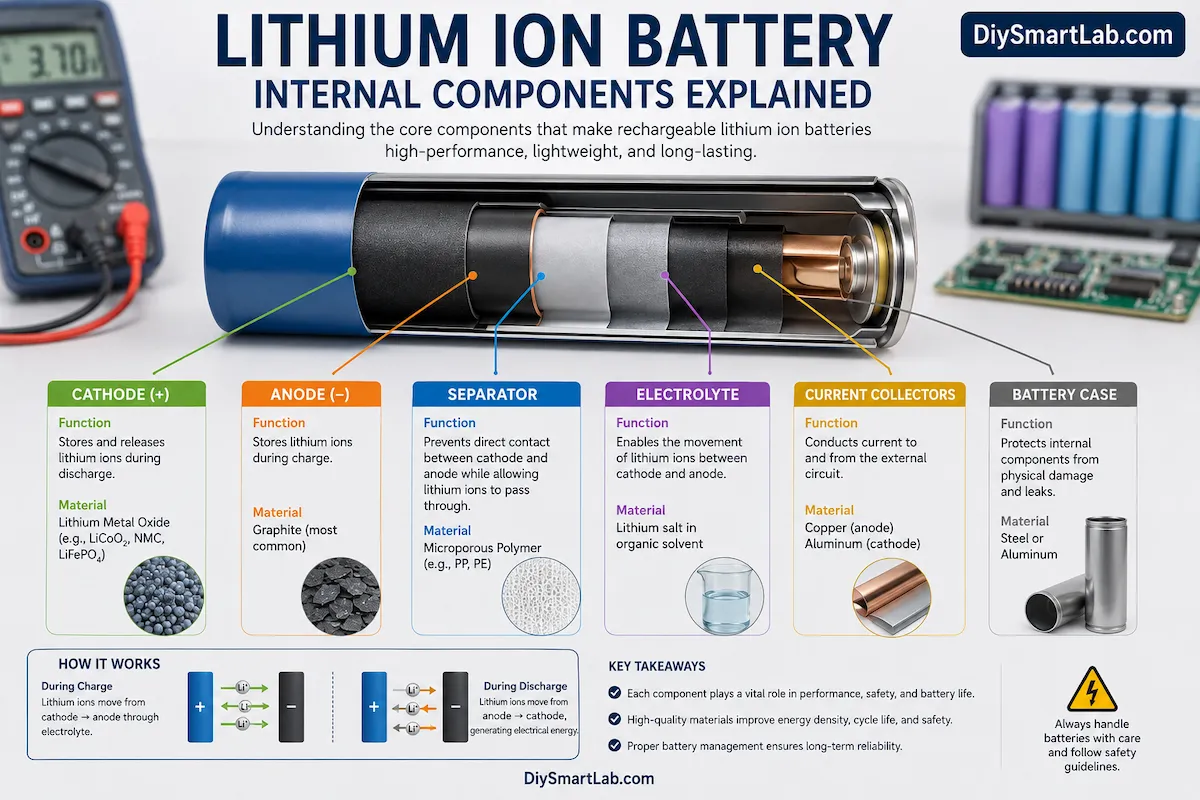
Understanding the internal structure helps beginners learn how a lithium-ion battery works.
| Component | Function |
|---|---|
| Cathode (Positive Electrode) | Stores lithium ions during discharge |
| Anode (Negative Electrode) | Stores lithium ions during charging |
| Electrolyte | Allows ion movement between electrodes |
| Separator | Prevents short circuits between electrodes |
| Current Collectors | Transfer electrical current |
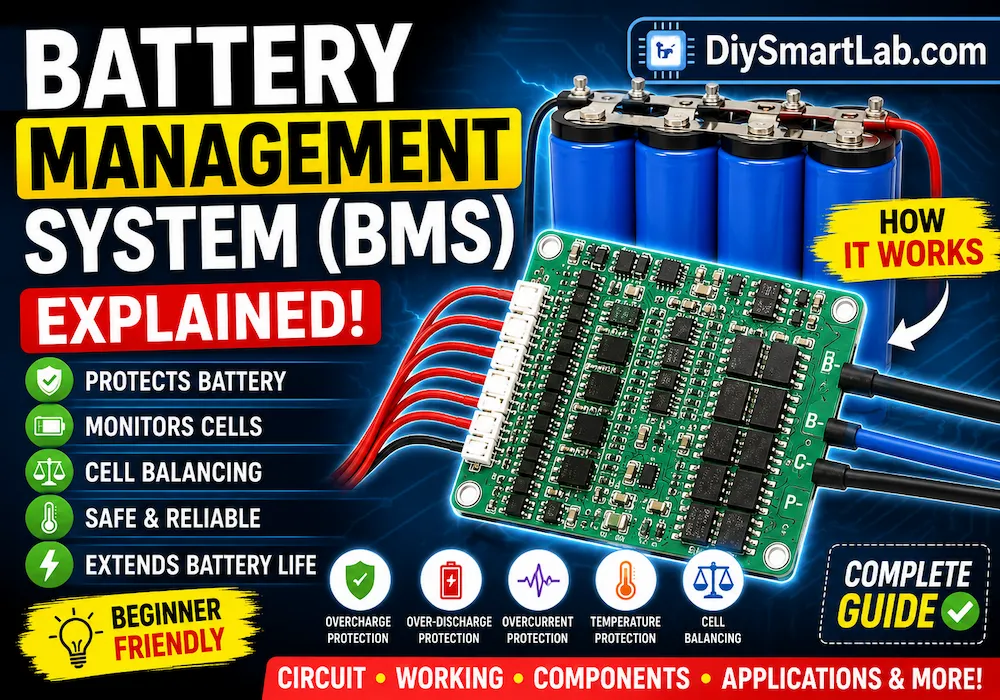
| Battery Management System (BMS) | Protects battery from damage |
How Does a Lithium-Ion Battery Work?
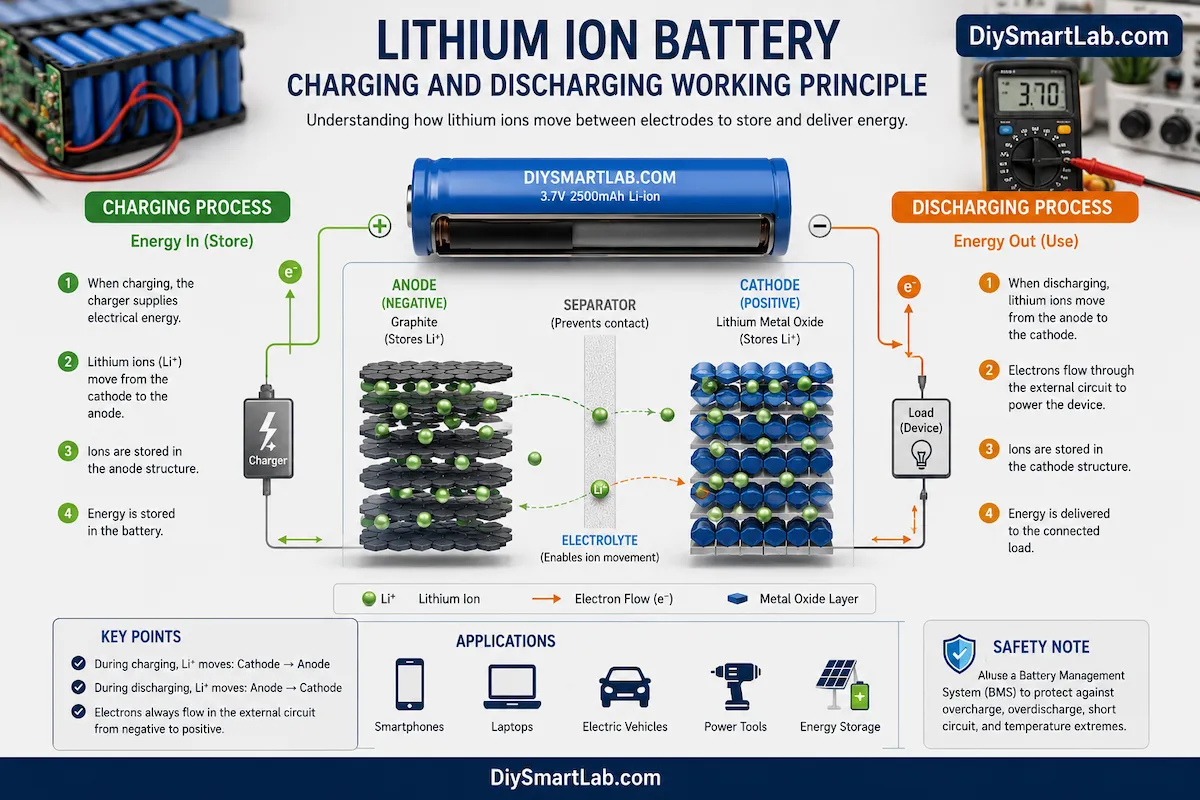
The working principle of a lithium-ion battery is based on the movement of lithium ions between the anode and cathode.
Charging Process
When a charger is connected:
- Lithium ions move from the cathode to the anode.
- Energy is stored inside the battery.
- The battery voltage increases.
- The Battery Management System monitors charging safety.
Discharging Process
When the battery powers a device:
- Lithium ions move back to the cathode.
- Electrons flow through the external circuit.
- The connected device receives electrical energy.
- The battery gradually loses charge.
Simple Circuit Explanation of a Lithium-Ion Battery System
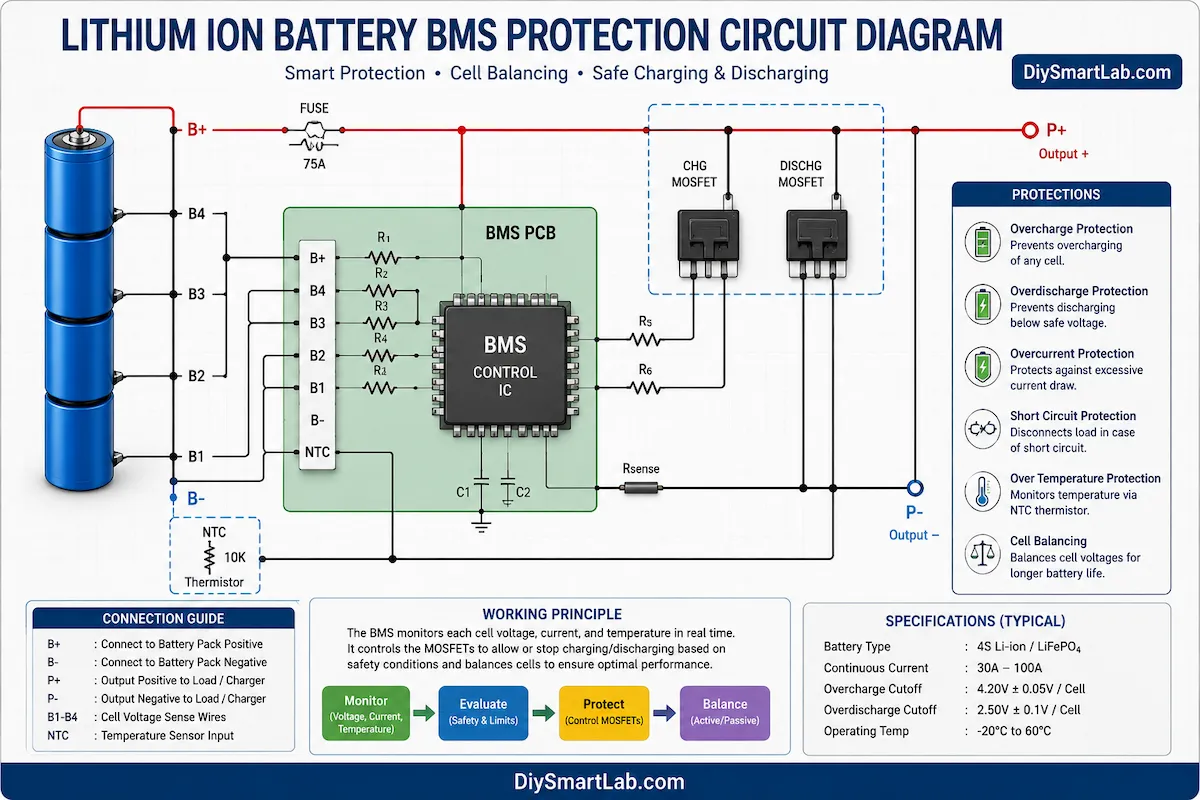
A lithium-ion battery system usually contains additional protection circuitry.
The basic battery circuit consists of:
- Lithium-ion cells
- Battery Management System (BMS)
- Charging circuit
- Load connection
- Protection MOSFETs
- Temperature monitoring sensors
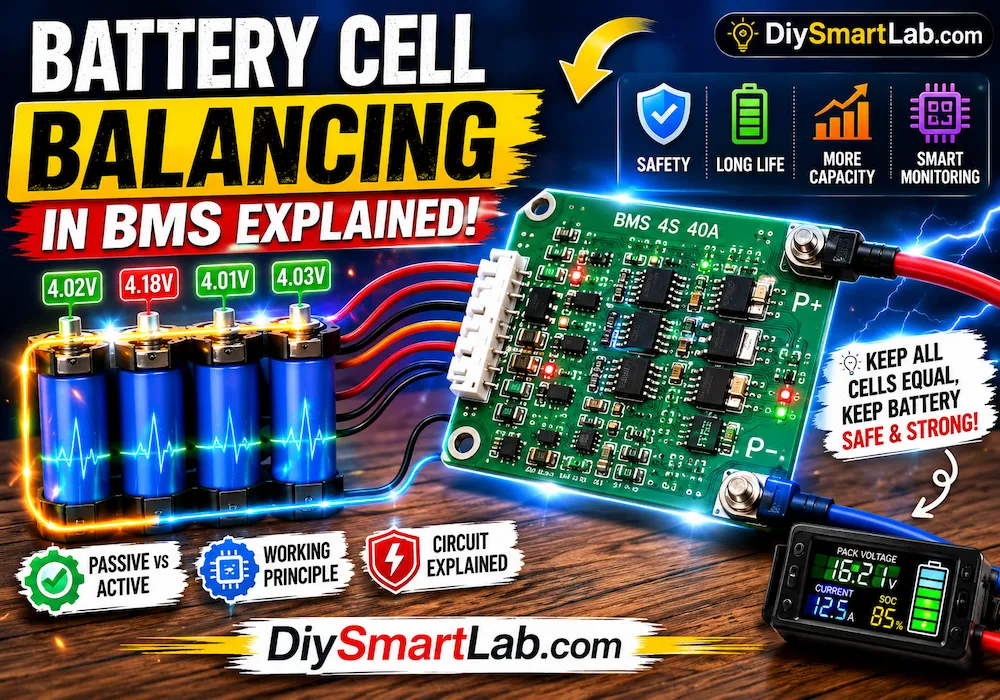
The Battery Management System continuously monitors:
- Cell voltage
- Current flow
- Temperature
- Overcharge conditions
- Over-discharge conditions
- Short circuits
As a result, the battery remains safe and operates efficiently.
Common Types of Lithium-Ion Batteries
| Battery Type | Main Feature | Application |
|---|---|---|
| LCO | High energy density | Smartphones, laptops |
| NMC | Balanced performance | Electric vehicles |
| NCA | High capacity | EVs and energy storage |
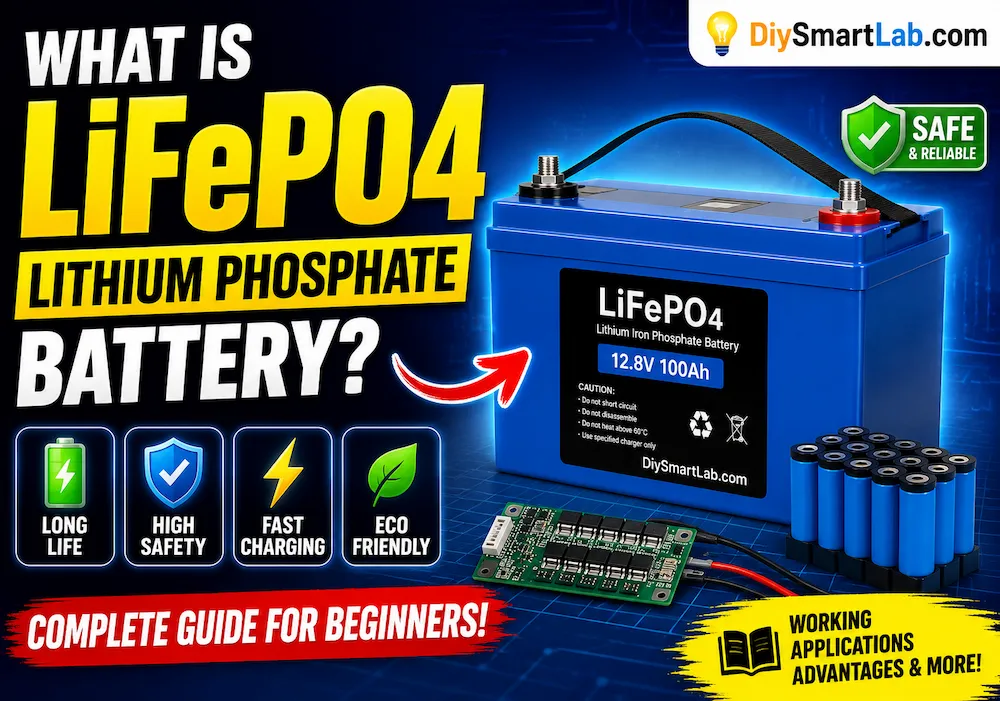
| LFP (LiFePO4) | Excellent safety | Solar systems, EVs |
| LTO | Very long lifespan | Industrial applications |
Applications of Lithium-Ion Batteries
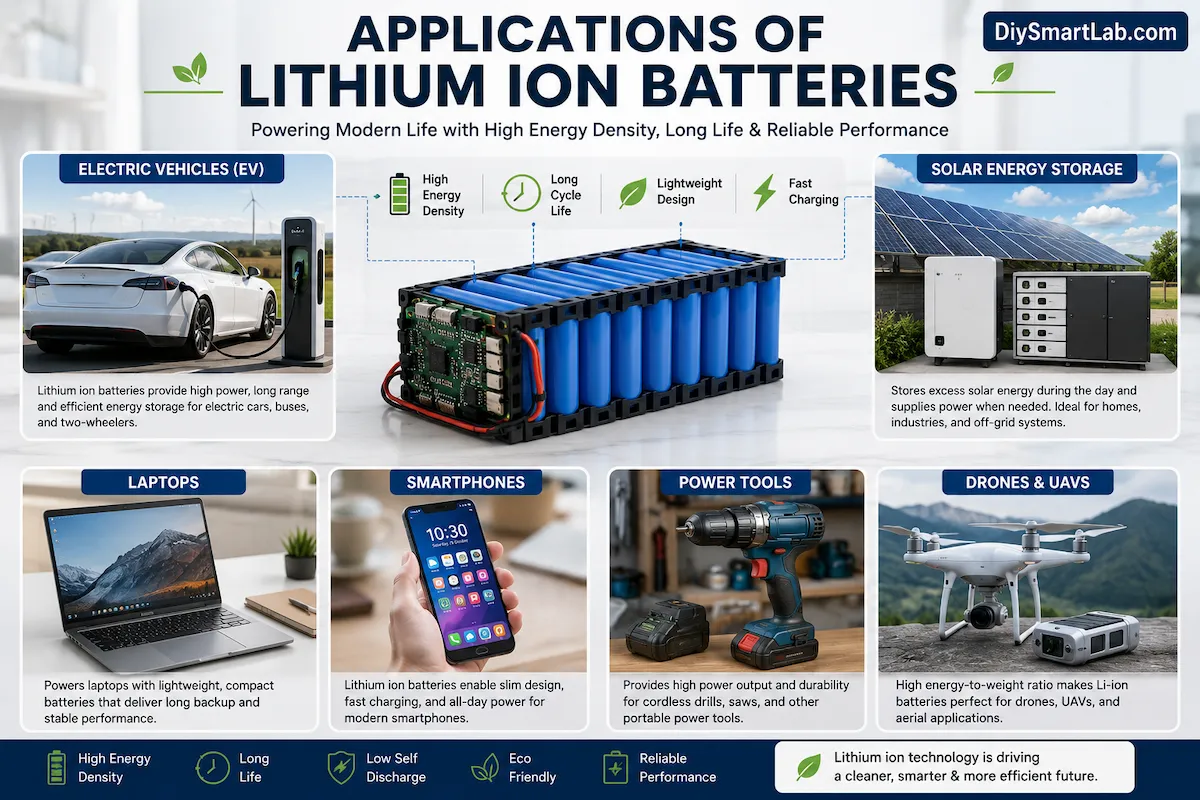
Today, lithium-ion batteries are used in countless devices and industries.
1. Smartphones
Almost all modern smartphones use lithium-ion batteries because they are lightweight and compact.
2. Laptops
Long battery life makes lithium-ion technology ideal for portable computers.
3. Electric Vehicles
Electric cars depend heavily on lithium-ion battery packs for propulsion.
4. Solar Energy Storage
Many solar power systems use lithium-ion batteries to store renewable energy.
5. Power Banks
Portable charging devices commonly use lithium-ion battery cells.
6. Drones
Lightweight batteries improve flight performance and endurance.
7. Medical Equipment
Portable medical devices require reliable rechargeable batteries.
8. Power Tools
Cordless drills and other tools use lithium-ion battery packs.
Advantages of Lithium-Ion Batteries
- High energy density
- Long cycle life
- Fast charging support
- Lightweight design
- Low maintenance requirements
- Low self-discharge rate
- No memory effect
- Environmentally friendlier than many older battery types
- Available in multiple capacities
- Excellent efficiency
Disadvantages of Lithium-Ion Batteries
- Higher initial cost
- Requires Battery Management System
- Sensitive to extreme temperatures
- Can degrade over time
- Risk of thermal runaway if damaged
- Needs proper charging circuitry
- Recycling process can be challenging
Lithium-Ion Battery vs Lead Acid Battery
| Feature | Lithium-Ion | Lead Acid |
|---|---|---|
| Weight | Lightweight | Heavy |
| Cycle Life | 500-3000+ cycles | 200-500 cycles |
| Charging Speed | Fast | Slow |
| Maintenance | Low | Moderate |
| Energy Density | High | Low |
| Efficiency | High | Lower |
Safety Tips for Lithium-Ion Batteries
- Use the correct charger.
- Avoid overcharging.
- Do not puncture the battery.
- Keep away from excessive heat.
- Store in a cool, dry place.
- Use a Battery Management System.
- Replace damaged batteries immediately.
- Follow manufacturer guidelines.
Frequently Asked Questions (FAQs)
What is a lithium-ion battery used for?
It is used in smartphones, laptops, electric vehicles, solar systems, power banks, drones, and many other electronic devices.
How long does a lithium-ion battery last?
Most lithium-ion batteries last between 500 and 3000 charge cycles depending on quality and usage conditions.
Can a lithium-ion battery be recharged?
Yes. Lithium-ion batteries are rechargeable and designed for repeated charging cycles.
Why are lithium-ion batteries popular?
They provide high energy density, lightweight construction, fast charging, and long service life.
Are lithium-ion batteries safe?
Yes. When used with proper charging circuits and a Battery Management System, they are generally very safe.
Conclusion
Now you know what a lithium-ion battery is, how it works, and why it has become the most widely used rechargeable battery technology in the world.
Its high energy density, lightweight design, fast charging capability, and long lifespan make it ideal for smartphones, laptops, electric vehicles, solar energy storage systems, and countless other applications.
As battery technology continues to improve, lithium-ion batteries will play an even bigger role in powering future electronic devices and renewable energy systems.
At DiySmartLab.com, we regularly publish beginner-friendly electronics and battery technology guides to help you learn and build smarter projects.
You May Also Like
- What is a Battery Management System (BMS)? Working, Features & Applications
- What is a LiFePO4 Battery? Working, Advantages & Applications
- What’s Inside a LiFePO4 Cell? Internal Structure & Working Explained
- What is Electricity and How Does It Work?
- Common Electronic Components Every Beginner Should Know
- What is IoT (Internet of Things)? Explained for Beginners