
What is a Battery Management System (BMS)? How It Works Explained

What is a Battery Management System (BMS)? – How it Works
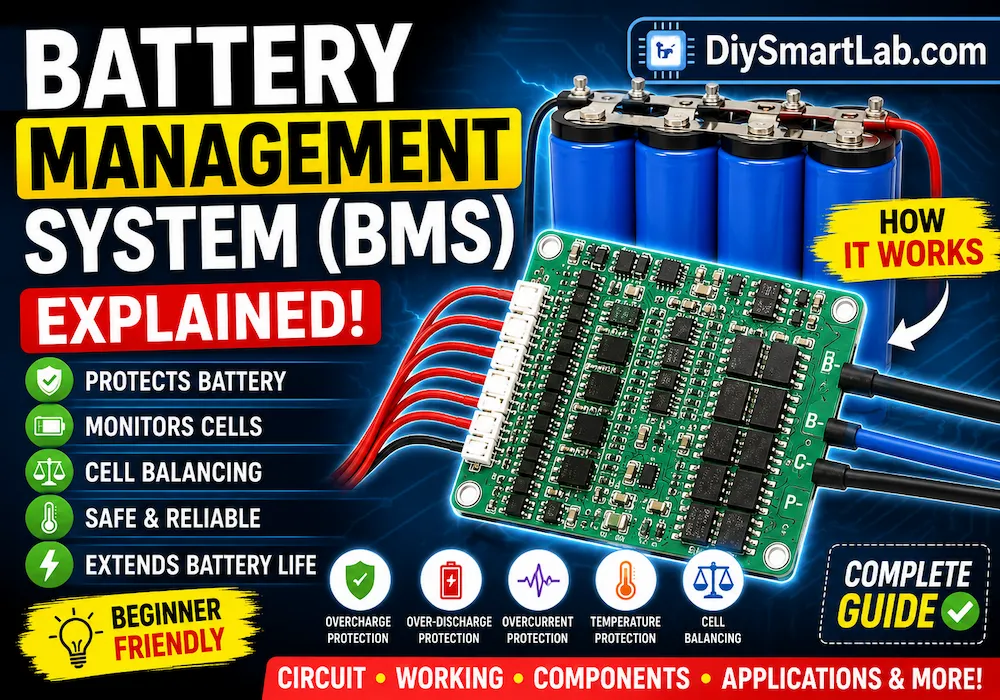
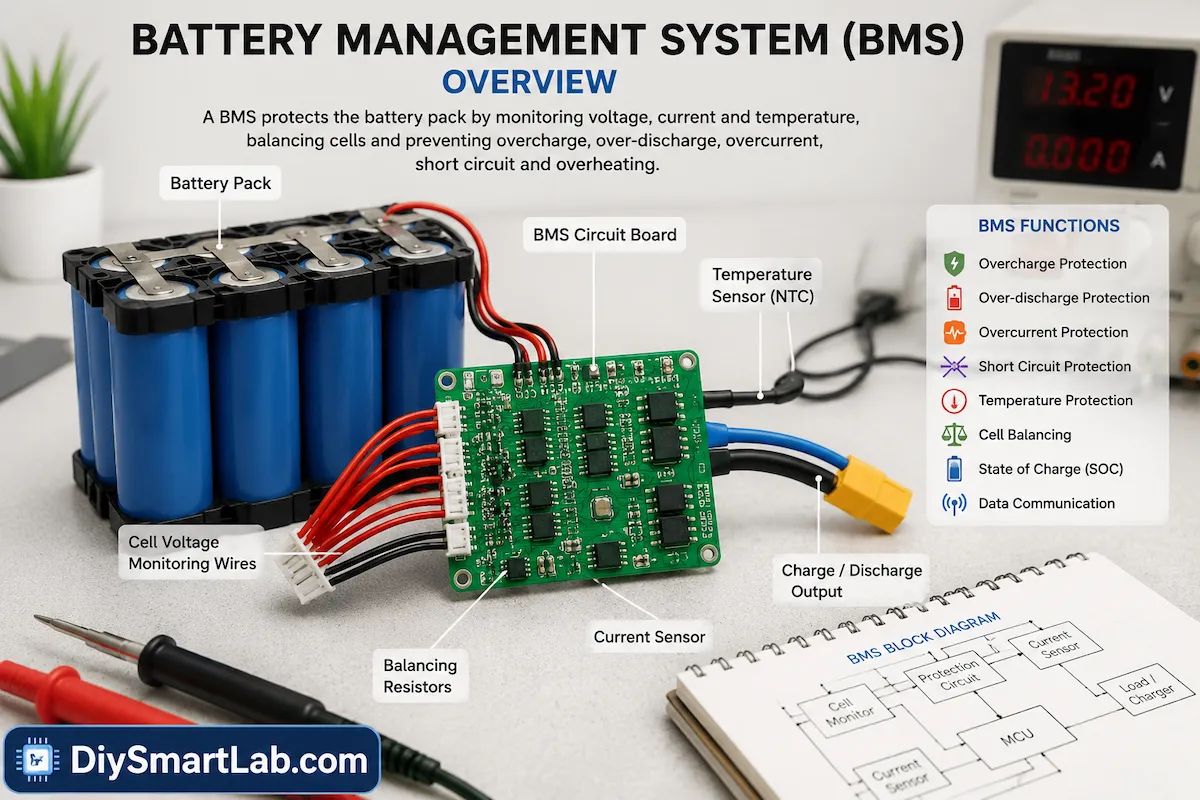
A Battery Management System (BMS) is an electronic protection and monitoring system used inside rechargeable battery packs. It helps protect the battery from overcharging, over-discharging, overheating, short circuits, and cell imbalance.
In simple words, a Battery Management System works like the brain of a battery pack. It checks battery voltage, current, and temperature in real time. Then, it controls charging and discharging to keep the battery safe.
In this beginner-friendly guide from DiySmartLab.com, you will learn what a Battery Management System is, how it works, its features, components, circuit explanation, applications, advantages, disadvantages, FAQs, and more.
What is a Battery Management System (BMS)?
A Battery Management System is a special electronic circuit that manages a rechargeable battery pack. It is commonly used with lithium-ion, LiFePO4, lithium polymer, and other rechargeable battery technologies.
The main job of a BMS is to keep the battery operating within safe limits. It monitors each battery cell and disconnects the battery when unsafe conditions occur.
A Battery Management System helps improve:
- Battery safety
- Battery life
- Charging performance
- Battery efficiency
- Cell balancing
- Protection from electrical faults
Without a BMS, lithium battery packs can become unsafe. They may overheat, lose capacity, or get permanently damaged.
Why is a Battery Management System Important?
Modern batteries store a large amount of energy in a small size. Therefore, they need proper control. If a battery is charged or discharged incorrectly, it can become dangerous.
A Battery Management System protects the battery from common problems such as:
- Overcharging
- Deep discharging
- High current flow
- Short circuit
- Overheating
- Cell voltage imbalance
Because of this, a BMS is very important in electric vehicles, solar battery banks, inverter batteries, power banks, e-bikes, and DIY electronics projects.
Main Features of a Battery Management System
A good Battery Management System includes many safety and monitoring features. These features help the battery work safely and efficiently.
| Feature | Purpose |
|---|---|
| Overcharge Protection | Stops charging when cell voltage becomes too high |
| Over-discharge Protection | Disconnects the load when battery voltage becomes too low |
| Short Circuit Protection | Protects the battery during accidental short circuits |
| Overcurrent Protection | Stops excessive current flow during charge or discharge |
| Temperature Monitoring | Protects cells from overheating |
| Cell Balancing | Keeps all cells at nearly equal voltage |
| State of Charge Monitoring | Helps estimate remaining battery capacity |
How Does a Battery Management System Work?
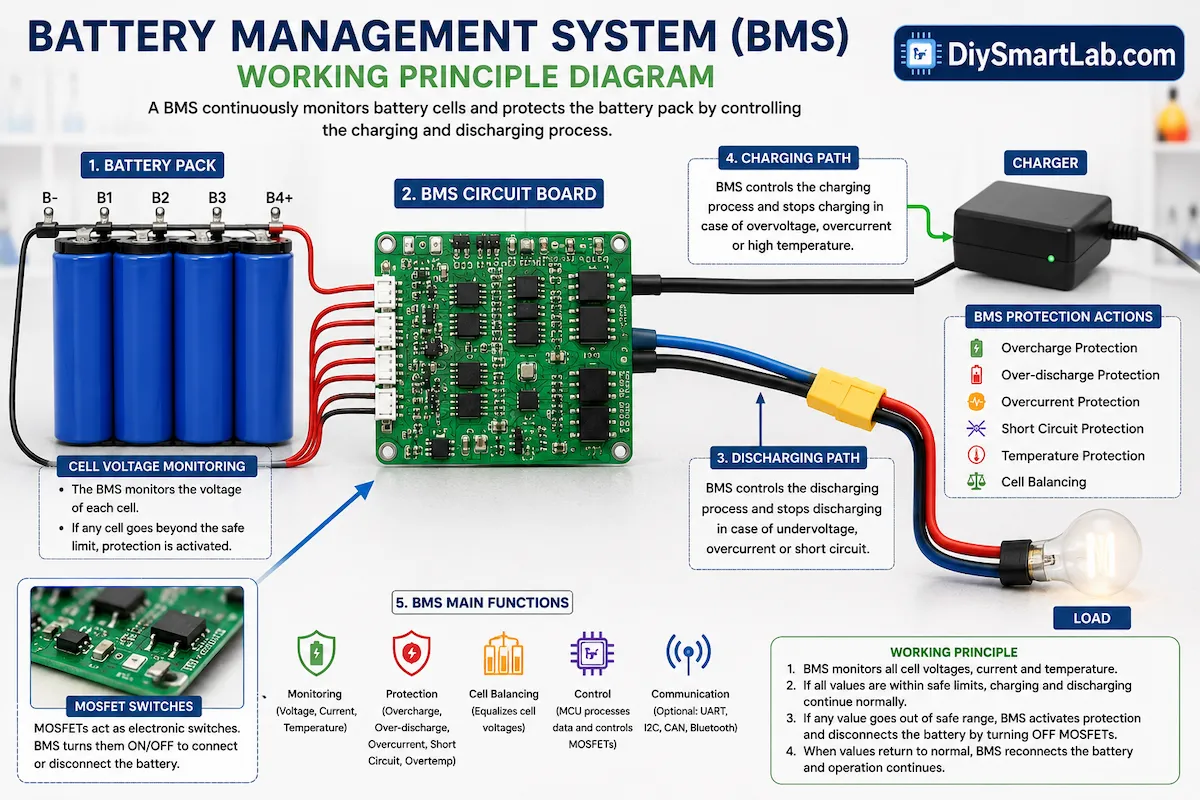
The working principle of a Battery Management System is simple to understand. The BMS continuously monitors the battery pack and takes action when any value goes outside the safe range.
It checks voltage, current, and temperature. Then, it controls MOSFET switches to allow or stop charging and discharging.
1. Voltage Monitoring
Each battery cell has a safe voltage range. For example, a lithium-ion cell usually works between about 3.0V and 4.2V. A LiFePO4 cell usually works between about 2.5V and 3.65V.
The Battery Management System monitors each cell voltage. If any cell voltage goes too high, the BMS stops charging. If any cell voltage goes too low, the BMS stops discharging.
2. Current Monitoring
The BMS also checks how much current is flowing in or out of the battery pack. If the current becomes too high, the BMS disconnects the battery from the charger or load.
This protects the battery, wires, MOSFETs, and connected devices.
3. Temperature Monitoring
Battery temperature is very important for safety. If a battery becomes too hot, it can lose capacity or become dangerous.
That is why many BMS boards use temperature sensors. These sensors help stop charging or discharging when the temperature crosses the safe limit.
4. Cell Balancing
When multiple cells are connected in series, their voltages may become different over time. This is called cell imbalance.
Cell imbalance reduces battery performance and lifespan. So, the Battery Management System balances the cells by equalizing their voltage levels.
Components Required in a Battery Management System
A Battery Management System contains different electronic components. Each component performs a specific function inside the circuit.
| Component | Function |
|---|---|
| Battery Cells | Store electrical energy |
| BMS IC | Monitors voltage and controls protection |
| MOSFETs | Connect or disconnect charging and discharging paths |
| Resistors | Used for voltage sensing and cell balancing |
| NTC Thermistor | Measures battery temperature |
| Current Sense Resistor | Detects charging and discharge current |
| Capacitors | Filter noise and stabilize the circuit |
| Connector Wires | Connect each battery cell to the BMS board |
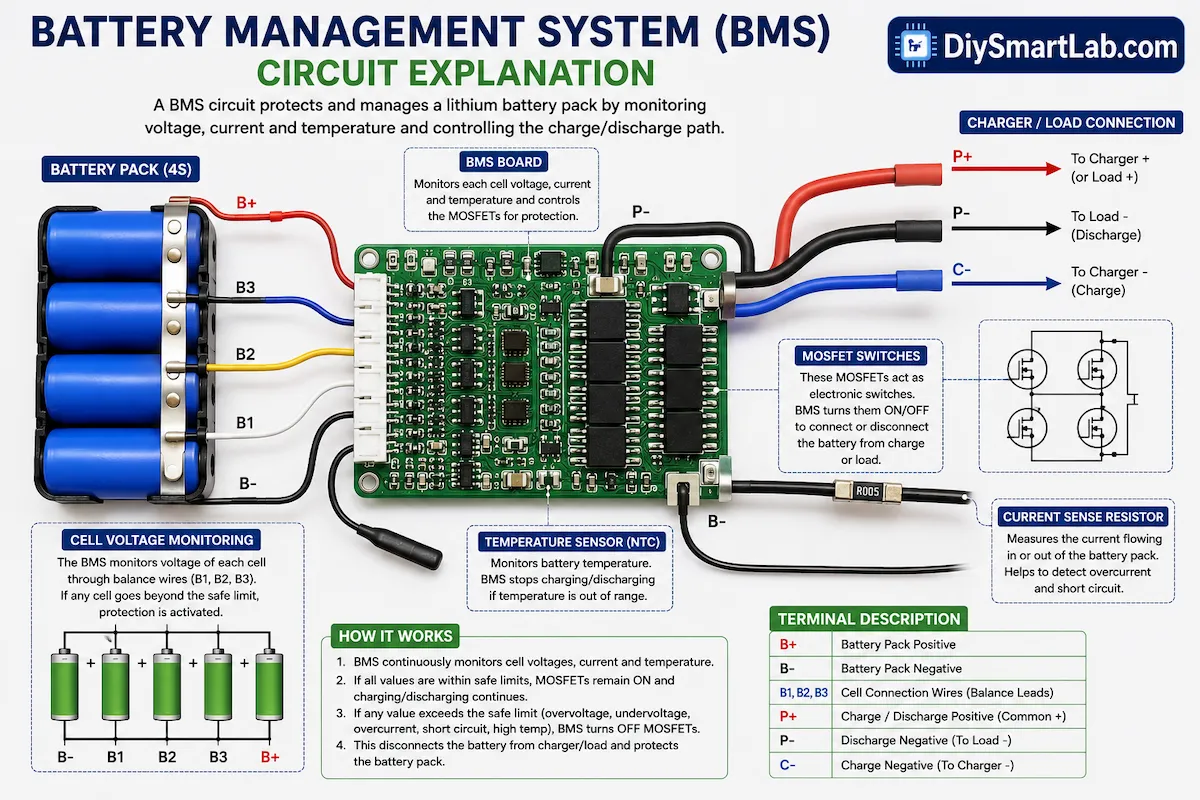
Battery Management System Circuit Explanation
A basic BMS circuit connects directly to the battery pack. It has separate points for battery positive, battery negative, charging negative, and load negative.
In many common BMS boards, the positive terminal is shared. The BMS mainly controls the negative path using MOSFETs.
The circuit measures each cell voltage through balance wires. These wires connect between series-connected battery cells.
When all values are normal, the MOSFETs remain ON. Current can flow between the battery, charger, and load.
However, if the BMS detects overvoltage, undervoltage, overcurrent, short circuit, or high temperature, it turns OFF the MOSFETs. This disconnects the battery and protects the complete system.
Battery Cell Balancing Explained
Battery cell balancing is one of the most important functions of a Battery Management System.
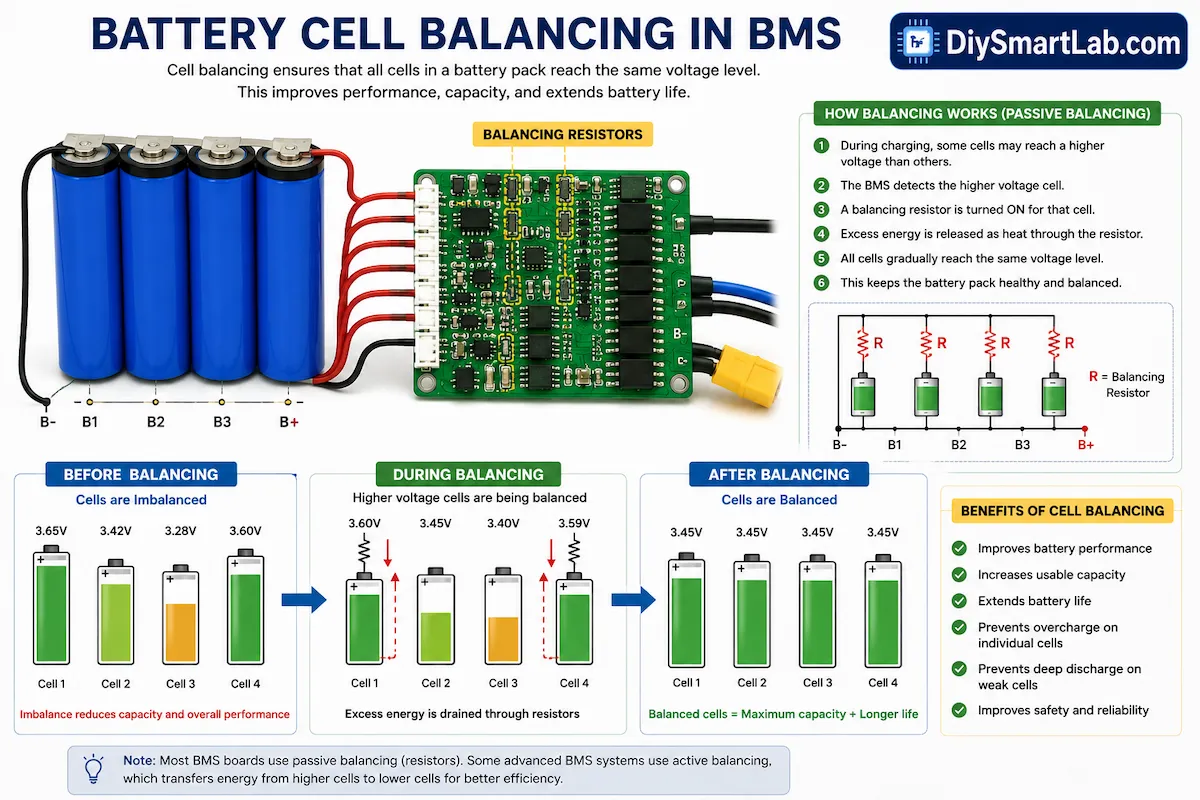
When several lithium cells are connected in series, small differences between cells begin to appear. Over time, some cells charge faster while others charge slower.
This creates voltage imbalance inside the battery pack.
If balancing is not performed, one cell may become overcharged while another remains undercharged. As a result, battery performance decreases and lifespan becomes shorter.
The Battery Management System solves this problem through cell balancing.
Passive Cell Balancing
Passive balancing is the most common balancing method.
In this technique, excess energy from higher-voltage cells is converted into heat through balancing resistors.
Advantages of passive balancing:
- Simple design
- Low cost
- Reliable operation
- Widely used in LiFePO4 BMS boards
Active Cell Balancing
Active balancing transfers energy from high-voltage cells to low-voltage cells.
This method is more efficient because energy is not wasted as heat.
Advantages of active balancing:
- Higher efficiency
- Better energy utilization
- Suitable for large battery packs
- Improves battery lifespan
However, active balancing circuits are more expensive and complex.
Protection Functions of a Battery Management System
A Battery Management System continuously protects the battery from dangerous operating conditions.
Overcharge Protection
Overcharging can permanently damage lithium battery cells.
When a cell reaches its maximum voltage limit, the BMS stops charging immediately.
Over-Discharge Protection
Deep discharge can reduce battery capacity and lifespan.
The BMS disconnects the load before the voltage becomes dangerously low.
Overcurrent Protection
Excessive current can damage cells, wires, connectors, and electronic components.
The BMS monitors current continuously and disconnects the battery if the current exceeds the safe limit.
Short Circuit Protection
Short circuits can cause extremely high current flow within milliseconds.
A Battery Management System detects this condition and immediately disconnects the battery pack.
Temperature Protection
Battery temperature affects both safety and performance.
The BMS stops charging or discharging when temperature exceeds predefined limits.
Battery Management System Communication Features
Modern Battery Management Systems often include communication interfaces.
These interfaces allow the battery to share information with external devices.
Common communication methods include:
- UART
- I2C
- SPI
- RS485
- CAN Bus
- Bluetooth
- Wi-Fi
This information can be displayed on screens, mobile applications, battery monitors, solar charge controllers, or electric vehicle dashboards.
| Parameter | Information Provided |
|---|---|
| Battery Voltage | Total battery voltage |
| Cell Voltage | Individual cell voltage |
| Current | Charge and discharge current |
| Temperature | Battery temperature |
| SOC | State of Charge |
| SOH | State of Health |
| Cycle Count | Total charging cycles |
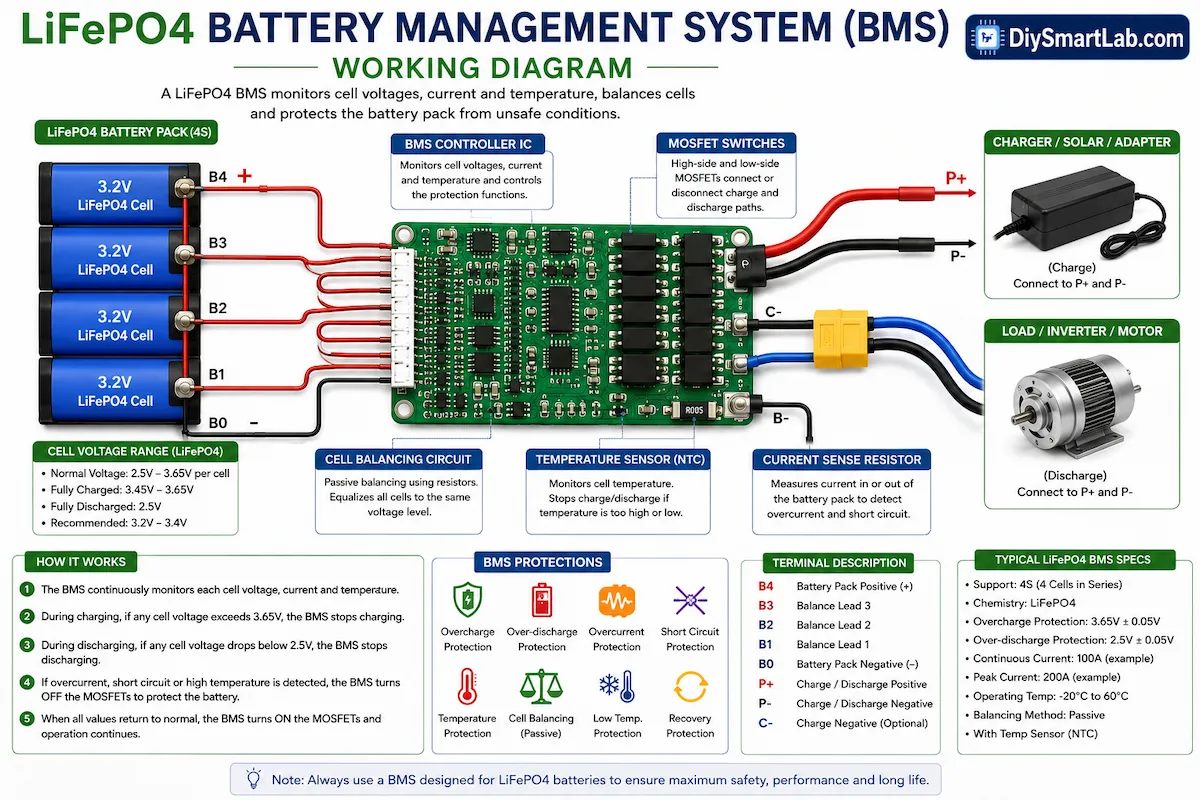
Battery Management System in LiFePO4 Batteries
LiFePO4 batteries have become very popular in recent years.
They are commonly used in:
- Solar energy storage systems
- Electric vehicles
- Power backup systems
- Marine batteries
- RV batteries
- DIY battery packs
Although LiFePO4 batteries are safer than traditional lithium-ion batteries, they still require a Battery Management System.
A LiFePO4 BMS typically provides:
- 3.65V overcharge protection per cell
- 2.5V over-discharge protection per cell
- Cell balancing
- Temperature monitoring
- Current protection
Applications of Battery Management Systems
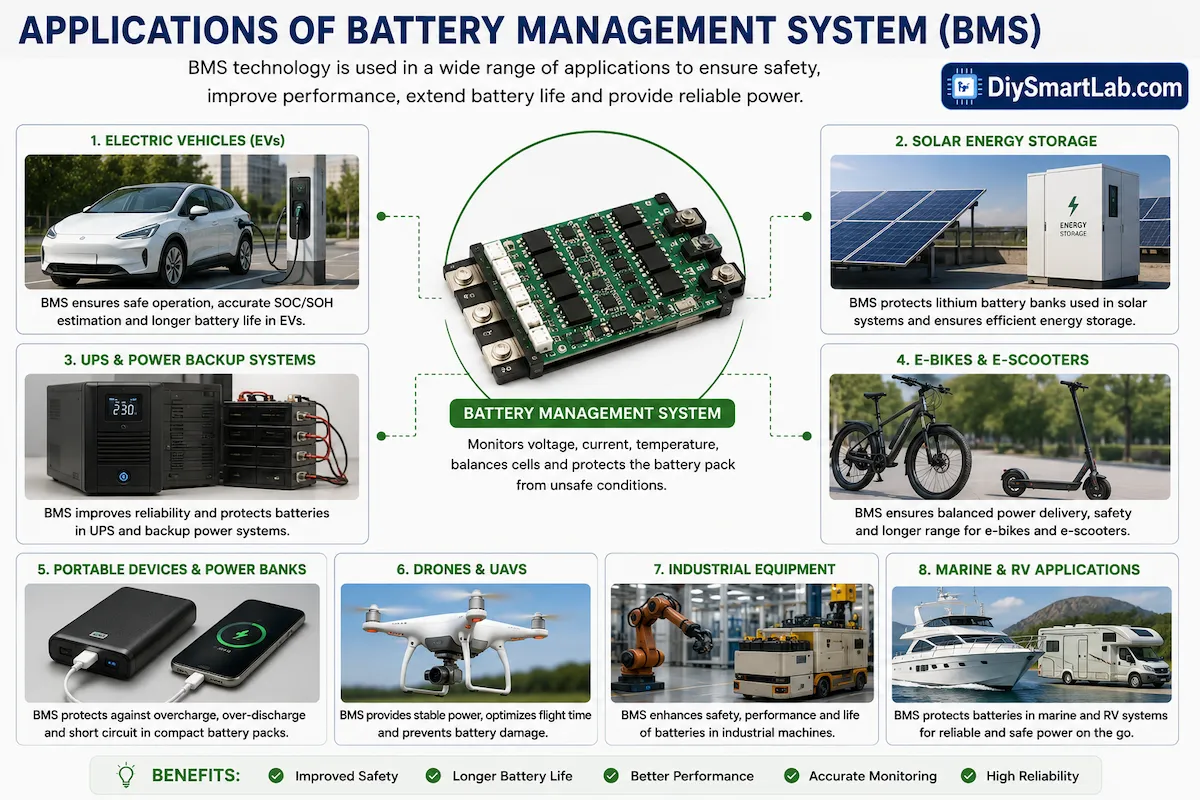
Battery Management Systems are used in almost every rechargeable battery application today.
1. Electric Vehicles (EVs)
Electric cars, scooters, and e-bikes use advanced BMS systems to monitor thousands of battery cells.
2. Solar Energy Storage
Solar battery banks require a BMS to safely store and manage renewable energy.
3. UPS Systems
Uninterruptible power supplies use BMS circuits to improve battery reliability.
4. Power Banks
Portable power banks include miniature BMS boards for battery protection.
5. Drones
Drone battery packs require proper monitoring and balancing for safe operation.
6. Medical Equipment
Medical devices use Battery Management Systems to ensure reliable power delivery.
7. Telecom Backup Systems
Telecommunication towers often use large battery banks protected by advanced BMS units.
8. Marine and RV Batteries
LiFePO4 batteries used in boats and recreational vehicles rely heavily on Battery Management Systems.
Advantages of a Battery Management System
- Improves battery safety
- Extends battery lifespan
- Prevents overcharging
- Prevents deep discharge
- Protects against short circuits
- Maintains cell balance
- Improves charging efficiency
- Provides battery monitoring
- Reduces maintenance requirements
- Increases overall reliability
Disadvantages of a Battery Management System
- Increases battery pack cost
- Adds circuit complexity
- Consumes a small amount of power
- May require calibration in advanced systems
- Repair can be difficult in some battery packs
Frequently Asked Questions (FAQs)
1. What is the main purpose of a Battery Management System?
The main purpose of a Battery Management System (BMS) is to protect, monitor, and manage rechargeable battery packs. It prevents overcharging, over-discharging, overheating, short circuits, and cell imbalance.
2. Is a BMS necessary for LiFePO4 batteries?
Yes. Although LiFePO4 batteries are safer than traditional lithium-ion batteries, they still require a Battery Management System to ensure safe operation and maximize battery lifespan.
3. Can a battery work without a BMS?
Technically, a battery can work without a BMS. However, doing so is unsafe. Without protection, battery cells can become damaged, overheat, or fail prematurely.
4. What happens if a BMS fails?
If a BMS fails, charging and discharging protection may stop working. This can lead to battery damage, reduced lifespan, or safety risks.
5. Does a BMS charge the battery?
No. A BMS does not charge the battery directly. The charger performs the charging process. The BMS only monitors and controls the charging path to ensure safe operation.
6. What is cell balancing in a BMS?
Cell balancing is a process that keeps all battery cells at similar voltage levels. This improves battery efficiency, capacity, and lifespan.
7. How do I choose the correct BMS?
You should select a BMS based on battery chemistry, battery voltage, number of cells in series, and maximum current requirements.
8. What is the difference between a PCM and a BMS?
A PCM (Protection Circuit Module) mainly provides basic protection features. A Battery Management System offers advanced monitoring, balancing, communication, and battery management functions.
Battery Management System vs Protection Circuit Module (PCM)
| Feature | PCM | BMS |
|---|---|---|
| Overcharge Protection | Yes | Yes |
| Over-discharge Protection | Yes | Yes |
| Cell Balancing | No | Yes |
| Temperature Monitoring | Limited | Yes |
| Communication Interface | No | Yes |
| Battery Monitoring | Basic | Advanced |
| Suitable for Large Packs | No | Yes |
Future of Battery Management Systems
Battery technology continues to evolve rapidly. As electric vehicles and renewable energy systems become more common, Battery Management Systems are becoming smarter and more advanced.
Modern BMS solutions now include:
- Bluetooth connectivity
- Mobile app monitoring
- Cloud-based battery analytics
- Artificial intelligence optimization
- Wireless cell monitoring
- Predictive maintenance features
These advancements help improve battery performance, reliability, and safety.
Conclusion
A Battery Management System (BMS) is one of the most important components in any rechargeable battery pack. It continuously monitors battery voltage, current, and temperature while protecting the battery from unsafe operating conditions.
Without a Battery Management System, modern lithium-ion and LiFePO4 batteries would not be able to operate safely. The BMS improves battery lifespan, increases efficiency, provides cell balancing, and prevents costly battery damage.
Whether you are building a DIY battery pack, installing a solar energy storage system, or working with electric vehicles, understanding how a Battery Management System works is extremely important.
At DiySmartLab.com, we recommend always using a quality BMS with lithium-based battery packs to ensure maximum safety and performance.