
What is an LED? How It Works and How to Use It Easily…

Meta Title: What is an LED? How It Works and How to Use It Easily
Meta Description: Learn what an LED is, how LEDs work, their types, applications, advantages, and how to use LEDs in Arduino and DIY electronics projects.
What is an LED? How It Works and How to Use It
LEDs are one of the most commonly used electronic components in modern electronics. From mobile phone flashlights to smart TVs and Arduino projects, LEDs are everywhere. They are energy-efficient, compact, long-lasting, and available in different colors and sizes.
In this guide, you will learn what an LED is, how it works, LED polarity, different LED types, practical applications, and how to use LEDs in DIY electronics projects.
What is an LED?
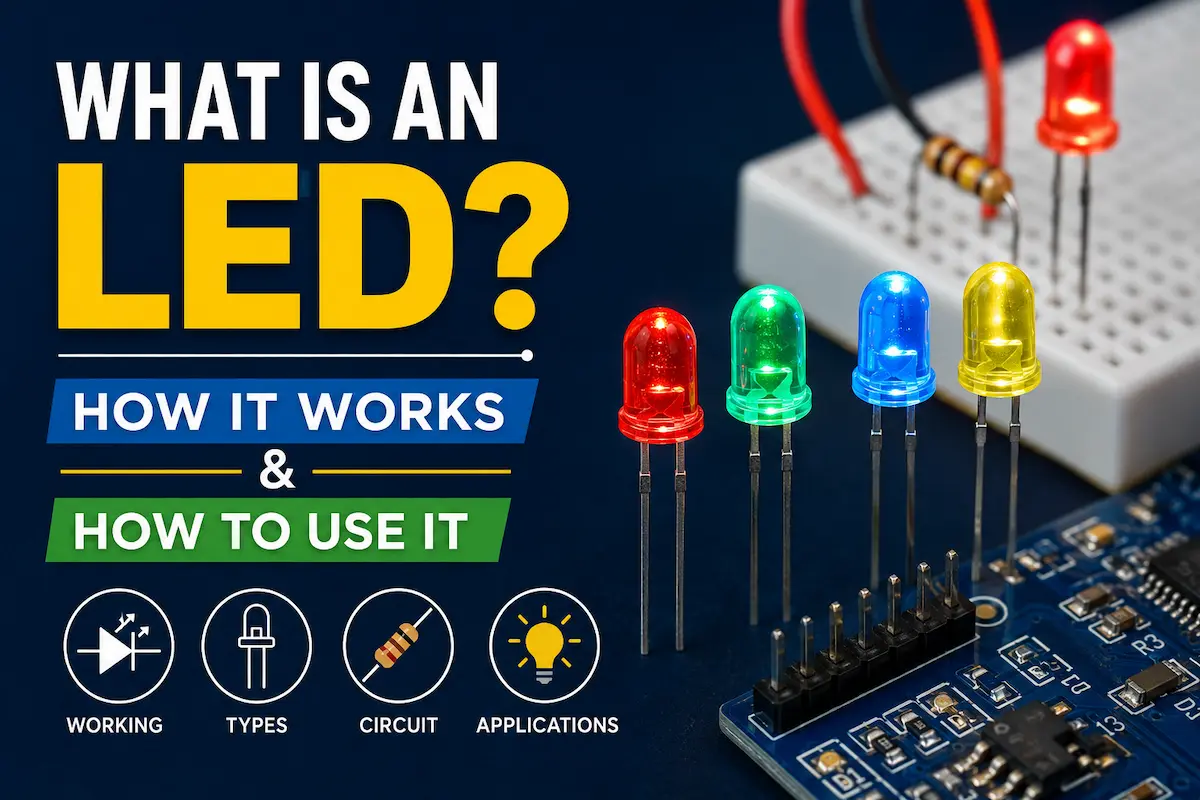
LED stands for Light Emitting Diode. It is a semiconductor electronic component that emits light when electric current flows through it in the forward direction.
An LED works similarly to a normal diode, but instead of producing heat, it converts electrical energy into visible light efficiently.
LEDs are widely used because they consume less power and have a much longer lifespan compared to traditional incandescent bulbs.
LED Symbol and Structure
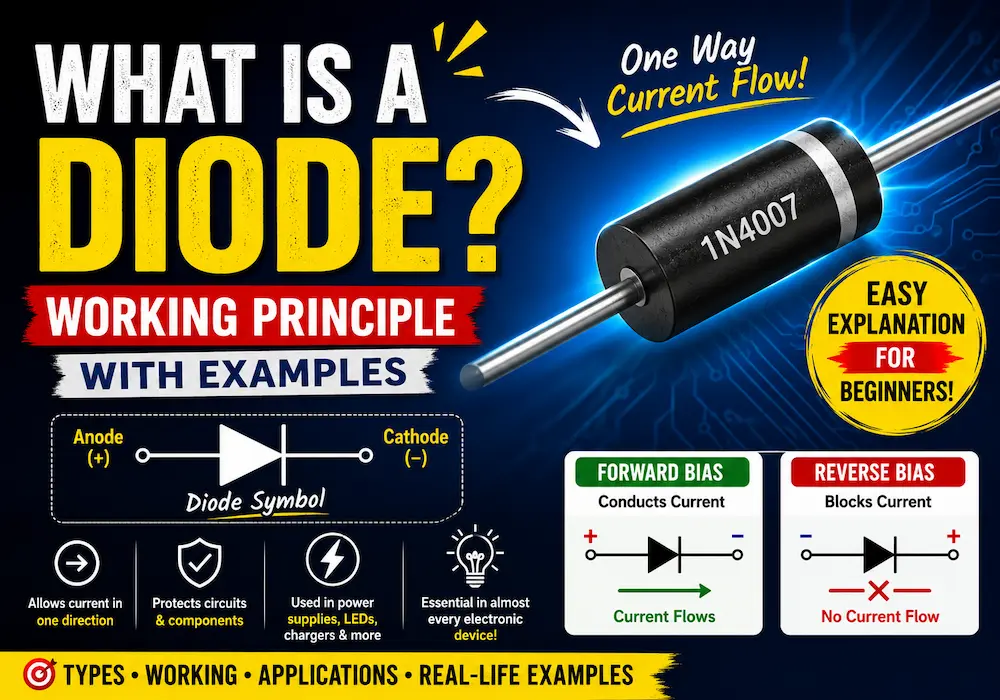
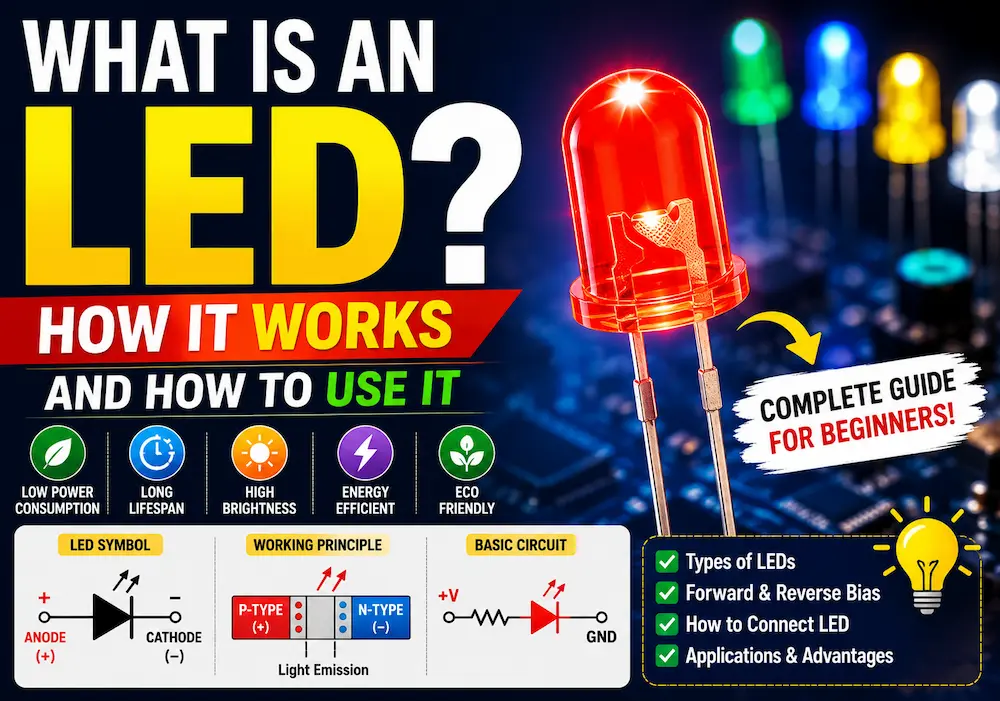
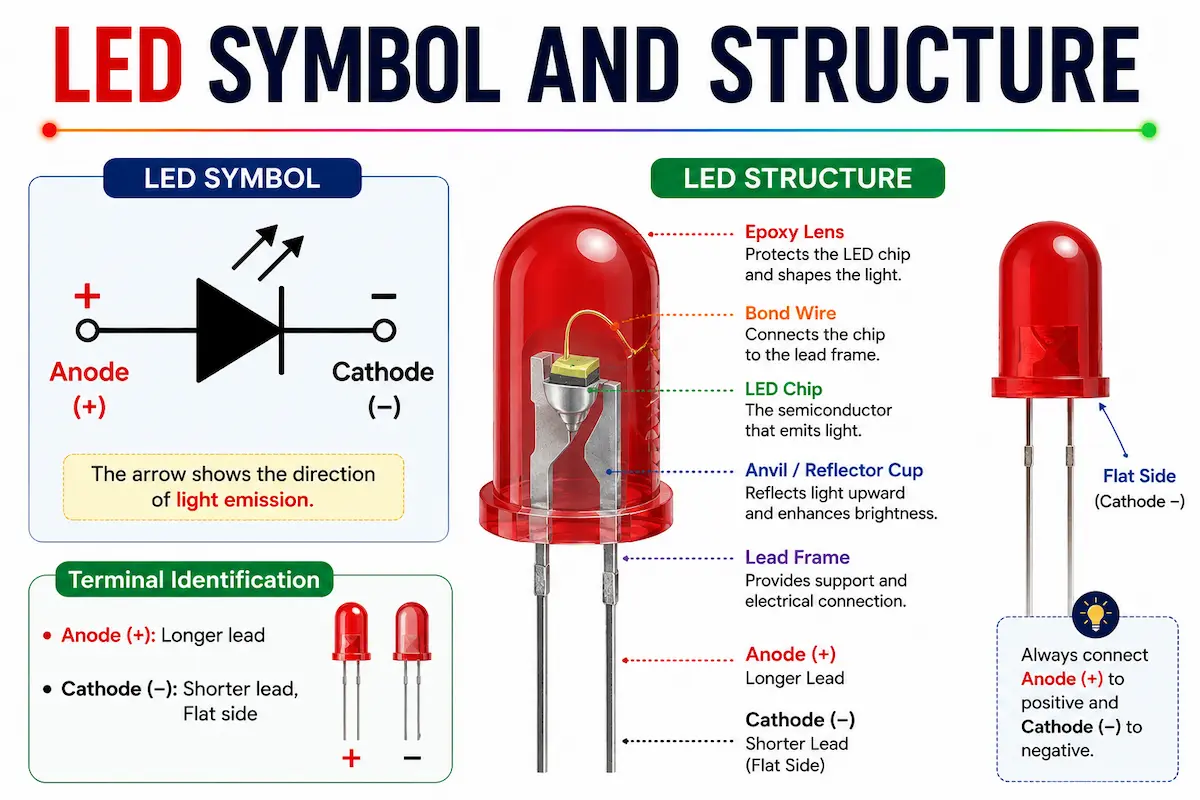
An LED has two terminals:
- Anode (+) → Positive terminal
- Cathode (-) → Negative terminal
The longer leg of the LED is usually the anode, while the shorter leg is the cathode.
How Does an LED Work?
LEDs work on the principle of electroluminescence. When forward voltage is applied, electrons combine with holes inside the semiconductor material and release energy in the form of light.
The color of the emitted light depends on the semiconductor material used inside the LED.
For example:
- Red LED → Lower energy band gap
- Blue LED → Higher energy band gap
- White LED → Blue LED with phosphor coating
Forward Bias and Reverse Bias in LED
1. Forward Bias LED
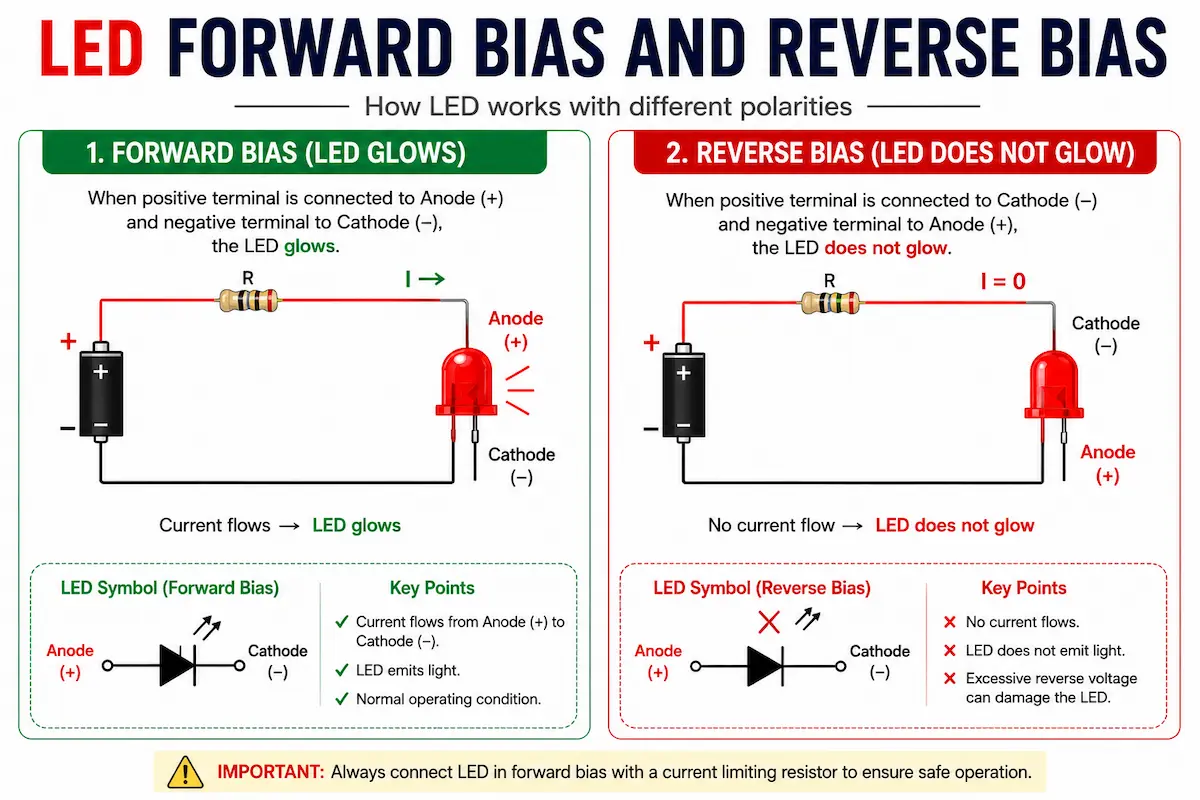
When the positive terminal of the battery is connected to the anode and the negative terminal is connected to the cathode, the LED glows.
This is called forward biasing.
2. Reverse Bias LED
If the connections are reversed, the LED blocks current flow and does not glow.
Applying high reverse voltage can permanently damage the LED.
Common Types of LEDs
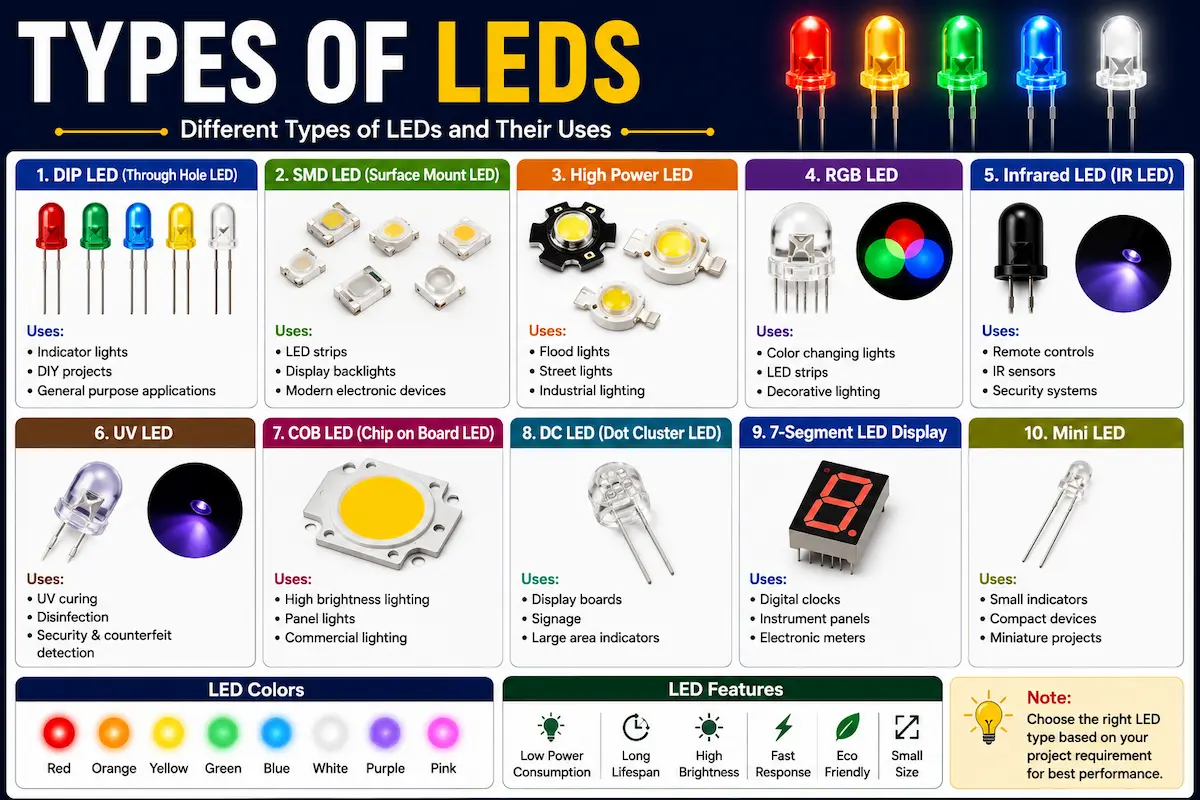
- Miniature LEDs – Used in indicators and small electronics
- High-Power LEDs – Used in flood lights and street lights
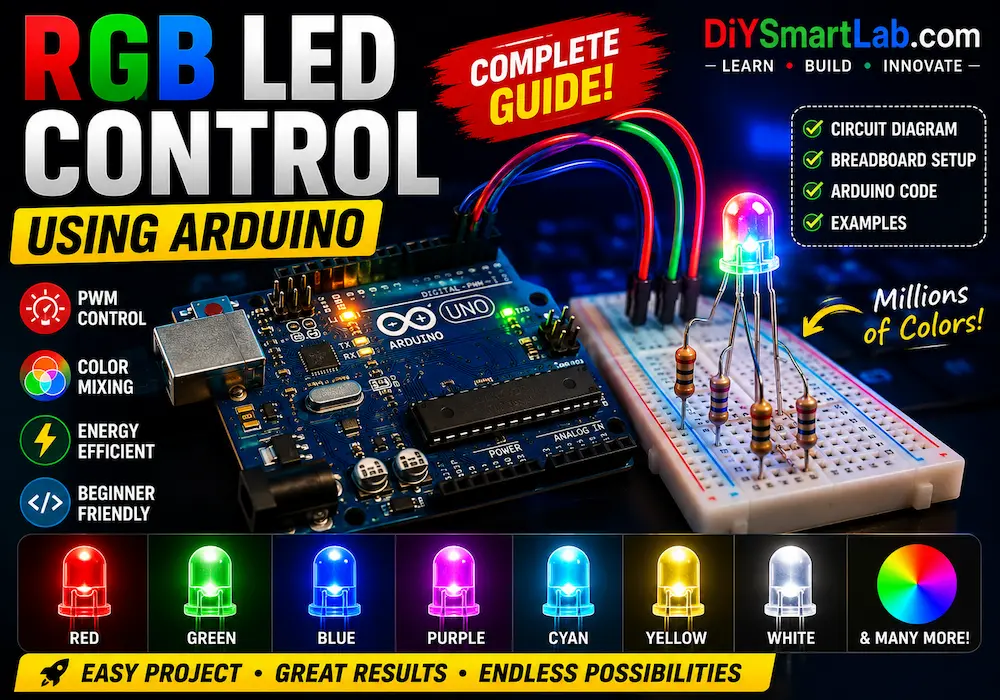
- RGB LEDs – Produce multiple colors using red, green, and blue LEDs
- Infrared LEDs – Used in remote controls and sensors
- SMD LEDs – Surface-mounted LEDs used in LED strips and modern electronics
- COB LEDs – Chip-on-board LEDs used in powerful lighting systems
Advantages of LEDs
- Low power consumption
- Long lifespan
- Small size
- Fast switching speed
- Available in multiple colors
- Low heat generation
- Eco-friendly lighting solution
Disadvantages of LEDs
- Require proper current limiting resistor
- Sensitive to reverse voltage
- Brightness decreases over time
- High-power LEDs require heat sinks
How to Use an LED in a Circuit
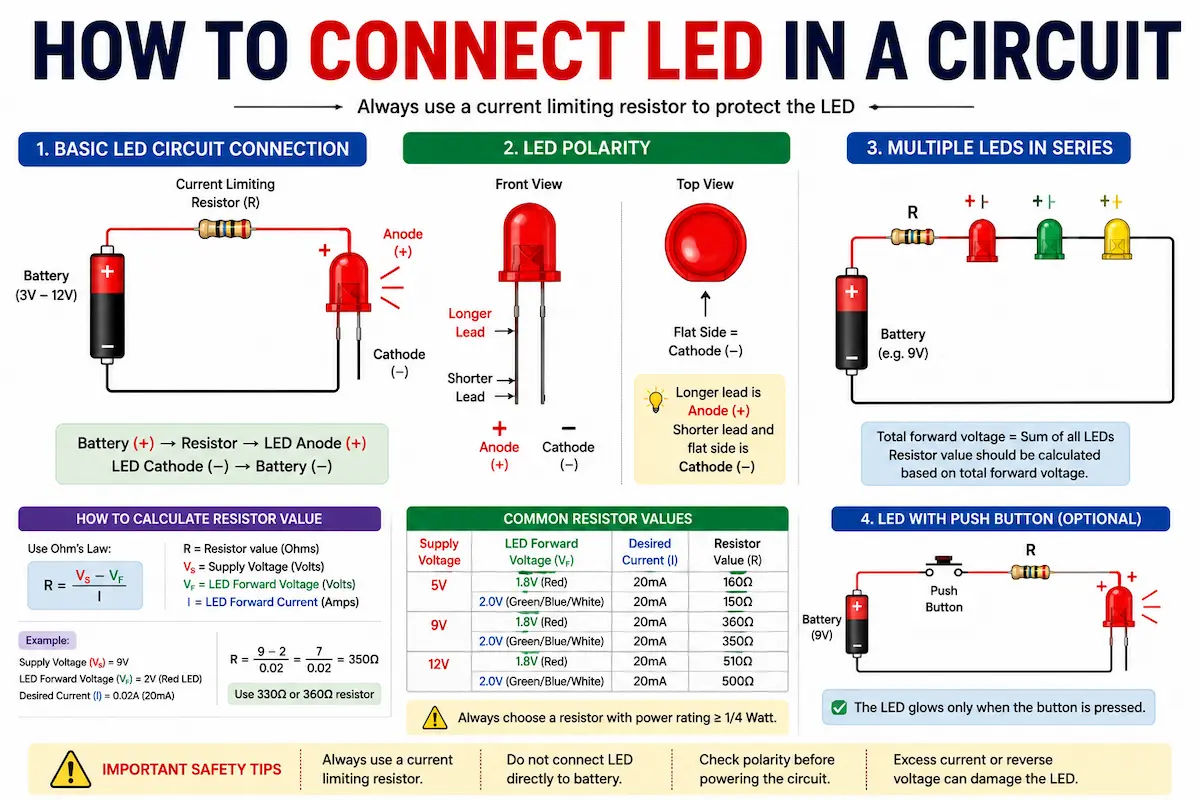
An LED should always be connected with a current-limiting resistor to prevent excessive current flow.
Basic LED circuit connection:
- Battery positive → Resistor → LED anode
- LED cathode → Battery negative
Typical resistor values:
- 220Ω resistor
- 330Ω resistor
- 1kΩ resistor (for low brightness)
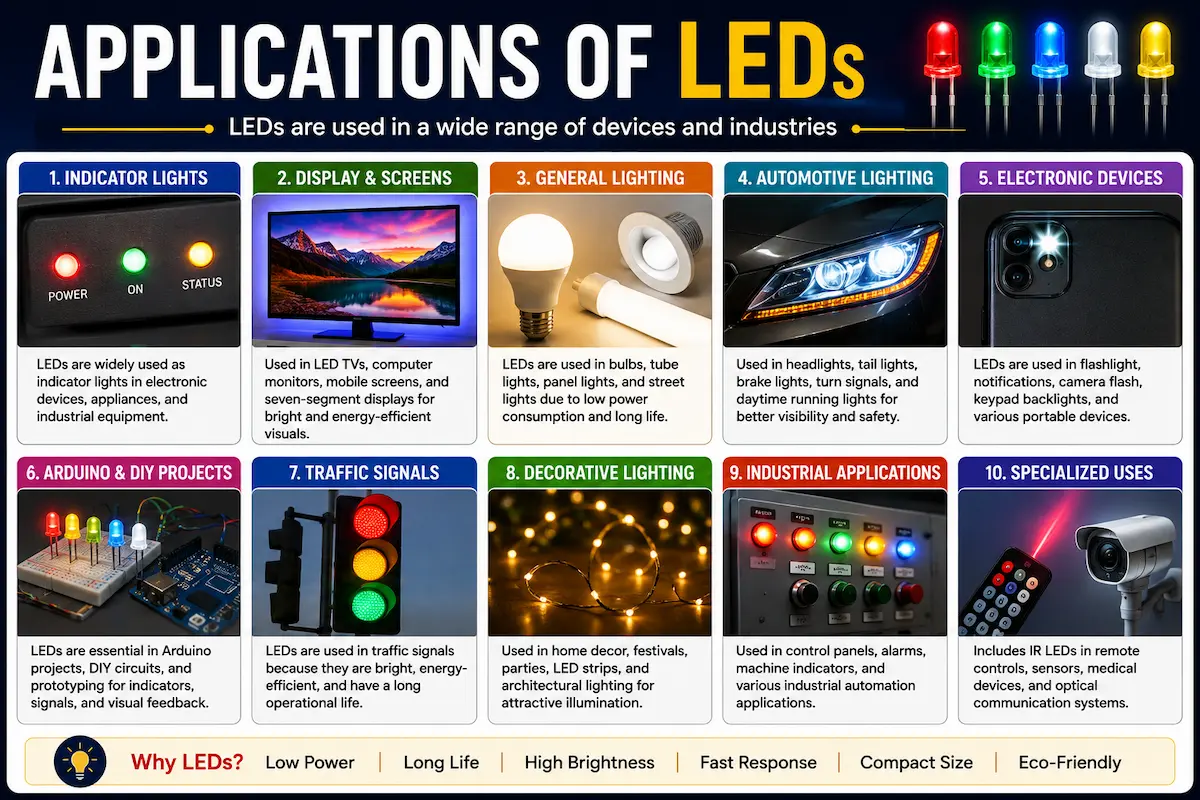
Applications of LEDs
- Indicator lights
- Arduino projects
- Smart home lighting
- LED TVs and displays
- Automotive lighting
- Flashlights
- Decorative lighting
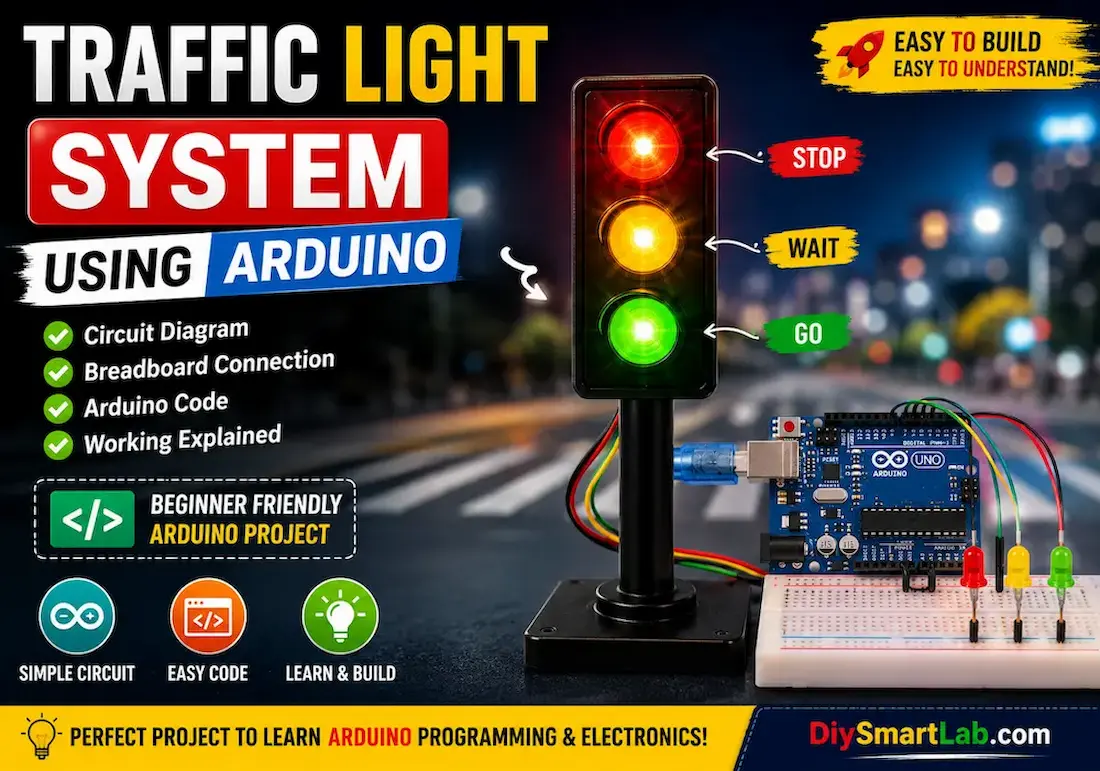
- Traffic signals
- Digital billboards
LED vs Traditional Bulb
| Feature | LED | Traditional Bulb |
|---|---|---|
| Power Consumption | Very Low | High |
| Heat Generation | Low | Very High |
| Lifespan | Long | Short |
| Efficiency | High | Low |
| Size | Compact | Large |
Safety Tips While Using LEDs
- Always use a resistor with LEDs
- Do not exceed recommended voltage and current
- Check LED polarity before connecting
- Use heat sinks for high-power LEDs
- Avoid direct exposure to high-brightness LEDs
Conclusion
LEDs are essential electronic components used in almost every modern electronic device. Their low power consumption, long lifespan, compact size, and high efficiency make them ideal for DIY electronics projects, Arduino circuits, smart lighting systems, and industrial applications.
If you are learning electronics, understanding LEDs is one of the best starting points because they are simple, affordable, and extremely useful in practical projects.
Frequently Asked Questions (FAQs)
Why do LEDs need resistors?
Resistors limit current flow and protect LEDs from burning out.
Can LEDs work on AC supply?
Standard LEDs are designed for DC supply. Additional circuits are needed for AC operation.
How long does an LED last?
Most LEDs can last between 25,000 to 50,000 hours depending on quality and operating conditions.
What happens if LED polarity is reversed?
The LED will not glow, and excessive reverse voltage may damage it permanently.