
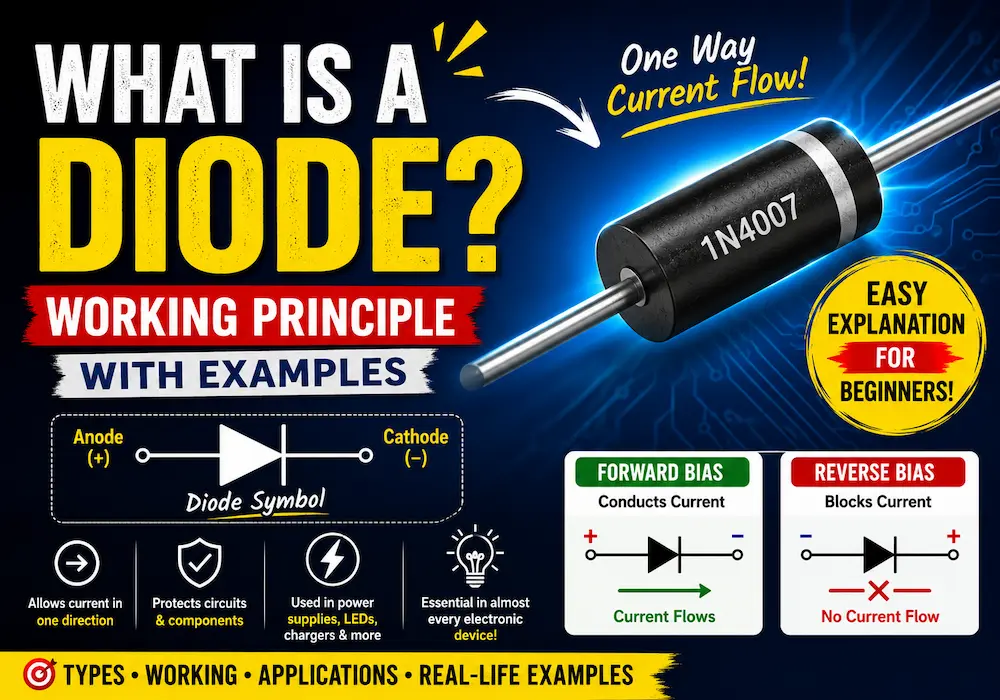
What is a Diode? Working Principle with Examples

What is a Diode? Working Principle with Examples
A diode is one of the most important electronic components used in modern electronics. From mobile chargers and LED lights to power supplies and solar systems, diodes are used everywhere. In simple words, a diode allows electric current to flow in only one direction and blocks it in the opposite direction.
In this article, you will learn what a diode is, how it works, its symbol, types, applications, and real-life examples in an easy-to-understand way.
Table of Contents
- What is a Diode?
- Diode Symbol & Structure
- Working Principle of Diode
- Forward Bias Condition
- Reverse Bias Condition
- Types of Diodes
- Applications of Diodes
- Real-Life Examples
- Advantages of Diodes
- Disadvantages of Diodes
- FAQs
- Conclusion
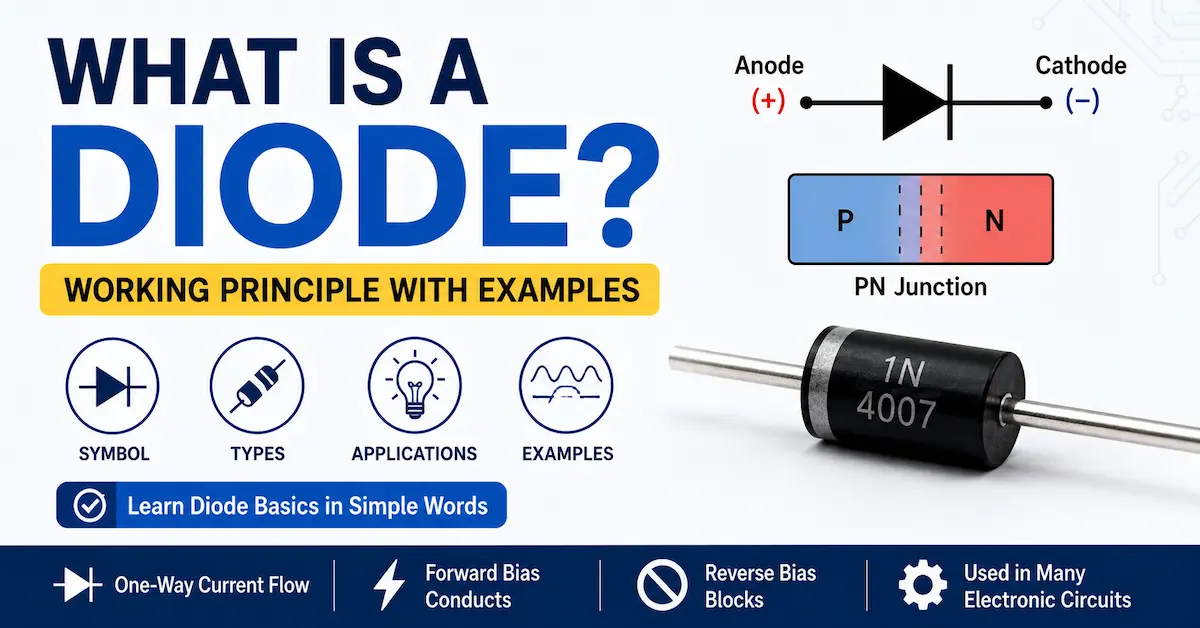
What is a Diode?
A diode is a two-terminal semiconductor device that acts like a one-way switch for electric current. It allows current to pass in one direction while blocking it in the opposite direction.
The two terminals of a diode are:
- Anode (+)
- Cathode (-)
Diodes are mainly made from semiconductor materials such as silicon or germanium.
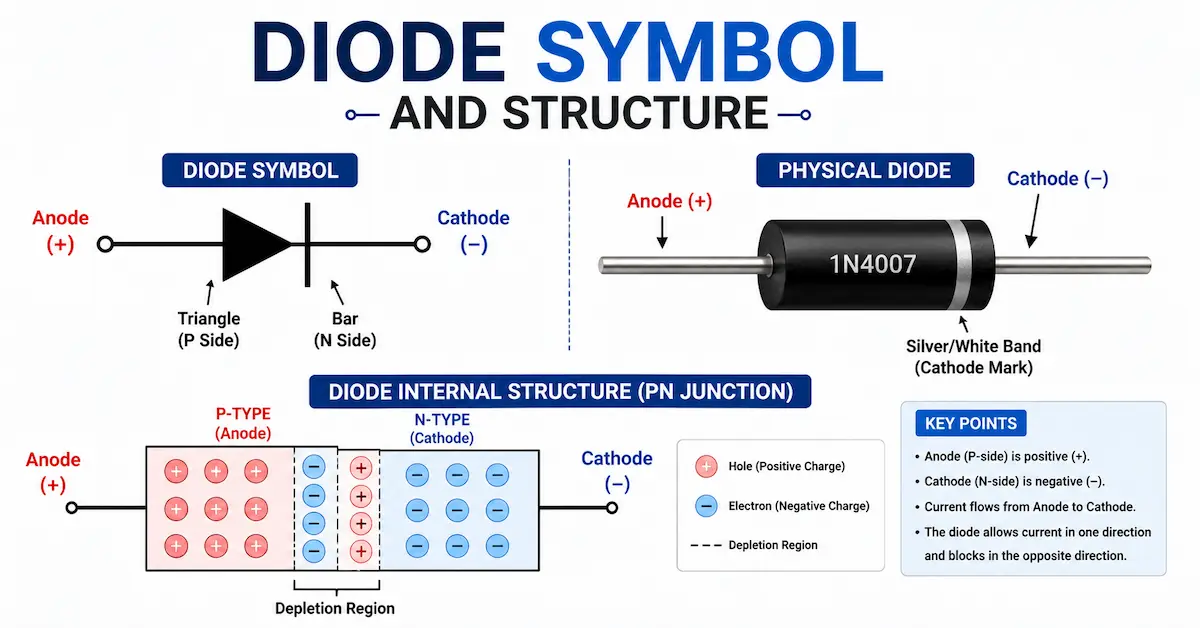
Diode Symbol & Structure
The diode symbol consists of an arrow-like triangle pointing toward a vertical line.
- The Anode side is positive.
- The Cathode side is negative.
The vertical line on the symbol represents the cathode terminal. In physical diodes, the cathode side is usually marked with a silver or white band.
A diode is formed by joining two semiconductor materials:
- P-type Semiconductor
- N-type Semiconductor
This junction is called a PN Junction.
Working Principle of Diode
The working principle of a diode is based on the behavior of the PN junction.
A diode works in two modes:
- Forward Bias
- Reverse Bias
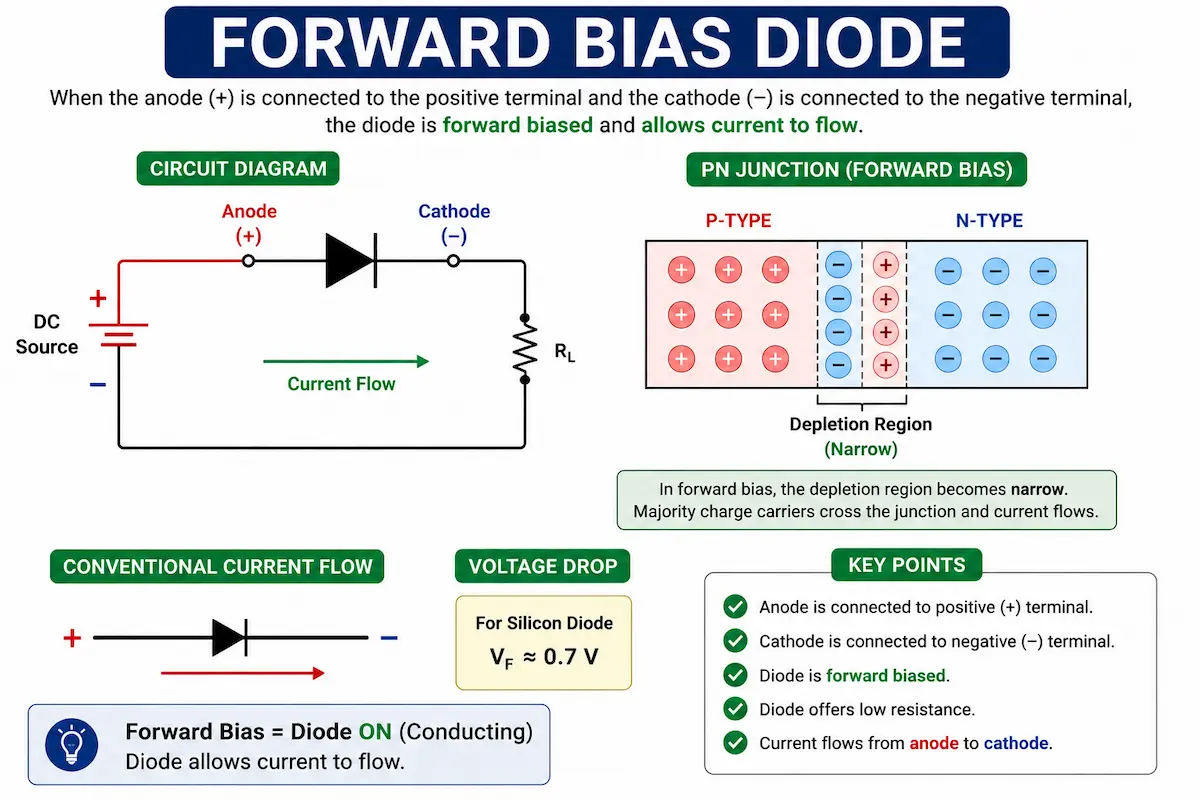
1. Forward Bias Condition
When the positive terminal of the battery is connected to the anode and the negative terminal is connected to the cathode, the diode becomes forward biased.
In this condition:
- The diode allows current flow.
- The resistance becomes very low.
- The circuit works normally.
Silicon diodes usually require about 0.7V to start conducting.
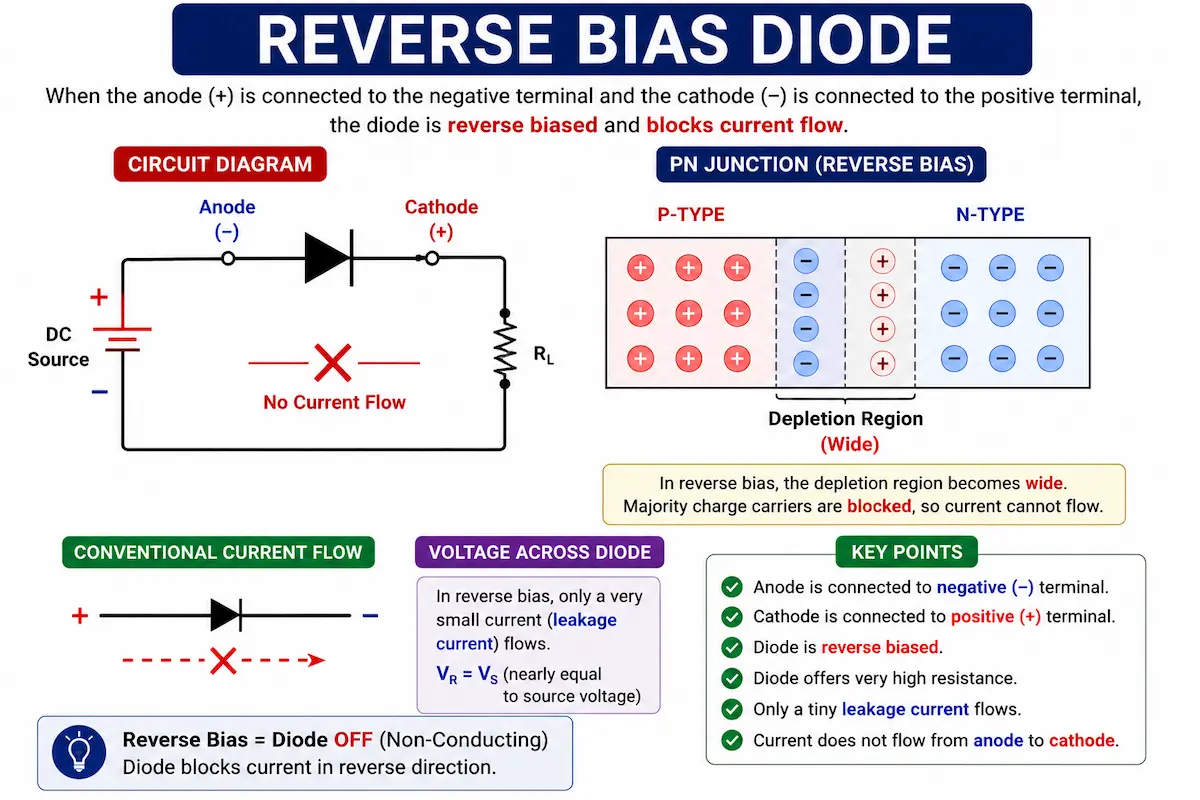
2. Reverse Bias Condition
When the positive terminal is connected to the cathode and the negative terminal is connected to the anode, the diode becomes reverse biased.
In this condition:
- The diode blocks current flow.
- The resistance becomes very high.
- The circuit acts like an open switch.
Types of Diodes
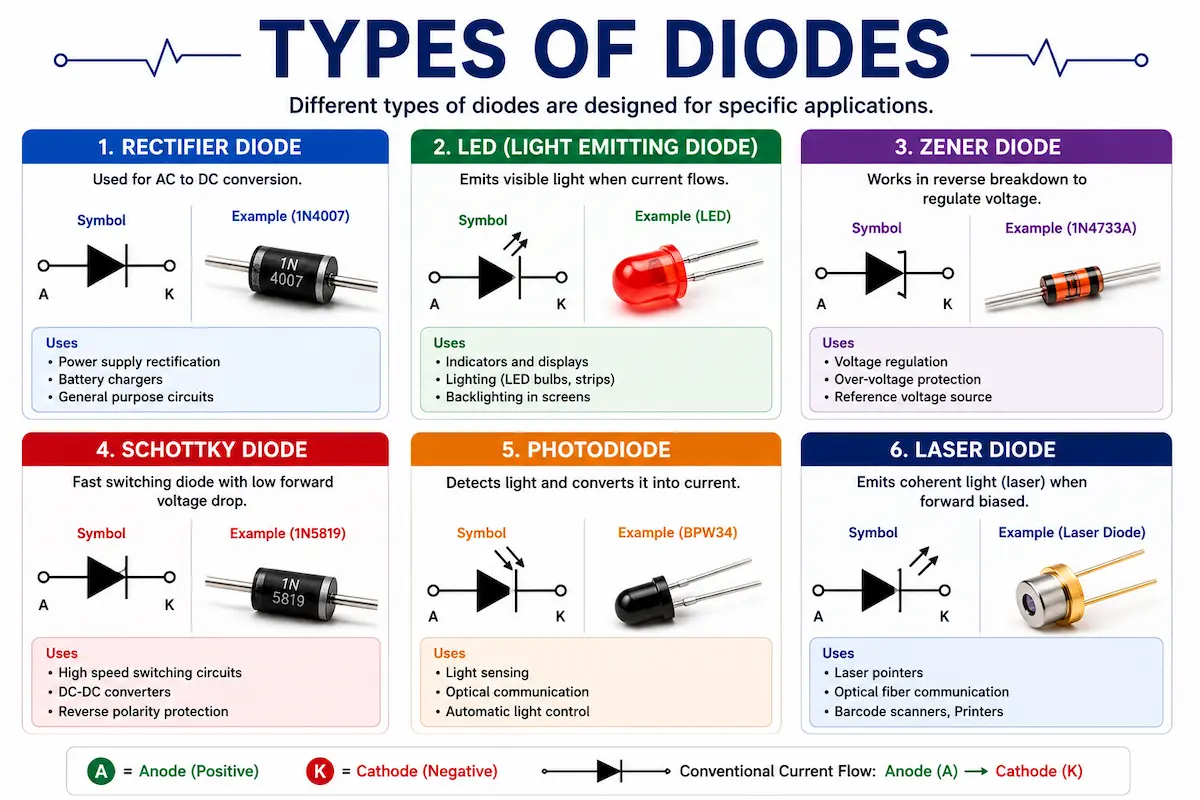
Different types of diodes are used for different applications.
| Diode Type | Main Use |
|---|---|
| Rectifier Diode | AC to DC conversion |
| LED (Light Emitting Diode) | Producing light |
| Zener Diode | Voltage regulation |
| Schottky Diode | High-speed switching |
| Photodiode | Light sensing |
| Laser Diode | Laser applications |
Applications of Diodes
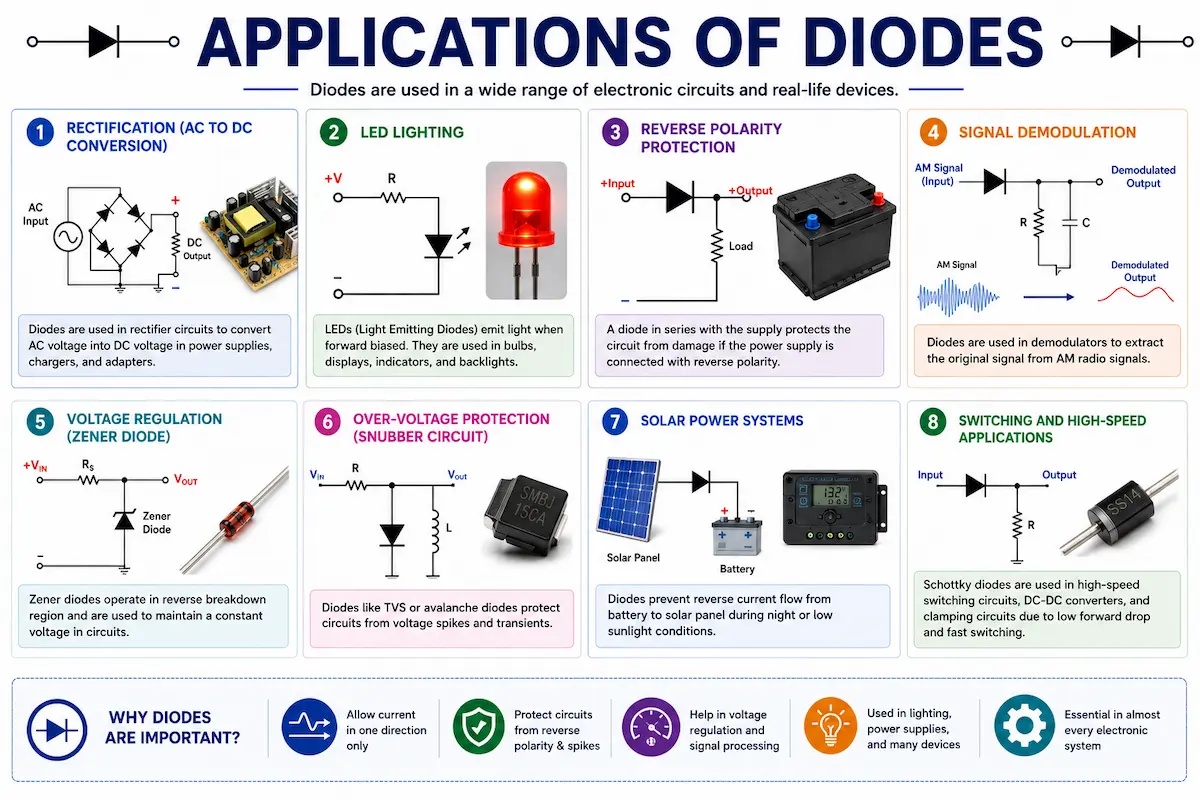
Diodes are used in almost every electronic circuit. Some common applications include:
- Power supply rectification
- LED lighting circuits
- Reverse polarity protection
- Signal demodulation
- Voltage regulation
- Solar charge controllers
- Mobile chargers
- TV and radio circuits
Real-Life Examples of Diodes
1. Mobile Phone Charger
Rectifier diodes convert AC electricity from the wall socket into DC electricity for charging your phone.
2. LED Bulbs
LEDs are special diodes that emit light when current flows through them.
3. Solar Panels
Diodes prevent reverse current flow from batteries to solar panels during nighttime.
4. Car Electronics
Diodes protect sensitive electronic circuits from reverse polarity damage.
Advantages of Diodes
- Small and lightweight
- Low cost
- High efficiency
- Fast switching speed
- Reliable operation
- Low power consumption
Disadvantages of Diodes
- Allow current only in one direction
- Can be damaged by high voltage
- Temperature-sensitive performance
- Voltage drop occurs during conduction
Frequently Asked Questions (FAQs)
What is the main function of a diode?
The main function of a diode is to allow current flow in one direction and block it in the opposite direction.
Why is a diode called a one-way switch?
A diode behaves like a one-way switch because it permits current in forward bias and blocks it in reverse bias.
What are diodes made of?
Most diodes are made using semiconductor materials like silicon and germanium.
What is the difference between LED and normal diode?
An LED emits light when current flows through it, while a normal diode mainly controls current direction.
What is diode forward voltage?
The forward voltage of a silicon diode is typically around 0.7V.
Conclusion
A diode is a fundamental semiconductor device used in almost every electronic circuit. It works as a one-way valve for electric current and plays a major role in power supplies, LED lighting, protection circuits, and communication systems.
Understanding the working principle of diodes is very important for beginners in electronics and Arduino projects. Once you learn how a diode works, it becomes easier to understand many other electronic components and circuits.
You May Also Like
- What is an LED? How It Works and How to Use It
- What is a Transistor? NPN vs PNP Explained Simply
- What is a Resistor? Types, Uses & Color Code Explained
- What is a Capacitor? Working, Types & Applications
- Common Electronic Components Every Beginner Should Know
- What is Ohm’s Law? Explained with Examples