

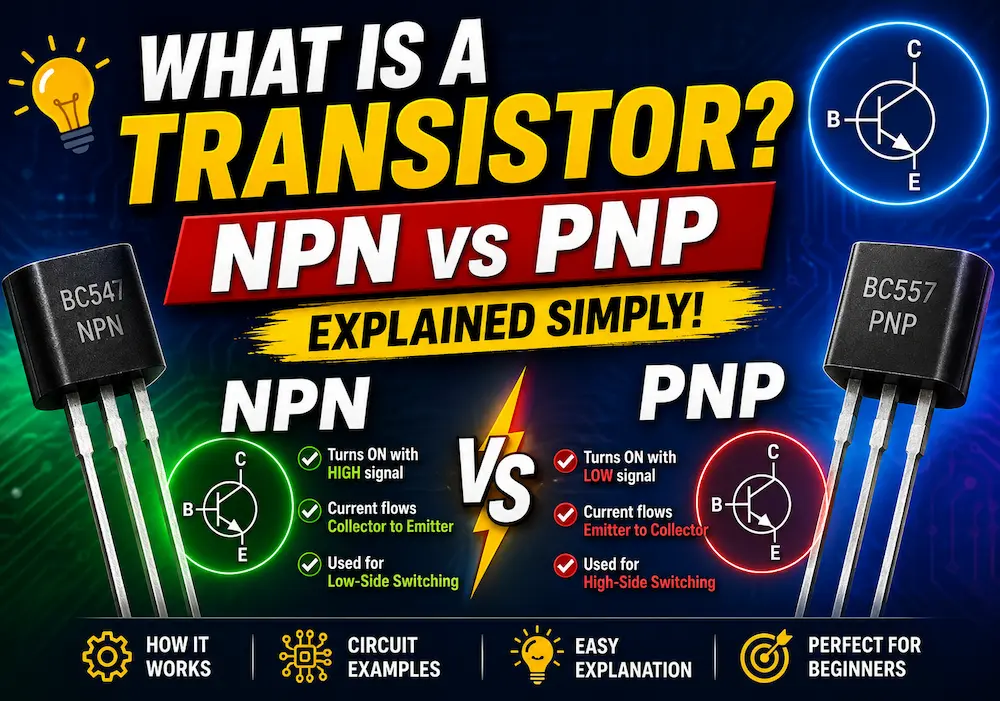
What is a Transistor? NPN vs PNP Explained Simply

What is a Transistor? NPN vs PNP Explained Simply
A transistor is one of the most important electronic components used in modern circuits. It can work as an electronic switch or as a signal amplifier. From Arduino projects to smart switches, LED drivers, audio circuits, and power control systems, transistors are used almost everywhere.
In this beginner-friendly guide, you will learn what a transistor is, how it works, and the simple difference between NPN and PNP transistors.
What is a Transistor?
A transistor is a semiconductor device that controls the flow of current in an electronic circuit. It has three terminals and can control a large current using a small current or voltage signal.
In simple words, a transistor works like an automatic electronic switch. When a small signal is applied to its control pin, it allows current to flow through the main circuit.
Transistor Terminals
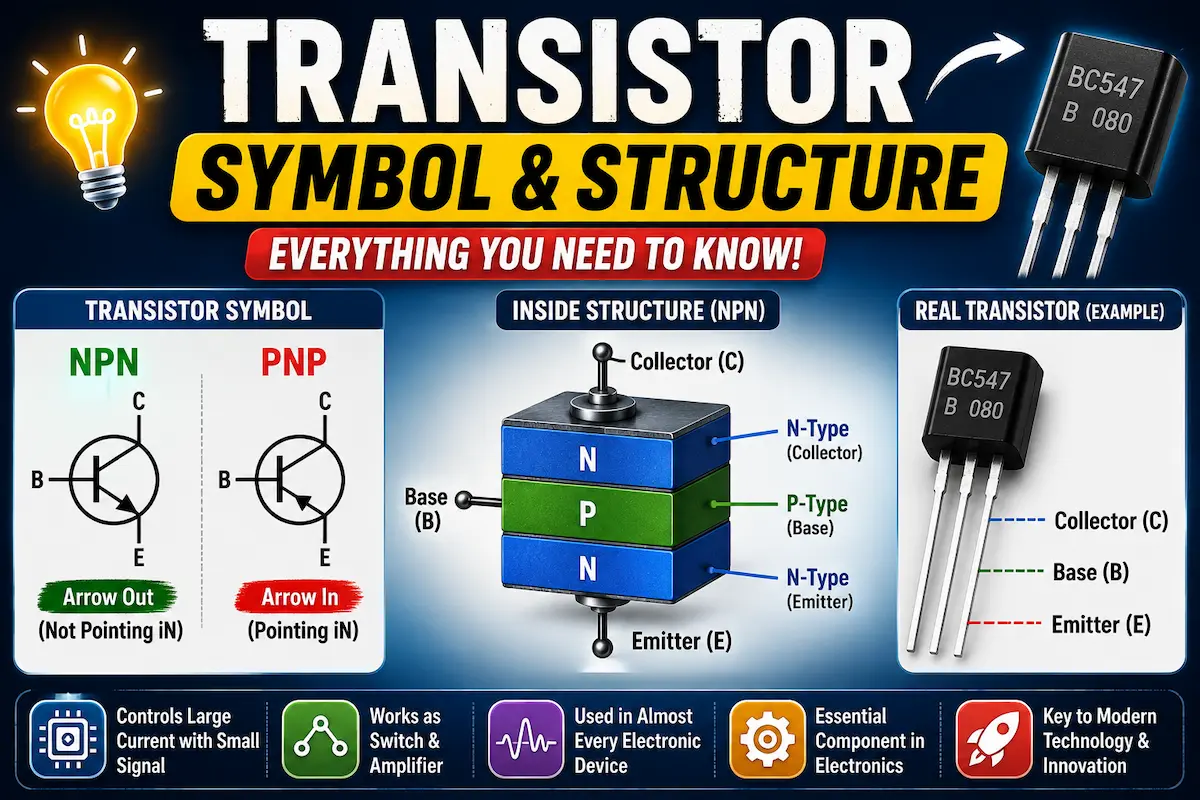
A basic BJT transistor has three terminals:
| Terminal | Full Form | Function |
|---|---|---|
| Base | B | Controls the transistor |
| Collector | C | Receives the main current |
| Emitter | E | Sends current out of the transistor |
The Base is like a control gate. A small current at the base can control a larger current between the collector and emitter.
How Does a Transistor Work?
A transistor works by using a small input signal to control a larger output current. When the base receives enough voltage, the transistor turns ON and allows current to flow. When the base does not receive enough voltage, the transistor remains OFF.
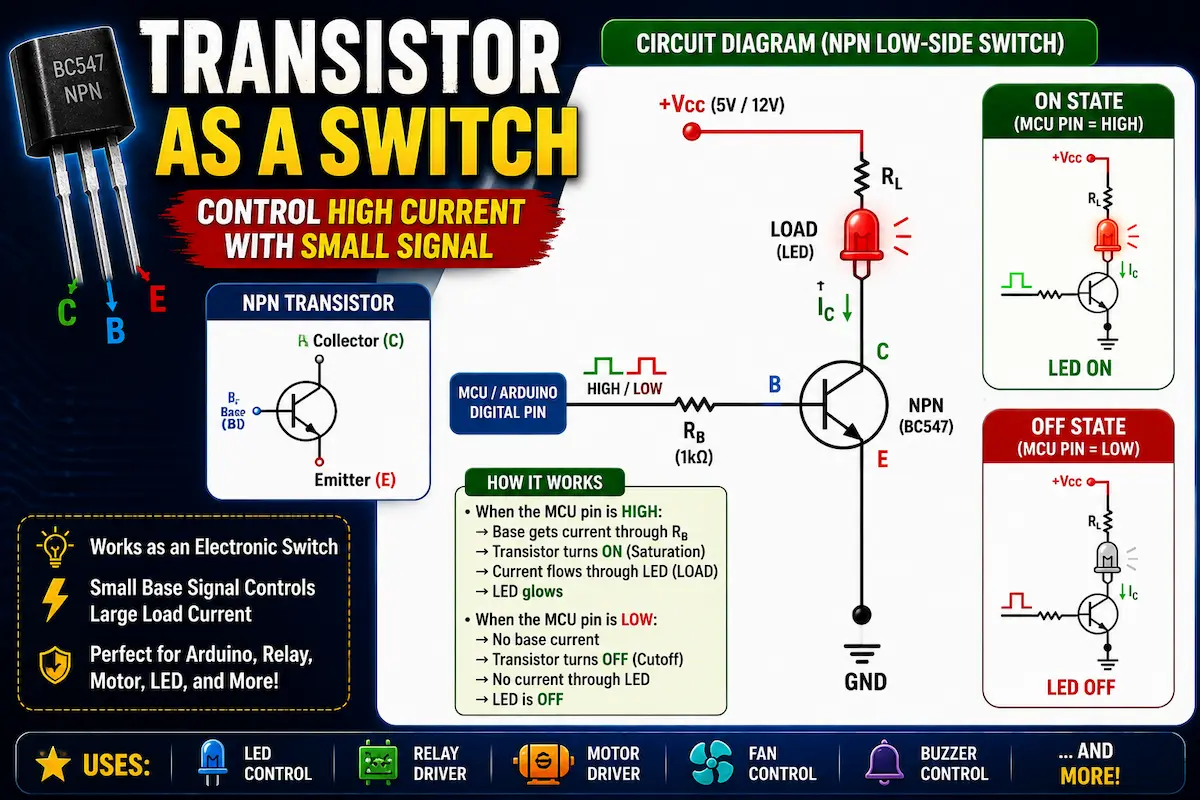
Transistor as a Switch
When used as a switch, a transistor has two states:
- OFF State: No base signal, no current flow through the load.
- ON State: Base signal applied, current flows through the load.
This is very useful in Arduino and microcontroller projects because Arduino pins cannot directly drive high-current loads like relays, motors, or high-power LEDs. A transistor helps control these loads safely.
Types of Transistors
There are many types of transistors, but the most common beginner-level transistor is the BJT, which stands for Bipolar Junction Transistor.
BJT transistors are mainly divided into two types:
- NPN Transistor
- PNP Transistor
What is an NPN Transistor?
An NPN transistor is a type of transistor in which current flows from the collector to the emitter when a positive voltage is applied to the base.
NPN transistors are very commonly used in electronics projects because they are easy to control using microcontrollers like Arduino, ESP32, and Raspberry Pi Pico.
NPN Transistor Working
In an NPN transistor:
- The emitter is usually connected to ground.
- The load is connected between positive supply and collector.
- A positive signal is applied to the base through a resistor.
- When the base gets voltage, the transistor turns ON.

What is a PNP Transistor?
A PNP transistor is a type of transistor in which current flows from the emitter to the collector when the base voltage is lower than the emitter voltage.
PNP transistors are commonly used in high-side switching circuits where the load needs to be connected to ground and switched from the positive supply side.
PNP Transistor Working
In a PNP transistor:
- The emitter is connected to positive voltage.
- The load is connected between collector and ground.
- The transistor turns ON when the base is pulled LOW.
- The transistor turns OFF when the base is HIGH.

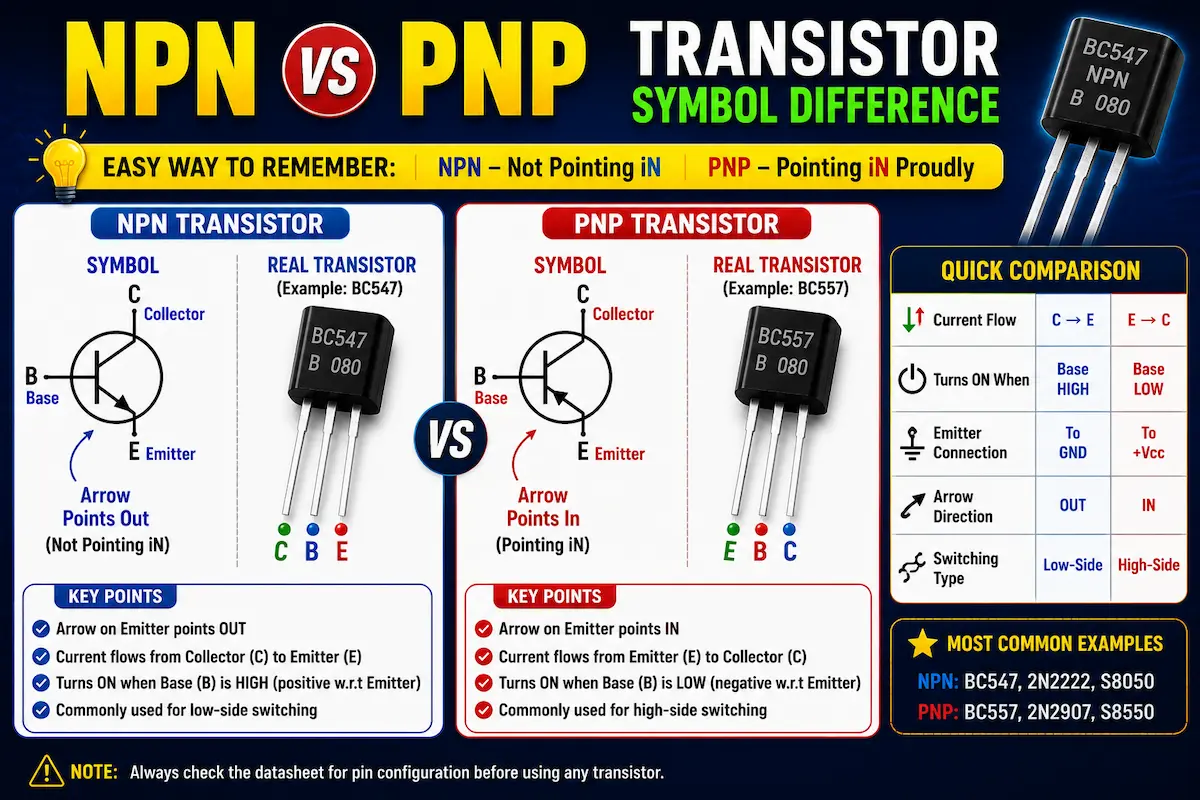
NPN vs PNP Transistor: Simple Difference
| Feature | NPN Transistor | PNP Transistor |
|---|---|---|
| Current Flow | Collector to Emitter | Emitter to Collector |
| Turns ON When | Base is positive | Base is negative or LOW |
| Common Use | Low-side switching | High-side switching |
| Emitter Connection | Usually connected to ground | Usually connected to positive supply |
| Arduino Friendly | Very easy to use | Needs careful circuit design |
| Symbol Arrow | Arrow points outward | Arrow points inward |
Easy Trick to Remember NPN and PNP
Here is a simple way to remember transistor symbols:
- NPN: Arrow is Not Pointing iN
- PNP: Arrow is Pointing iN Proudly
This arrow is shown on the emitter terminal of the transistor symbol.
Common Transistor Examples
| Transistor | Type | Common Use |
|---|---|---|
| BC547 | NPN | Small signal switching and amplification |
| 2N2222 | NPN | LED, relay, and motor driver circuits |
| S8050 | NPN | General-purpose switching |
| BC557 | PNP | Small signal PNP switching |
| 2N2907 | PNP | General-purpose PNP transistor circuits |
Transistor as an Amplifier
A transistor can also work as an amplifier. In amplifier mode, a small input signal applied to the base is converted into a larger output signal at the collector.
This is useful in:
- Audio amplifier circuits
- Microphone circuits
- Radio frequency circuits
- Sensor signal amplification
Transistor as a Switch in Arduino Projects
In DIY electronics, transistors are often used with Arduino to control devices that need more current than an Arduino pin can provide.
For example, you can use an NPN transistor to control:
- LED strips
- Relays
- DC motors
- Buzzers
- Small fans
- Solenoids
Basic NPN Transistor LED Circuit
In this circuit, an Arduino output pin controls the base of the transistor through a resistor. When the Arduino pin becomes HIGH, the transistor turns ON and the LED lights up.

Why Do We Use a Base Resistor?
A base resistor is very important because it limits the current going into the transistor base. Without a base resistor, too much current can flow from the microcontroller pin and damage the transistor or Arduino.
Common base resistor values are:
- 1kΩ
- 2.2kΩ
- 4.7kΩ
- 10kΩ
For most simple Arduino switching projects, a 1kΩ to 4.7kΩ base resistor works well.
Applications of Transistors
Transistors are used in almost every electronic device. Some common applications include:
- Electronic switching circuits
- Signal amplification
- Motor driver circuits
- Relay driver circuits
- LED dimming circuits
- Audio amplifier circuits
- Power supply circuits
- Oscillator circuits
- Logic circuits
- Smart home automation circuits

NPN or PNP: Which One Should You Use?
For beginners and Arduino projects, an NPN transistor is usually easier to use. It works well for low-side switching, where the transistor is placed between the load and ground.
Use a PNP transistor when you need high-side switching, where the transistor controls the positive supply side of the load.
Simple Recommendation
- For Arduino LED, relay, and motor control: use NPN transistor.
- For switching positive supply lines: use PNP transistor.
- For higher power loads: consider using a MOSFET instead of a BJT transistor.
Important Safety Tips
- Always use a base resistor with a transistor.
- Check the transistor pinout before connecting it.
- Do not exceed the maximum collector current rating.
- Use a flyback diode when controlling relays or motors.
- Use a heat sink for high-power transistor circuits.
- Check the datasheet before using any transistor.
Frequently Asked Questions
What is the main function of a transistor?
The main function of a transistor is to control current. It can work as a switch or as an amplifier in electronic circuits.
What is the difference between NPN and PNP transistors?
An NPN transistor turns ON when a positive voltage is applied to the base, while a PNP transistor turns ON when the base is pulled LOW compared to the emitter.
Which transistor is best for Arduino projects?
For most Arduino beginner projects, an NPN transistor like BC547 or 2N2222 is commonly used for switching LEDs, relays, buzzers, and small motors.
Why is a resistor used at the transistor base?
A base resistor limits current flowing into the base terminal and protects both the transistor and the microcontroller pin.
Can a transistor control a motor?
Yes, a transistor can control a small DC motor. For motors and relays, you should also use a flyback diode to protect the transistor from voltage spikes.
Conclusion
A transistor is a powerful and useful electronic component that can work as a switch or amplifier. The two most common BJT transistor types are NPN and PNP. NPN transistors are easier for beginners and are widely used in Arduino and DIY electronics projects, while PNP transistors are useful for high-side switching.
If you are learning electronics, understanding transistors is an important step. Once you understand how a transistor works, you can build many useful circuits such as LED controllers, relay drivers, motor drivers, smart switches, and sensor-based automation projects.








One thought on “What is a Transistor? NPN vs PNP Explained Simply”