

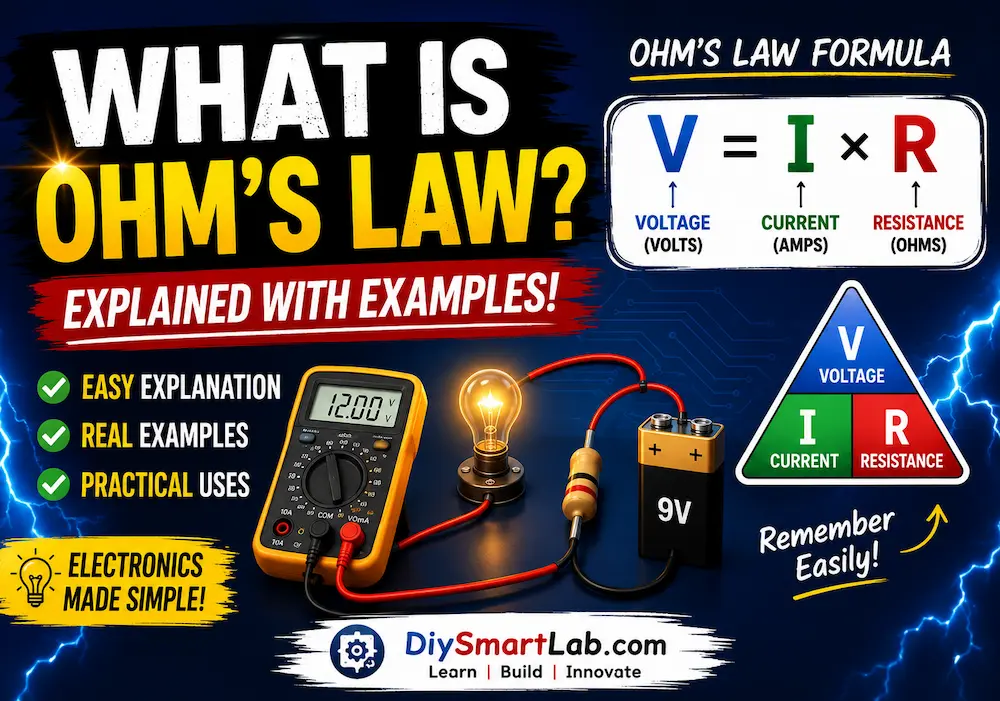

What is Ohm’s Law? Explained with Examples
Ohm’s Law is one of the most important basic laws in electronics and electrical engineering. It explains the relationship between Voltage (V), Current (I), and Resistance (R) in an electrical circuit. Whether you are learning electronics for the first time or building Arduino projects, understanding Ohm’s Law is essential.
In this beginner-friendly guide by DiySmartLab.com, you will learn what Ohm’s Law is, its formula, practical examples, real-life applications, and how to use it in electronics projects.
What is Ohm’s Law?
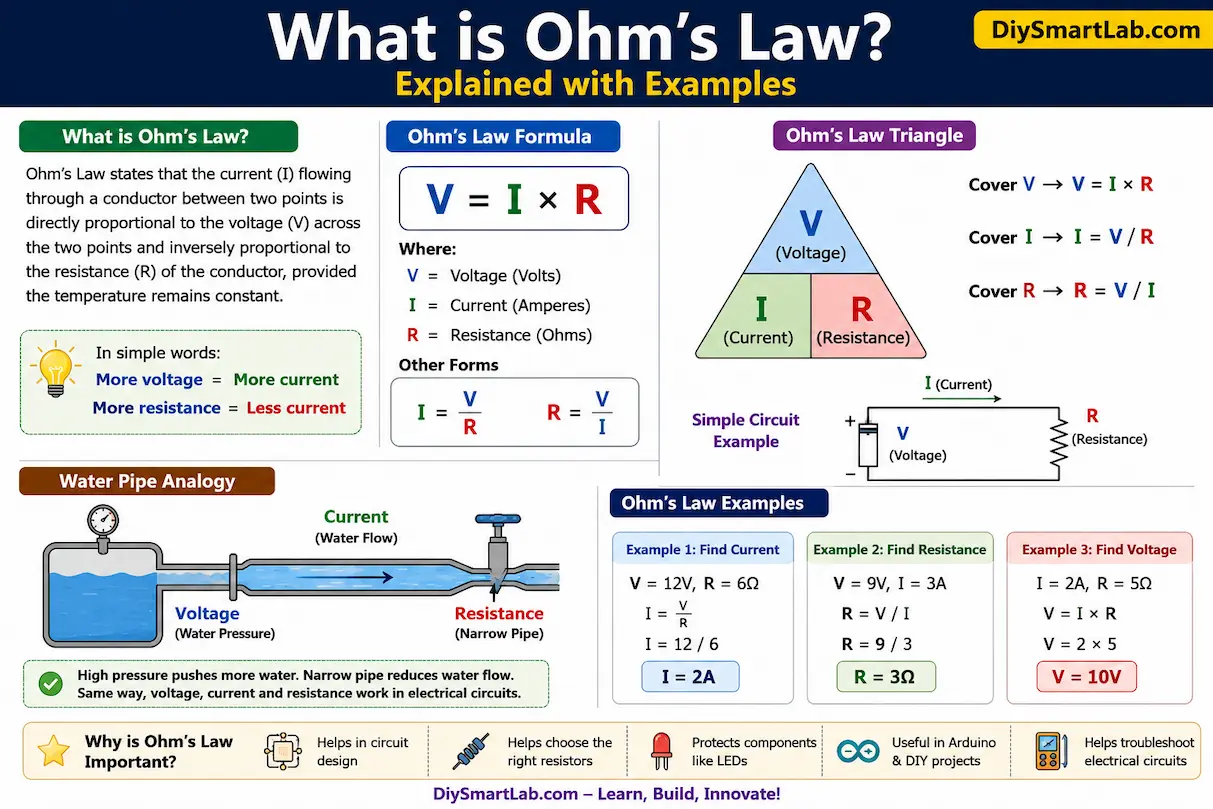
Ohm’s Law states that the current flowing through a conductor is directly proportional to the voltage and inversely proportional to the resistance, provided the temperature remains constant.
Ohm’s Law Formula:
V = I × R
- V = Voltage (Volts)
- I = Current (Amperes)
- R = Resistance (Ohms)
This formula helps calculate voltage, current, or resistance in any electrical circuit.
Ohm’s Law Triangle Formula
The Ohm’s Law triangle is a simple memory trick used by beginners to remember the formula relationships.
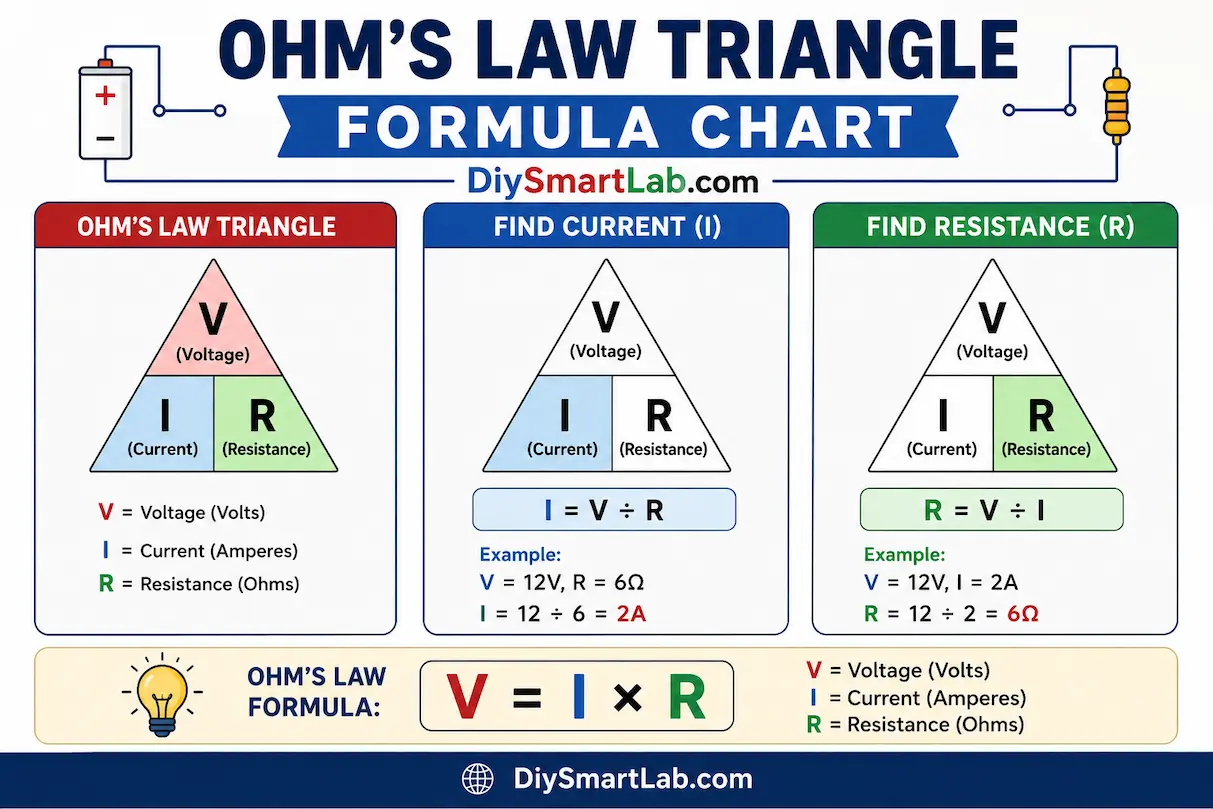
- V = I × R
- I = V ÷ R
- R = V ÷ I
How Ohm’s Law Works
Ohm’s Law explains how electricity behaves in a circuit:
- Increasing voltage increases current.
- Increasing resistance decreases current.
- Low resistance allows more current flow.
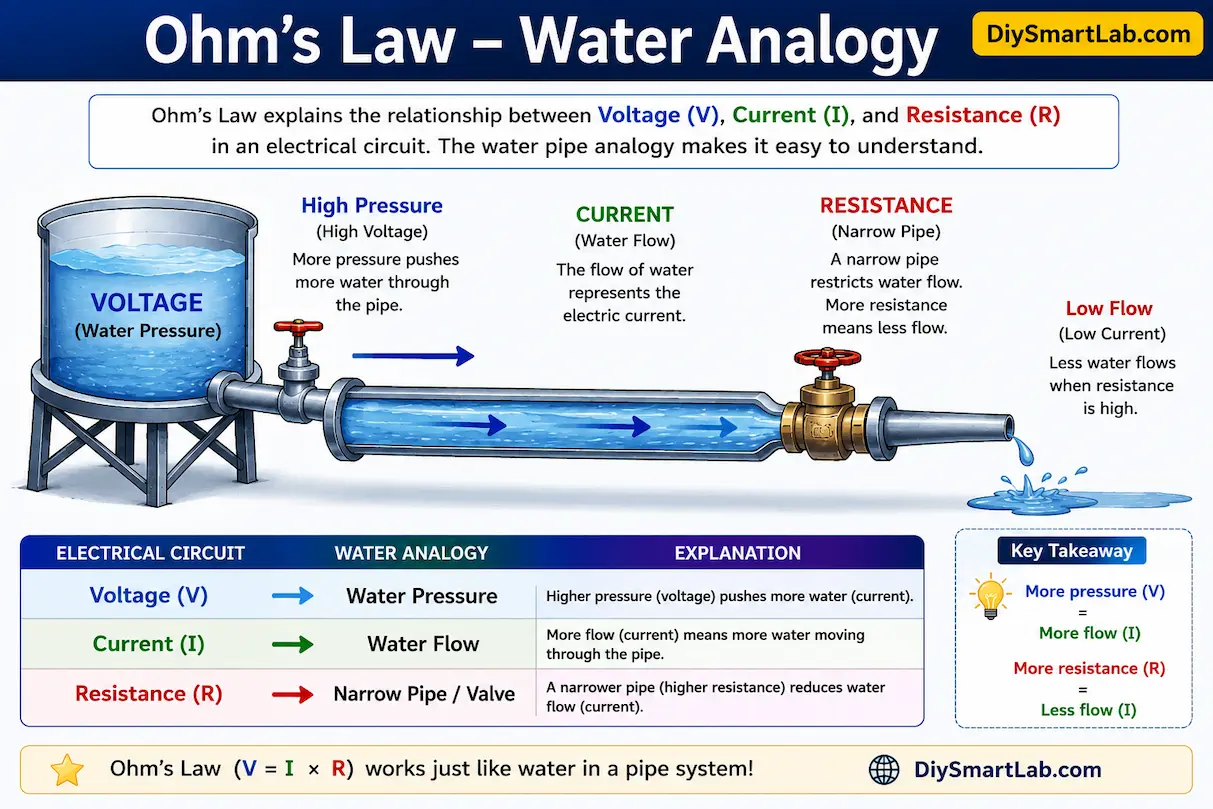
You can compare electricity flow to water flowing through a pipe:
- Voltage = Water pressure
- Current = Water flow rate
- Resistance = Narrowness of the pipe
Ohm’s Law Examples
Example 1: Finding Current
A circuit has:
- Voltage = 12V
- Resistance = 6Ω
Using Ohm’s Law:
I = V ÷ R
I = 12 ÷ 6
I = 2A
The current flowing through the circuit is 2 Amps.
Example 2: Finding Resistance
A bulb operates at:
- Voltage = 9V
- Current = 0.5A
Using the formula:
R = V ÷ I
R = 9 ÷ 0.5
R = 18Ω
The resistance of the bulb is 18 Ohms.
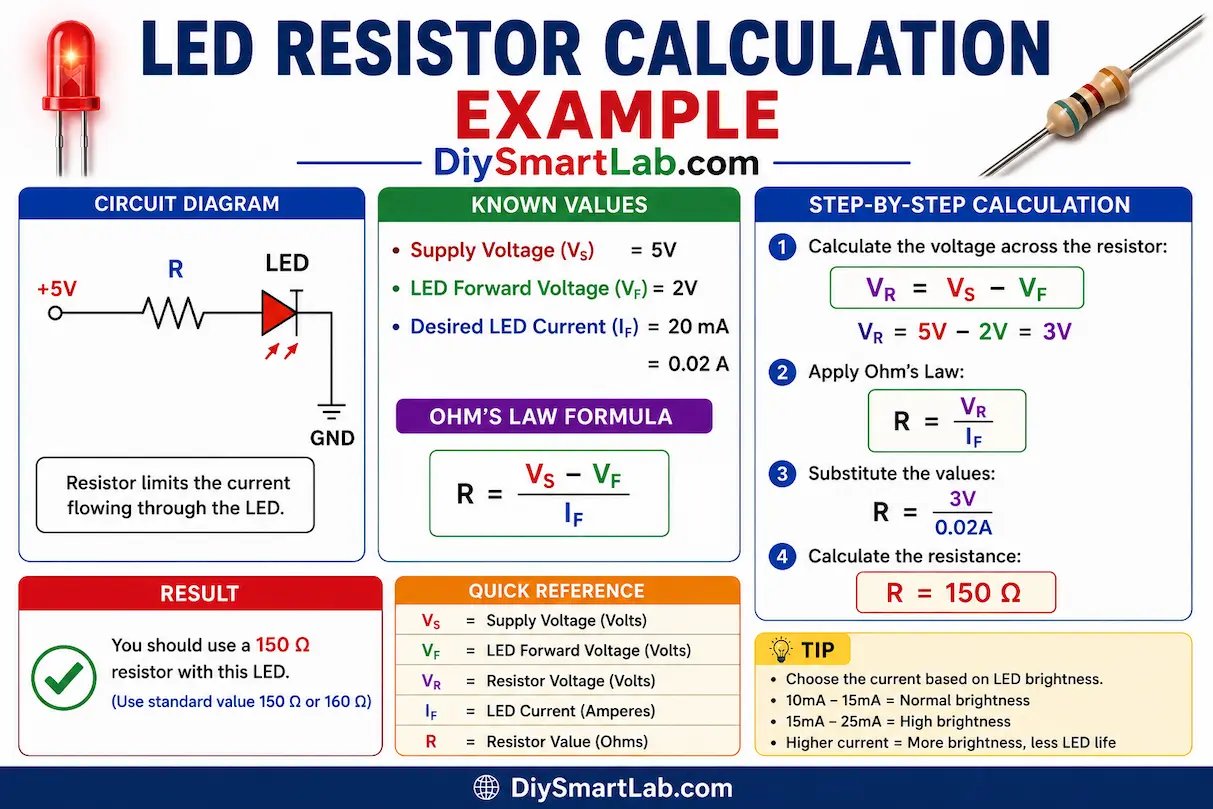
Example 3: LED Resistor Calculation
Suppose you want to connect an LED to a 5V Arduino pin.
- Supply Voltage = 5V
- LED Voltage Drop = 2V
- Desired Current = 20mA (0.02A)
Using Ohm’s Law:
R = (5V − 2V) ÷ 0.02
R = 150Ω
You should use a 150 Ohm resistor with the LED.
Applications of Ohm’s Law
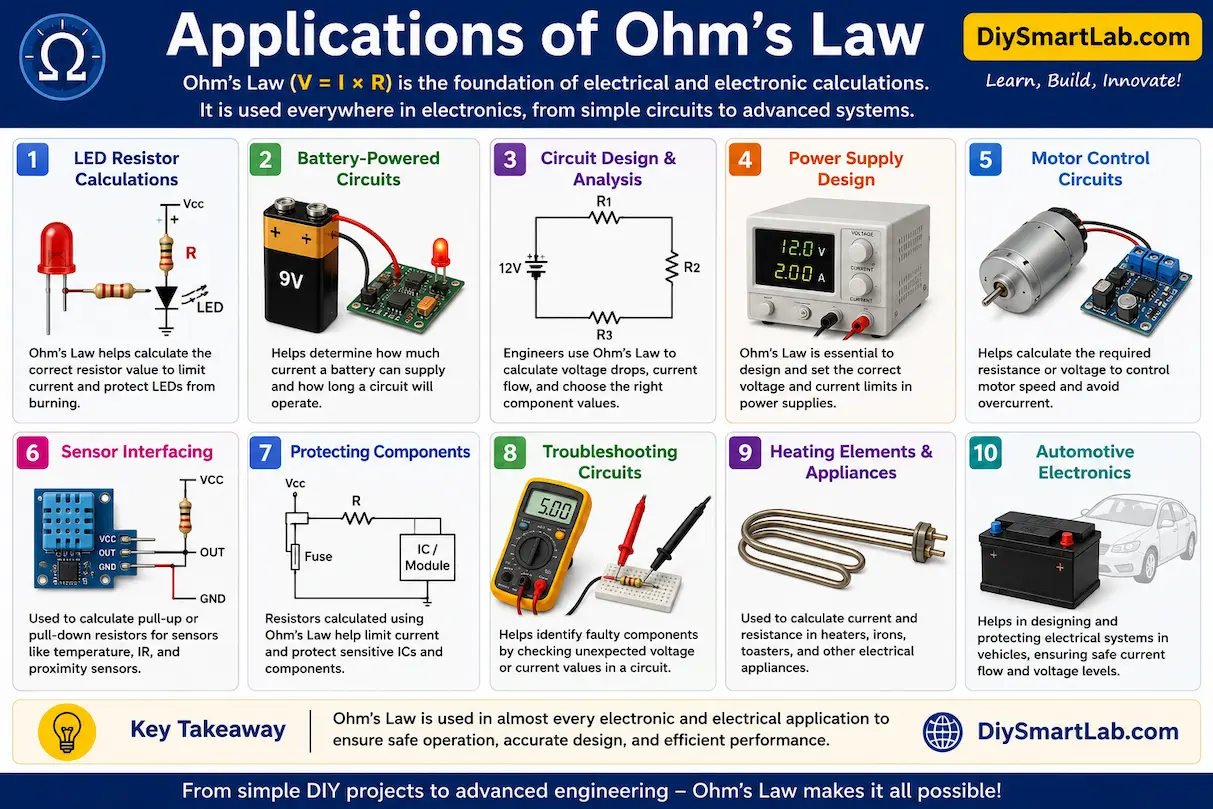
Ohm’s Law is used in almost every electrical and electronics project.
- LED resistor calculations
- Arduino projects
- Power supply circuits
- Battery-powered devices
- Home electrical systems
- Electronic troubleshooting
- Current limiting circuits
- Sensor and relay circuits
Advantages of Ohm’s Law
- Simple and easy to understand
- Helps calculate unknown electrical values
- Useful in circuit design and troubleshooting
- Essential for beginners learning electronics
- Widely used in Arduino and DIY projects
Limitations of Ohm’s Law
- Only works for linear components
- Does not apply to semiconductors like diodes and transistors in all conditions
- Temperature changes can affect resistance
Tips for Beginners
- Always check resistor values before connecting LEDs.
- Use a multimeter to measure voltage and current.
- Learn Ohm’s Law formulas by practicing simple calculations.
- Start with low-voltage circuits for safety.
- Use proper resistors in Arduino projects to avoid damaging components.
Frequently Asked Questions (FAQs)
Why is Ohm’s Law important?
Ohm’s Law helps understand and calculate voltage, current, and resistance in electrical circuits.
Who discovered Ohm’s Law?
Ohm’s Law was discovered by German physicist Georg Simon Ohm.
What is the unit of resistance?
The unit of resistance is Ohm (Ω).
Can Ohm’s Law be used in Arduino projects?
Yes, Ohm’s Law is commonly used in Arduino circuits for selecting resistors and calculating current flow.
What happens if resistance increases?
If resistance increases while voltage remains constant, the current decreases.
Conclusion
Ohm’s Law is the foundation of electronics and electrical engineering. It explains the relationship between voltage, current, and resistance in a simple mathematical way. Understanding this law helps beginners design circuits, troubleshoot problems, and build safe electronics projects.
If you are starting your electronics journey, mastering Ohm’s Law is one of the first and most important steps. Keep practicing calculations and experimenting with simple circuits to improve your skills.











2 thoughts on “What is Ohm’s Law? Explained with Examples”