

Difference Between AC and DC Current | Easy Beginner Guide

Difference Between AC and DC Current – Explained for Beginners
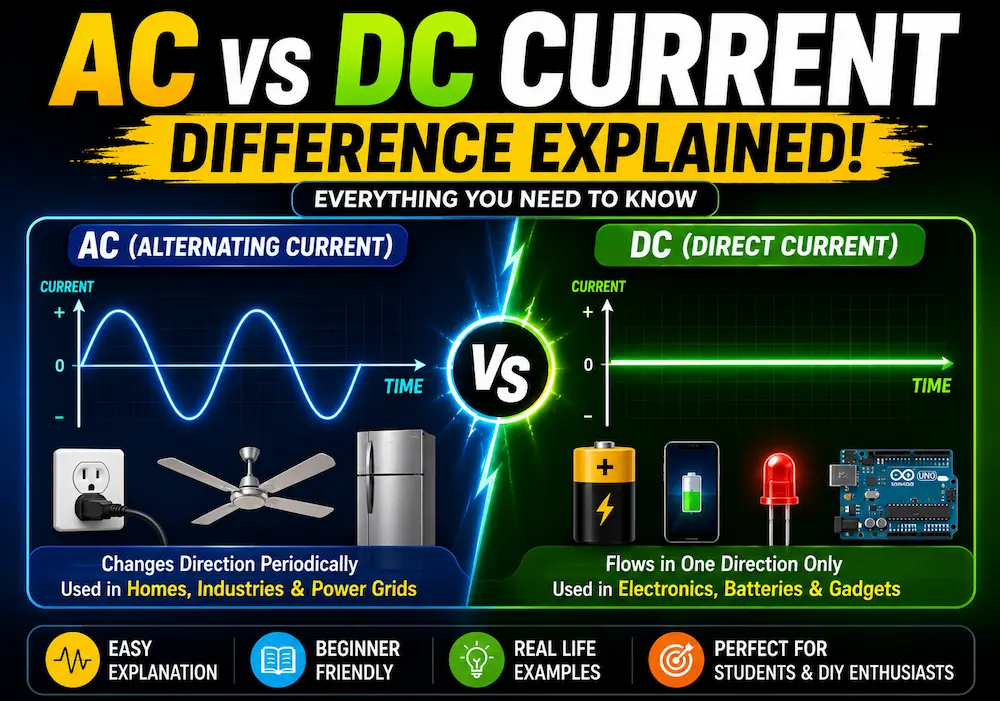
Electricity powers almost every electronic device around us, from smartphones and LEDs to refrigerators and industrial machines. But did you know that electricity mainly exists in two forms: AC (Alternating Current) and DC (Direct Current)? Understanding the difference between AC and DC current is one of the most important basics in electronics and electrical engineering.
In this beginner-friendly guide by DiySmartLab.com, you will learn what AC and DC current are, how they work, their advantages, applications, and the key differences between them.
What is Electric Current?
Electric current is the flow of electric charge (electrons) through a conductor such as a wire. It is measured in Amperes (A). Depending on the direction of electron flow, electric current is divided into two types:
- AC (Alternating Current)
- DC (Direct Current)
What is AC (Alternating Current)?
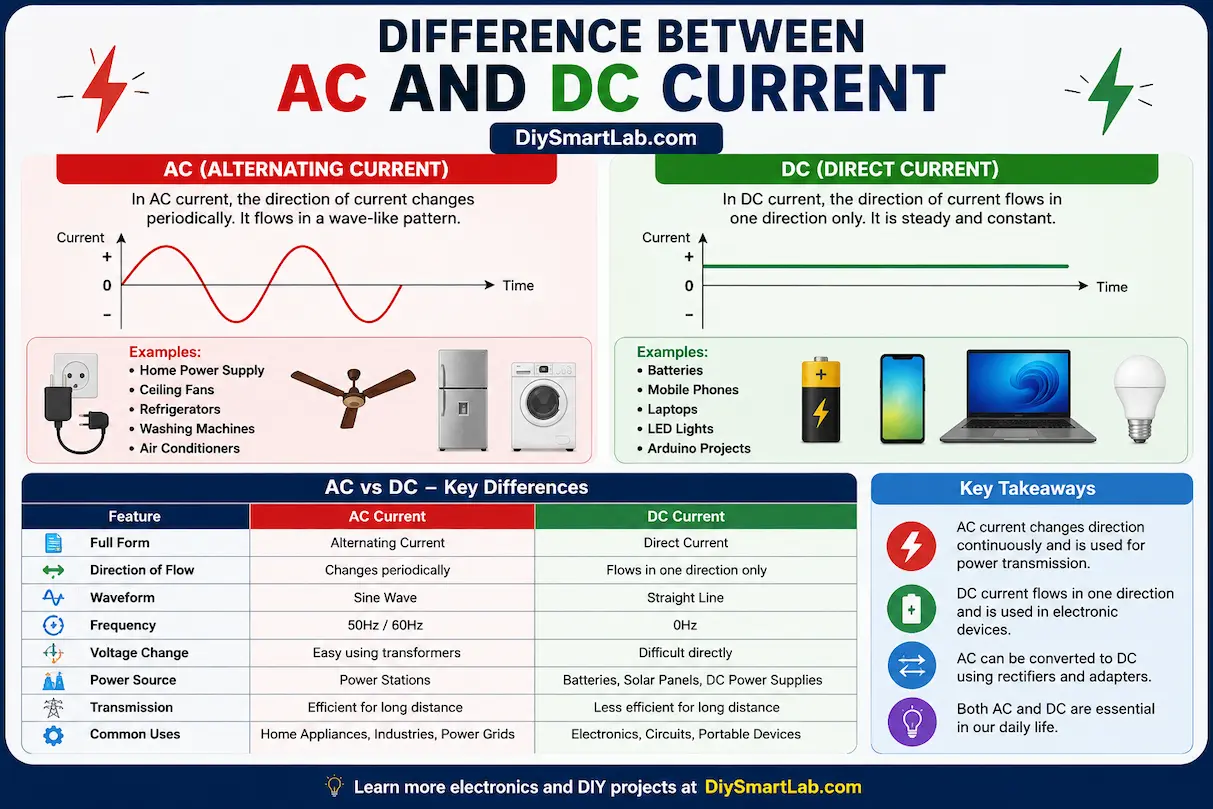
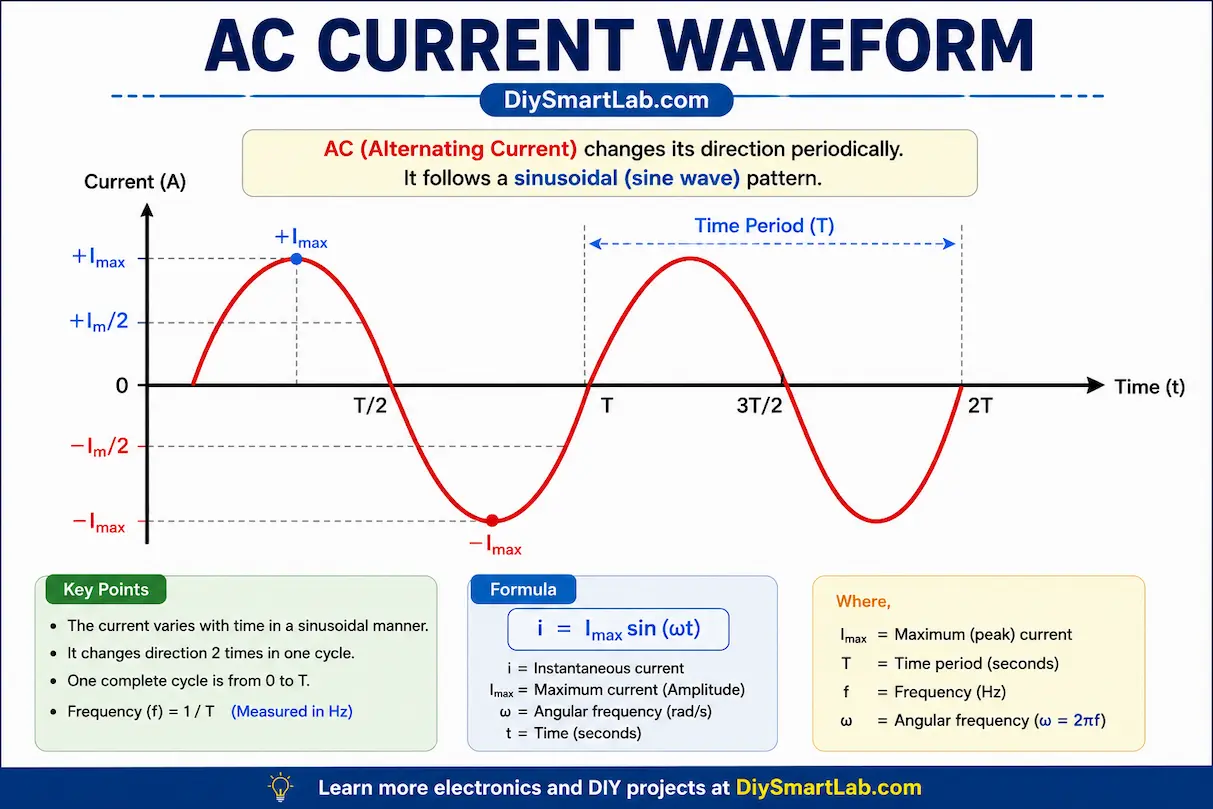
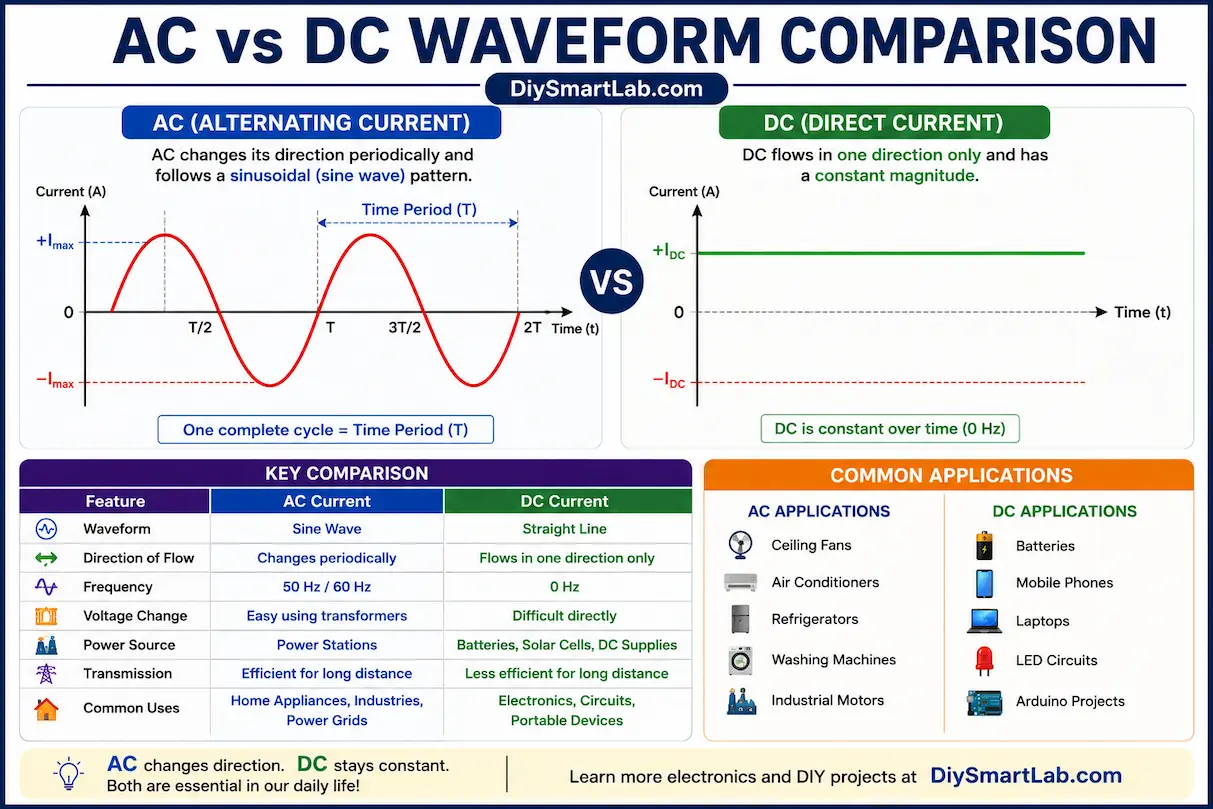
Alternating Current (AC) is a type of electricity in which the direction of current changes continuously. In most countries, AC power changes direction 50 or 60 times every second.
AC electricity is commonly used in homes, offices, schools, and industries because it can travel long distances efficiently.
Features of AC Current
- Direction changes continuously
- Usually generated by power stations
- Easy to increase or decrease voltage using transformers
- Efficient for long-distance power transmission
- Common frequency: 50Hz or 60Hz
Examples of AC Devices
- Ceiling Fans
- Refrigerators
- Air Conditioners
- Washing Machines
- Home Power Supply
What is DC (Direct Current)?
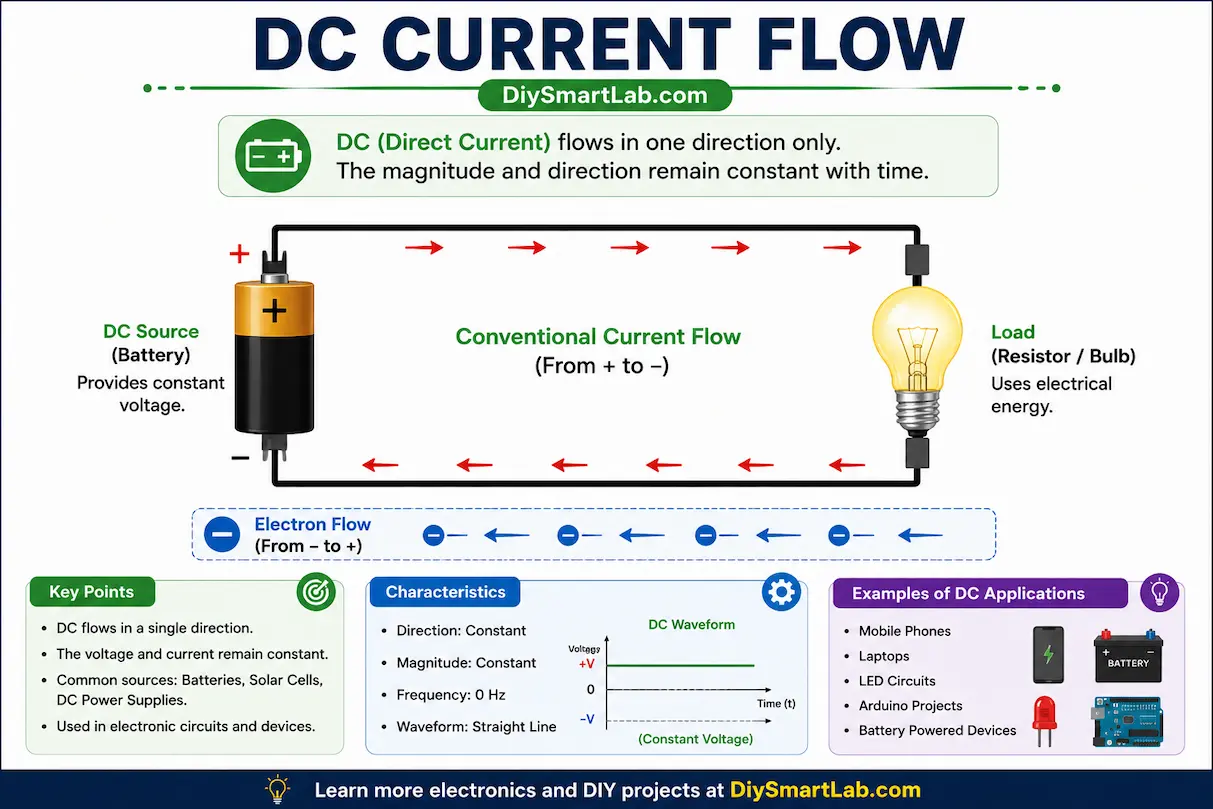
Direct Current (DC) is a type of electricity in which the current flows in only one direction. DC power is commonly produced by batteries, solar panels, and USB power supplies.
Most electronic circuits and Arduino projects use DC current.
Features of DC Current
- Flows in a single direction
- Provides stable voltage
- Used in low-voltage electronics
- Stored easily in batteries
- Ideal for electronic circuits and sensors
Examples of DC Devices
- Mobile Phones
- Laptops
- Arduino Boards
- LED Circuits
- Battery-Powered Devices
Main Difference Between AC and DC Current
| Feature | AC Current | DC Current |
|---|---|---|
| Full Form | Alternating Current | Direct Current |
| Direction of Flow | Changes periodically | Flows in one direction |
| Waveform | Sine Wave | Straight Line |
| Voltage Change | Easy using transformers | Difficult directly |
| Power Source | Power Stations | Batteries, Solar Panels |
| Transmission | Efficient for long distance | Less efficient for long distance |
| Common Uses | Home Appliances | Electronics & Circuits |
| Frequency | 50Hz / 60Hz | 0Hz |
AC vs DC Waveform Explained
AC current forms a wave because the direction changes continuously. DC current remains constant and flows steadily in one direction.
Advantages of AC Current
- Efficient long-distance power transmission
- Easy voltage conversion using transformers
- Lower power loss during transmission
- Used widely in homes and industries
Advantages of DC Current
- Stable and constant voltage
- Perfect for electronic circuits
- Can be stored in batteries
- Used in portable devices
Applications of AC Current
- Home electricity supply
- Industrial motors
- Power grids
- Air conditioners and refrigerators
- Large electrical machines
Applications of DC Current
- Arduino and microcontroller projects
- Battery-powered devices
- LED lighting circuits
- Solar power systems
- Mobile chargers and USB devices
Why Do Homes Use AC Instead of DC?
Homes use AC electricity because it can be transmitted over long distances with lower energy loss. Power companies can also easily change AC voltage levels using transformers, making electricity distribution safer and more efficient.
Why Do Electronic Devices Use DC?
Electronic devices like smartphones, laptops, sensors, and Arduino boards require stable voltage for proper operation. DC current provides a constant flow of electricity, making it ideal for electronics.
AC to DC Conversion
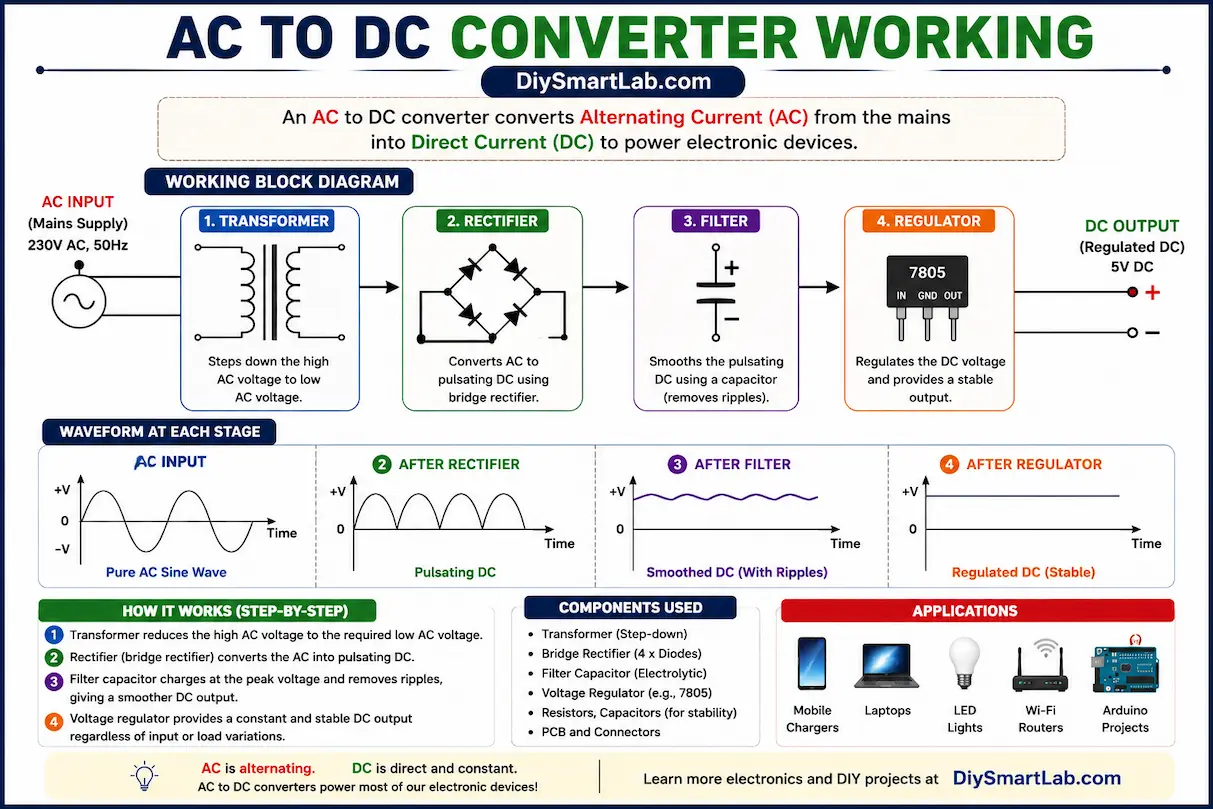
Many electronic devices use an adapter or power supply to convert AC power from wall sockets into DC power for circuits.
Conclusion
Understanding the difference between AC and DC current is essential for anyone learning electronics or electrical engineering. AC current is best for power transmission and household electricity, while DC current is ideal for electronic circuits and battery-powered devices.
If you are a beginner in electronics, learning AC and DC basics will help you understand circuits, Arduino projects, sensors, and power supplies more easily.
Keep following DiySmartLab.com for more beginner-friendly electronics tutorials, Arduino projects, and smart DIY guides.
Frequently Asked Questions (FAQs)
Which is more dangerous, AC or DC?
AC is generally considered more dangerous at the same voltage because it affects the human body differently and can cause severe electric shocks.
Does a battery provide AC or DC?
Batteries provide DC (Direct Current) electricity.
Can AC be converted into DC?
Yes, AC can be converted into DC using rectifiers, adapters, and power supply circuits.
Why is AC used in homes?
AC is used because it is easier and more efficient to transmit over long distances.
Why do Arduino projects use DC power?
Arduino boards and electronic components require stable DC voltage for proper operation.