
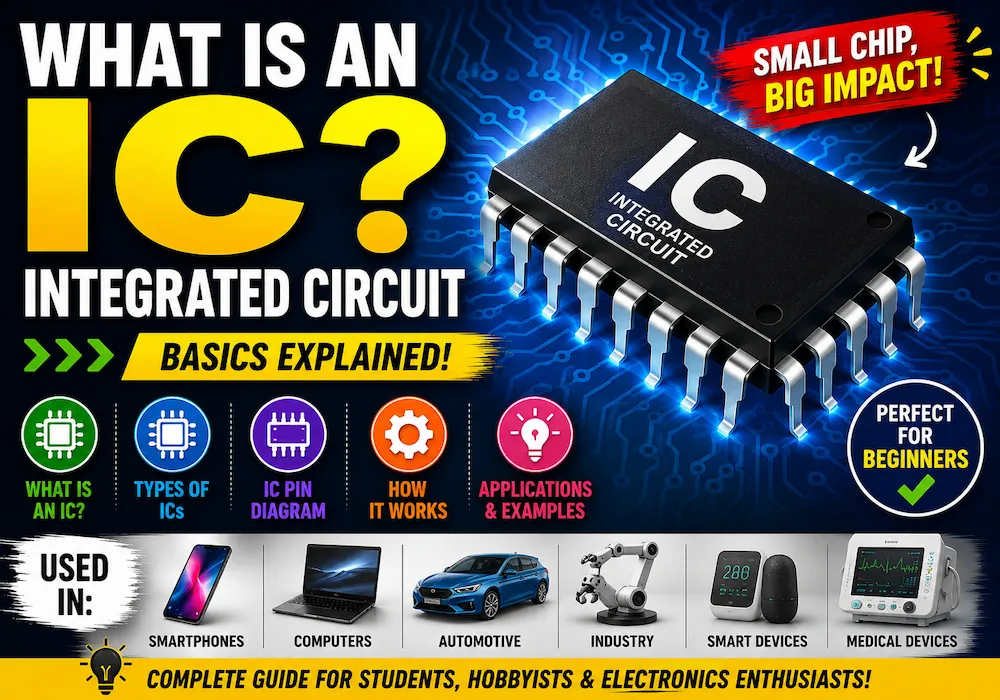
What is an IC (Integrated Circuit)? Basics Explained

What is an IC (Integrated Circuit)? Basics Explained
Integrated Circuits, also called ICs or microchips, are one of the most important inventions in electronics. Today, ICs are used in smartphones, computers, televisions, robots, Arduino boards, and smart home devices.
If you are a beginner in electronics, learning about ICs is very important. In this guide, you will understand what an Integrated Circuit is, how it works, different IC types, common applications, and how to identify IC pins.

What is an Integrated Circuit?
An Integrated Circuit is a tiny electronic chip. It contains many small electronic components inside a single package.
These components include:
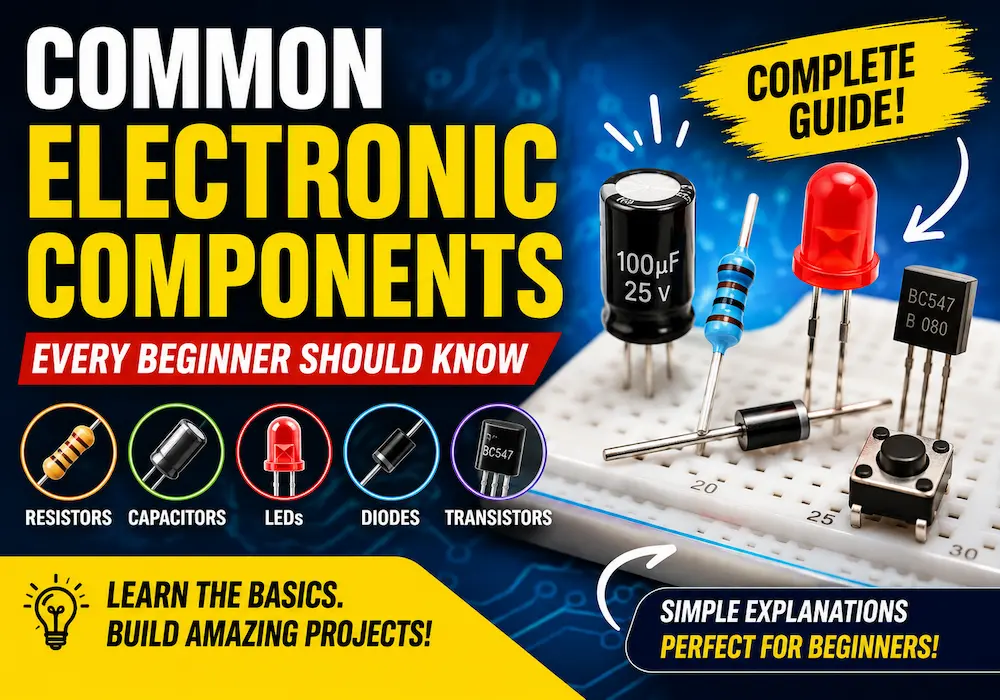
- Transistors
- Resistors
- Capacitors
- Diodes
All these parts are connected together on a silicon chip. As a result, the IC can perform different electronic tasks.
In simple words: An IC is a complete electronic circuit inside a tiny chip.
Why Are ICs Important?
Before ICs were invented, electronic circuits were very large. Engineers had to connect many separate components manually.
Because of this, old electronic devices were:
- Bigger
- Slower
- Expensive
- Less reliable
However, ICs solved this problem. They combined many components into one compact chip.
Therefore, modern electronic devices became:
- Smaller
- Faster
- More reliable
- More power efficient
- Easier to manufacture
History of Integrated Circuits
The first practical Integrated Circuit was invented in 1958 by Jack Kilby. Later, Robert Noyce improved the design using silicon technology.
Today, billions of ICs are used in modern electronics.
IC Structure and Parts
An IC contains several tiny electronic components built on a silicon wafer.
The main parts of an IC are:
- Silicon die
- Transistors
- Metal interconnections
- Protective package
- Input and output pins

How Does an IC Work?
An IC processes electrical signals through tiny internal components.
Different ICs perform different tasks. For example, some ICs amplify signals, while others process data.
An IC can:
- Amplify signals
- Store memory
- Process data
- Generate timing signals
- Control voltage
- Perform logical operations
For example, a timer IC can generate pulses. Similarly, a microcontroller IC can run programs and control devices.
Types of Integrated Circuits
Integrated Circuits are mainly divided into two categories.
1. Analog ICs
Analog ICs work with continuous signals.
These ICs are commonly used in:
- Audio circuits
- Voltage regulators
- Amplifiers
- Signal processing systems
Common examples:
- LM741
- LM7805
- Audio amplifier ICs
2. Digital ICs
Digital ICs work with binary values like 0 and 1.
These ICs are widely used in:
- Computers
- Memory devices
- Microcontrollers
- Logic circuits
Common examples:
- Logic gate ICs
- Memory ICs
- Microprocessors
- Microcontrollers

Common IC Packages
ICs are available in different package styles.
| Package Type | Description |
|---|---|
| DIP | Easy to use on breadboards |
| SMD | Used in compact electronics |
| QFP | Pins available on all four sides |
| BGA | Common in processors |
IC Pin Diagram
Most ICs have a small notch or dot. This mark helps identify Pin 1.
In most ICs, pin numbers increase in a counterclockwise direction.
Important points to remember:
- Pin 1 is near the notch or dot
- Pin numbering is counterclockwise
- The last pin is opposite Pin 1

Popular ICs for Beginners
Here are some common ICs beginners should know.
| IC Name | Main Function |
|---|---|
| NE555 | Timer IC |
| LM358 | Operational Amplifier |
| ATmega328P | Arduino Microcontroller |
| 74HC595 | Shift Register |
| LM7805 | Voltage Regulator |
Applications of ICs
Integrated Circuits are used in almost every electronic device.
Some common applications include:
- Smartphones
- Computers
- Robotics
- Arduino projects
- Medical devices
- Smart home systems
- Automotive electronics
- Audio systems

Advantages of ICs
Integrated Circuits offer many benefits.
Some major advantages are:
- Compact size
- Fast operation
- Low power consumption
- High reliability
- Low manufacturing cost
- Lightweight design
Disadvantages of ICs
Although ICs are very useful, they also have some limitations.
These disadvantages include:
- Difficult to repair
- Limited power handling capability
- Sensitive to static electricity
- SMD ICs need special soldering tools
IC vs Discrete Components
| Feature | Integrated Circuit | Discrete Components |
|---|---|---|
| Size | Very small | Larger |
| Cost | Lower | Higher |
| Reliability | High | Lower |
| Complexity | High functionality | Limited functionality |
Tips for Beginners
If you are using ICs for the first time, follow these simple tips.
- Always read the datasheet
- Identify Pin 1 carefully
- Use the correct voltage
- Avoid static electricity
- Use IC sockets for testing
Conclusion
Integrated Circuits are the heart of modern electronics. They make electronic devices smaller, faster, and smarter.
Today, ICs are used in almost every electronic product. Therefore, learning IC basics is essential for beginners in electronics and Arduino projects.
Once you understand ICs, you can build more advanced DIY electronics projects with confidence.
Frequently Asked Questions (FAQs)
What does IC stand for?
IC stands for Integrated Circuit.
What is an IC made of?
Most ICs are made using silicon semiconductor material.
What are the main types of ICs?
The two main types are Analog ICs and Digital ICs.
Which IC is used in Arduino Uno?
The ATmega328P microcontroller IC is used in Arduino Uno boards.
You May Also Like
- What is a Transistor? NPN vs PNP Explained Simply
- What is a Diode? Working Principle with Examples
- What is a Capacitor? Working, Types & Applications
- What is Arduino Uno? Features and Pin Diagram
- Common Electronic Components Every Beginner Should Know
- What is a Relay Module? Working and Arduino Usage