
What is Voltage, Current, and Resistance? Beginner-Friendly Guide

What is Voltage, Current, and Resistance? Beginner’s Guide to Electronics
Voltage, current, and resistance are the three most important concepts in electronics and electricity. If you are starting your journey in electronics, Arduino, or DIY circuits, understanding these basic electrical terms is essential. In this beginner-friendly guide by DiySmartLab.com, you will learn what voltage, current, and resistance mean, how they work together, practical examples, and why they are important in electronic circuits.
What is Voltage?
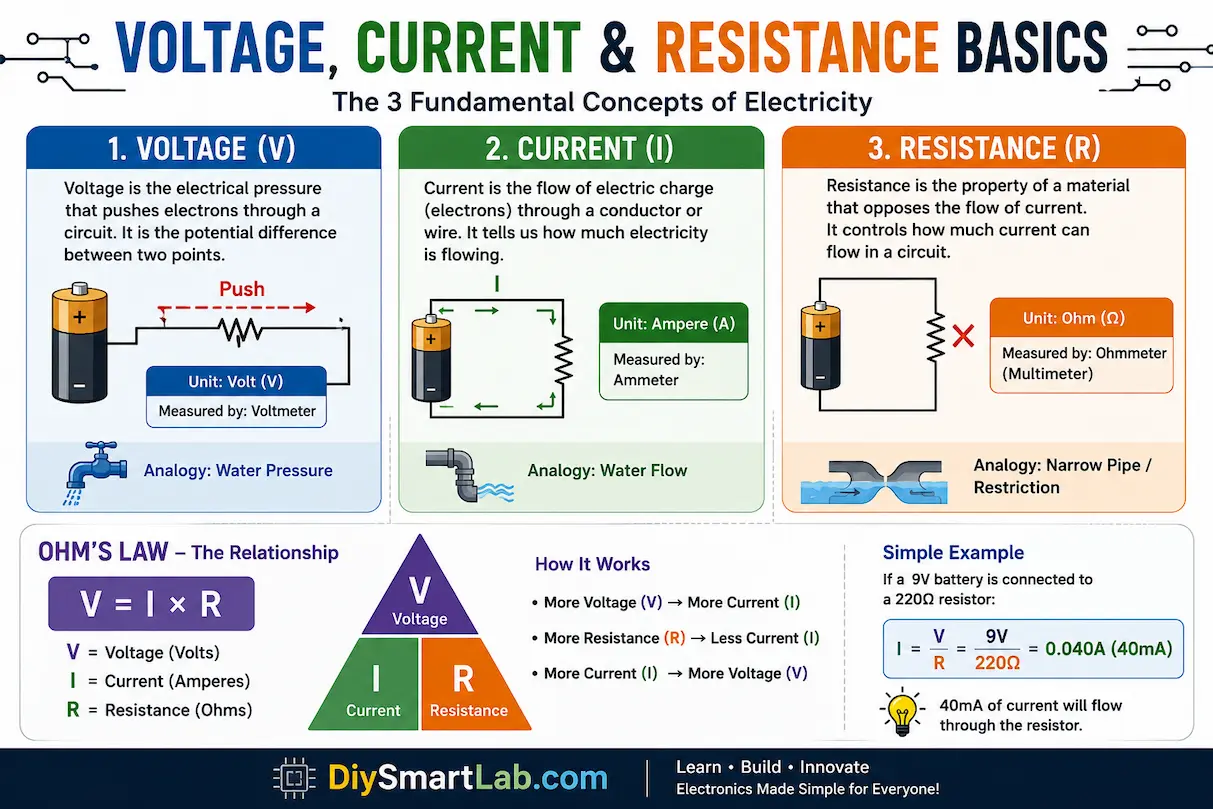
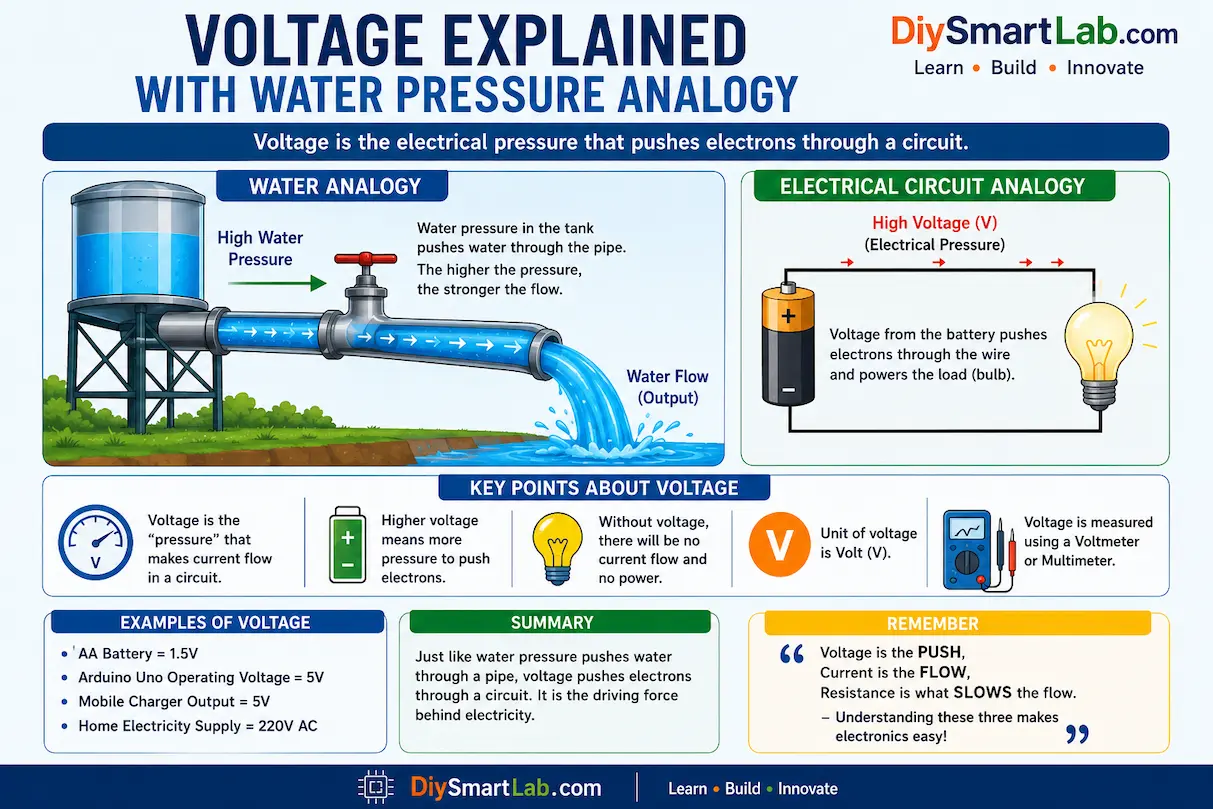
Voltage is the electrical pressure that pushes electrons through a wire or circuit. It is also called electric potential difference. Voltage is measured in Volts (V).
You can think of voltage like the water pressure in a pipe. Higher pressure pushes more water through the pipe, just like higher voltage pushes electrical charges through a circuit.
- Symbol of Voltage = V
- Unit of Voltage = Volt (V)
- Measured using = Voltmeter
Common examples of voltage:
- AA Battery = 1.5V
- Arduino Uno Operating Voltage = 5V
- Mobile Charger Output = 5V
- Home Electricity Supply = 220V AC (India)
What is Current?
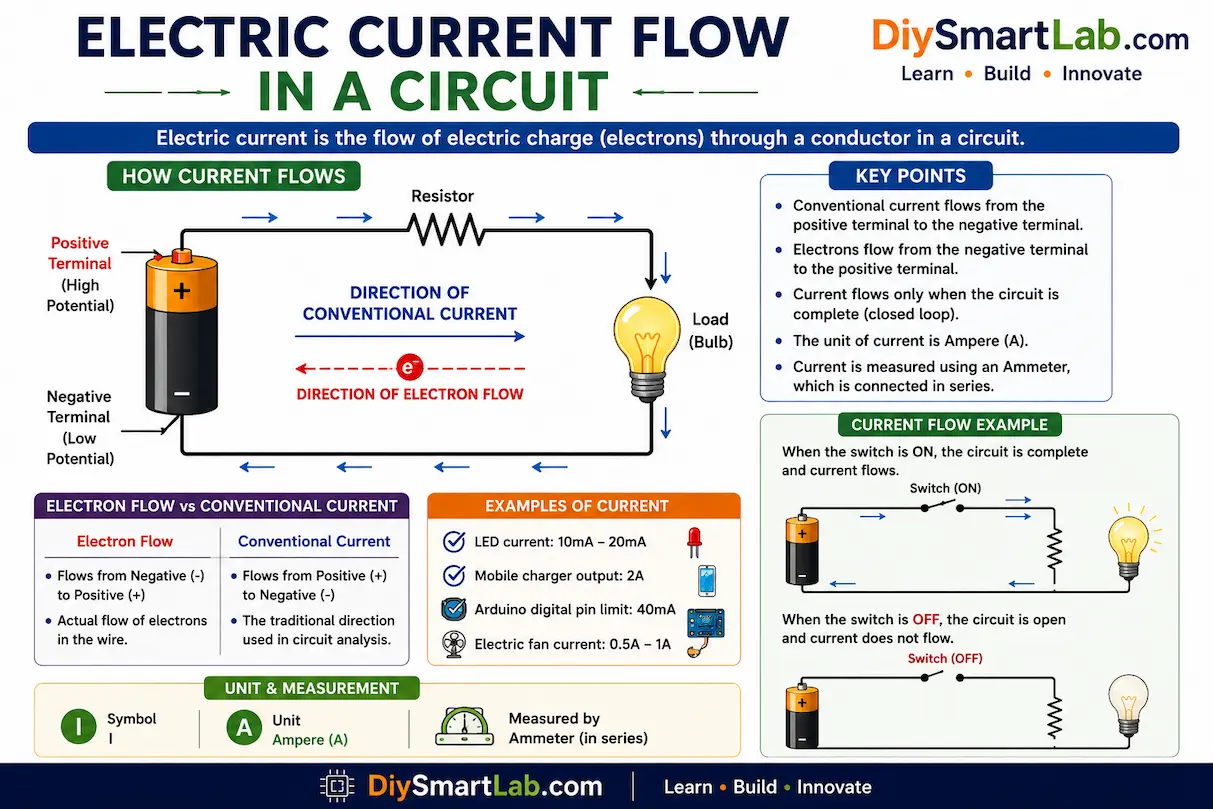
Current is the flow of electric charge (electrons) through a conductor or wire. It tells us how much electricity is flowing in a circuit. Current is measured in Amperes (A), commonly called Amps.
Using the water analogy again, current is like the amount of water flowing through the pipe.
- Symbol of Current = I
- Unit of Current = Ampere (A)
- Measured using = Ammeter
Examples of current in electronics:
- LED Current = 10mA to 20mA
- Mobile Charger Output = 2A
- Arduino Digital Pin Current Limit = 40mA
- Electric Fan Current = Around 0.5A to 1A
What is Resistance?
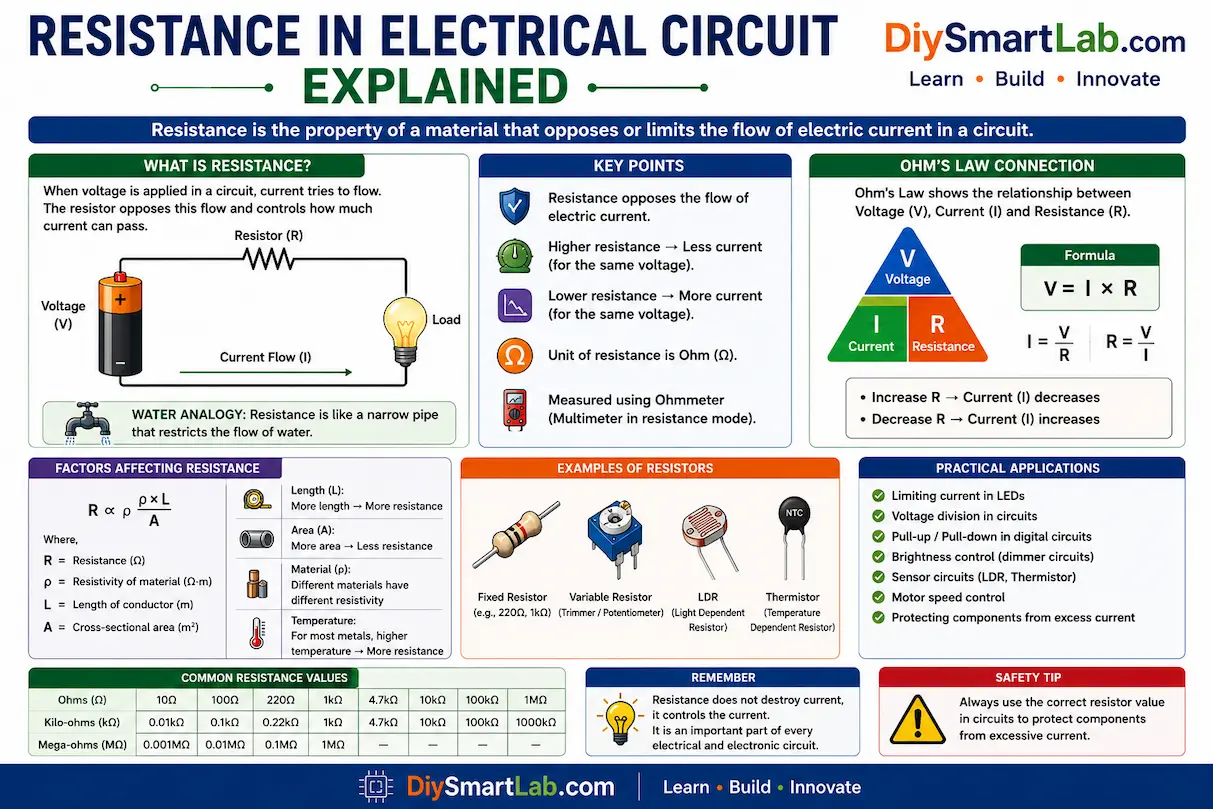
Resistance is the property of a material that opposes the flow of electric current. Resistance controls how much current can flow in a circuit. It is measured in Ohms (Ω).
In the water analogy, resistance is like a narrow pipe that restricts water flow.
- Symbol of Resistance = R
- Unit of Resistance = Ohm (Ω)
- Measured using = Multimeter
Examples of resistance in electronics:
- 220Ω resistor for LEDs
- 10kΩ resistor in Arduino pull-up circuits
- Variable resistor in fan speed control
- LDR changes resistance based on light
Relationship Between Voltage, Current, and Resistance
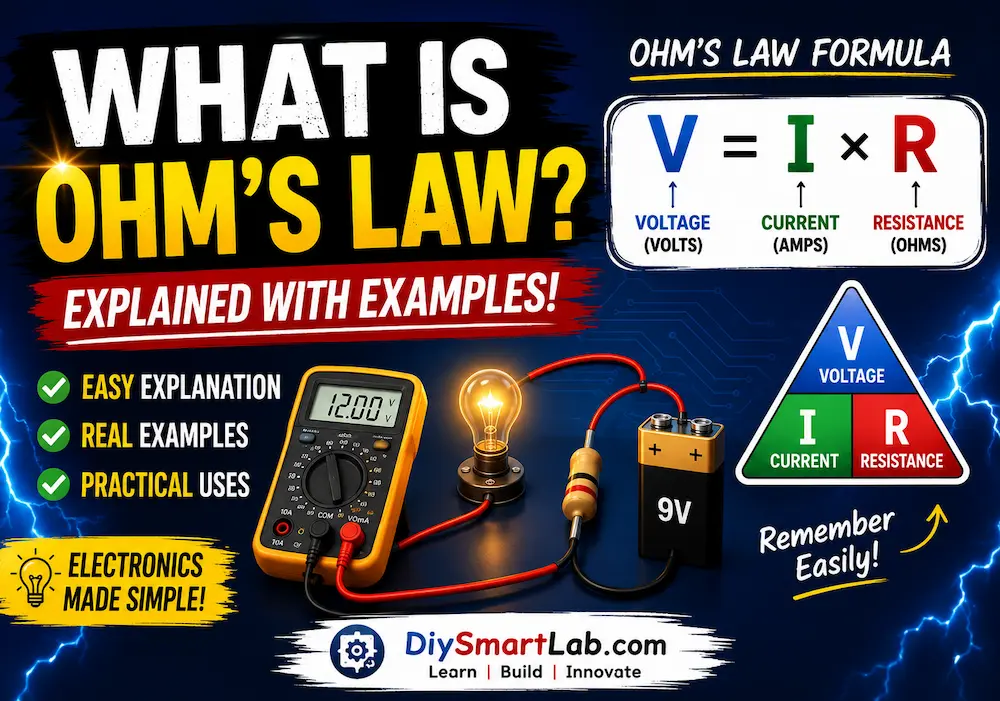
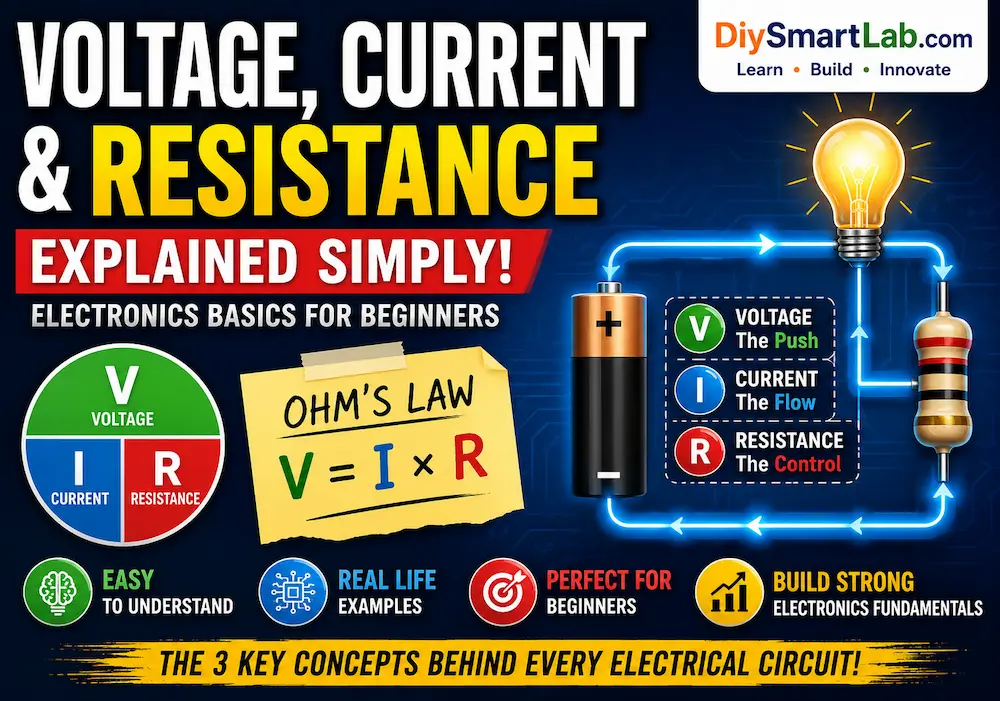
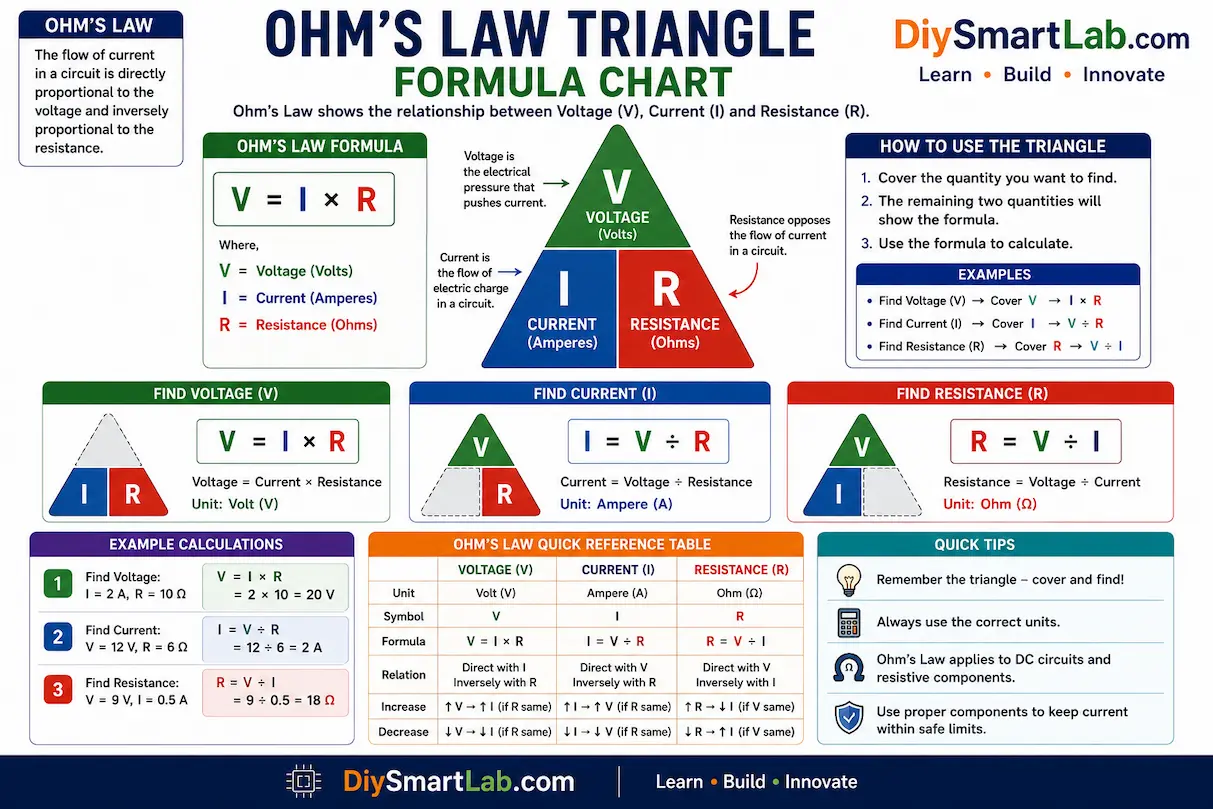
Voltage, current, and resistance are connected by Ohm’s Law. This law is one of the most important formulas in electronics.
Voltage (V) = Current (I) × Resistance (R)
Or simply:
V = I × R
This means:
- Higher voltage increases current
- Higher resistance decreases current
- Current depends on both voltage and resistance
Simple Example of Voltage, Current, and Resistance
Suppose you connect a 9V battery to a 220Ω resistor.
Using Ohm’s Law:
I = V ÷ R
I = 9 ÷ 220
I = 0.040A or 40mA
This calculation shows the amount of current flowing through the resistor.
Real-Life Water Pipe Analogy
| Electrical Quantity | Water Analogy |
|---|---|
| Voltage | Water Pressure |
| Current | Water Flow |
| Resistance | Narrow Pipe Restriction |
This analogy helps beginners easily understand basic electrical concepts.
Applications of Voltage, Current, and Resistance
- LED brightness control
- Arduino circuits and sensors
- Mobile charging circuits
- Home electrical wiring
- Battery-powered projects
- Motor speed control circuits
- Power supply design
- DIY electronics projects
Why Understanding These Concepts is Important
Every electronic project depends on voltage, current, and resistance. Understanding these concepts helps you:
- Build safe electronic circuits
- Select the correct resistor values
- Protect LEDs and Arduino boards
- Troubleshoot circuit problems
- Understand circuit diagrams easily
- Create better DIY electronics projects
Beginner Tips for Learning Electronics
- Start with simple LED circuits
- Use a multimeter for measurements
- Practice Ohm’s Law calculations
- Learn resistor color codes
- Experiment safely on a breadboard
- Always check voltage ratings before connecting components
Conclusion
Voltage, current, and resistance are the foundation of electronics and electrical engineering. Voltage pushes electrons, current is the flow of electrons, and resistance controls that flow. Once you understand these three concepts, learning Arduino, sensors, circuits, and DIY electronics becomes much easier.
At DiySmartLab.com, we simplify electronics for beginners with easy explanations, practical examples, and DIY projects. Keep exploring our tutorials to improve your electronics knowledge step by step.
Frequently Asked Questions (FAQs)
What is the difference between voltage and current?
Voltage is the electrical pressure, while current is the flow of electric charge in a circuit.
What is resistance in simple words?
Resistance is anything that opposes or limits the flow of electric current.
What is Ohm’s Law?
Ohm’s Law explains the relationship between voltage, current, and resistance using the formula V = I × R.
Why do LEDs need resistors?
Resistors limit current flow and protect LEDs from damage caused by excessive current.
Can I measure voltage and resistance using a multimeter?
Yes, a digital multimeter can measure voltage, current, and resistance in electronic circuits.