
What is an Inductor? Basics and Uses in Circuits

What is an Inductor? Basics and Uses in Circuits
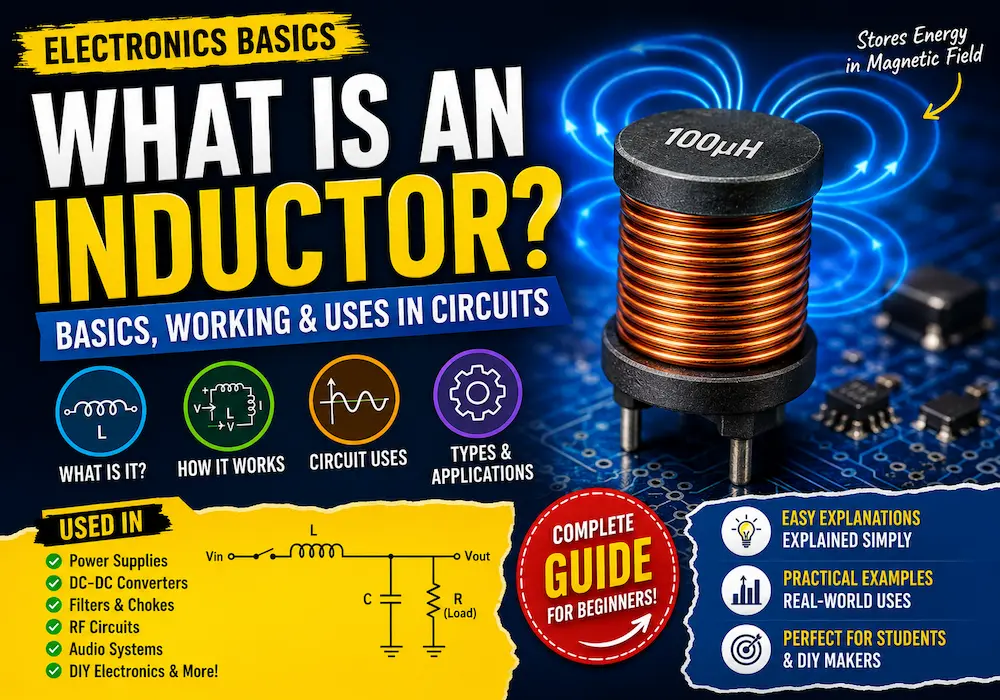
An inductor is a passive electronic component that stores energy in the form of a magnetic field when electric current flows through it. It is one of the three main passive components used in electronics alongside resistors and capacitors.
Inductors are commonly used in:
- Power supplies
- DC-DC converters
- RF circuits
- Audio systems
- Arduino projects
- Signal filtering circuits
The unit of inductance is called the Henry (H).
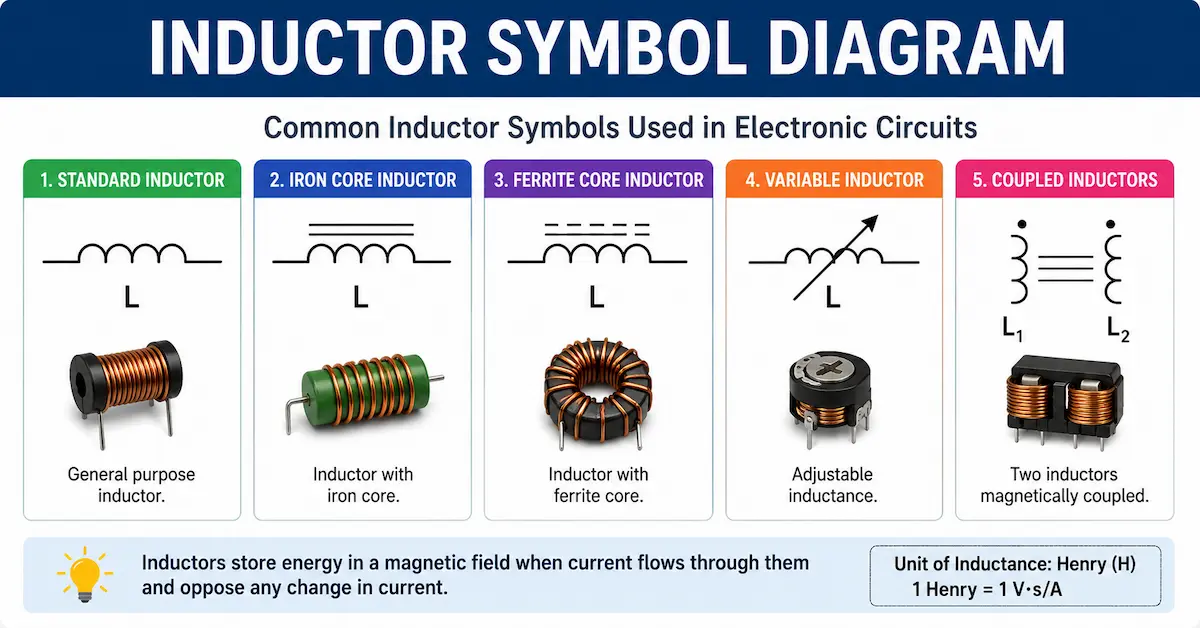
Inductor Symbol
An inductor is represented by a coil-shaped symbol in electronic circuit diagrams.
Structure of an Inductor
An inductor mainly consists of:
- Copper Wire Coil – Conductive wire wound into loops
- Core Material – Air, ferrite, or iron core
- Protective Casing – Protects the winding
| Core Type | Features |
|---|---|
| Air Core | Used in high-frequency circuits |
| Iron Core | Provides higher inductance |
| Ferrite Core | Compact and efficient |
| Powdered Iron | Common in RF applications |
How Does an Inductor Work?
When electric current passes through the coil, a magnetic field is created around it. If the current changes, the magnetic field also changes, generating a voltage that opposes the change in current.
An inductor opposes sudden changes in current and stores energy magnetically.
Inductance Formula
V = L × (dI/dt)| Symbol | Meaning |
|---|---|
| V | Voltage across inductor |
| L | Inductance |
| dI/dt | Rate of current change |
Energy Stored in an Inductor
E = ½ × L × I²This formula represents the energy stored in the magnetic field of the inductor.
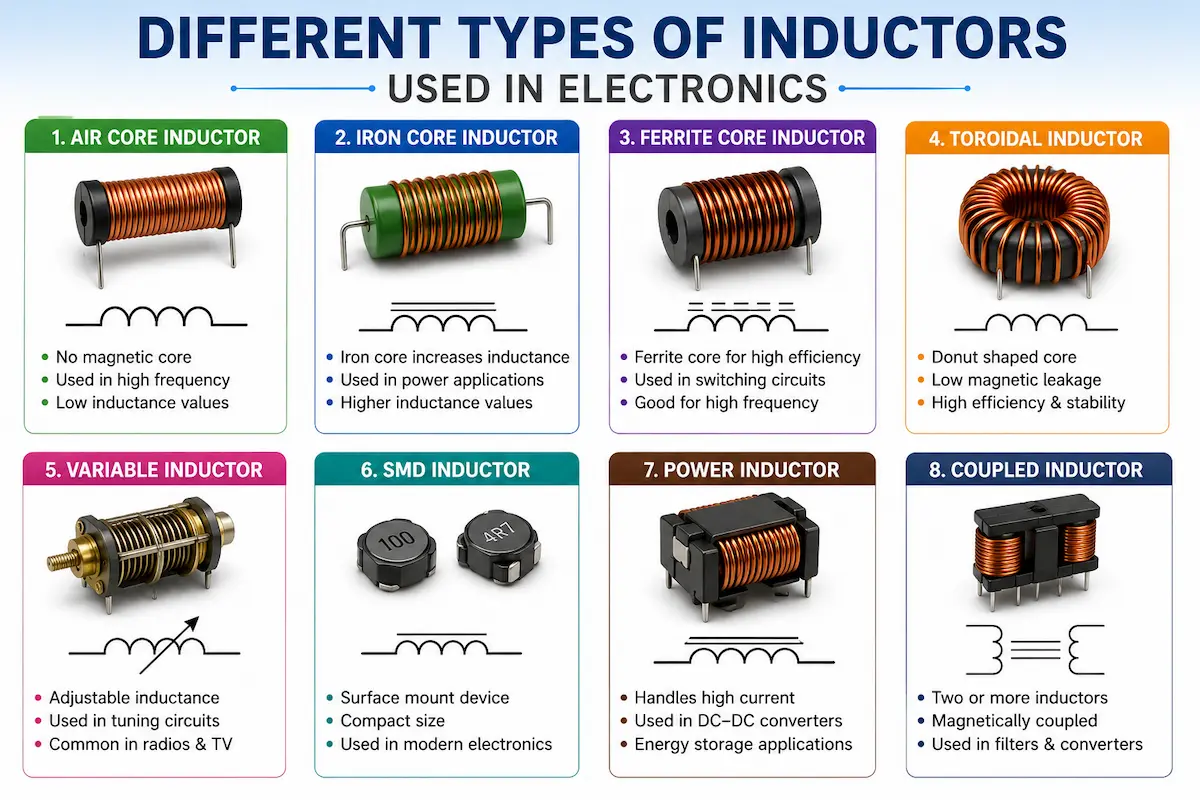
Types of Inductors
1. Air Core Inductor
- No magnetic core
- Used in RF applications
- Low inductance value
2. Iron Core Inductor
- High inductance
- Used in power circuits
3. Ferrite Core Inductor
- High efficiency
- Compact size
- Used in switching regulators
4. Toroidal Inductor
- Ring-shaped core
- Low magnetic leakage
- High efficiency
Uses of Inductors in Circuits
- Power supply filters
- DC-DC converters
- Audio crossover circuits
- RF tuning circuits
- Motor control systems
- Arduino and DIY electronics projects
Real-Life Applications
Inductors are found in many electronic devices such as:
- Mobile chargers
- LED drivers
- WiFi routers
- Computer motherboards
- Solar inverters
- Televisions
Difference Between Resistor, Capacitor, and Inductor
| Feature | Resistor | Capacitor | Inductor |
|---|---|---|---|
| Stores Energy | No | Electric Field | Magnetic Field |
| Opposes | Current | Voltage Change | Current Change |
| Unit | Ohm | Farad | Henry |
Advantages of Inductors
- Efficient energy storage
- Excellent filtering capability
- Long operational life
- Useful in power conversion circuits
Disadvantages of Inductors
- Larger physical size
- Can create electromagnetic interference
- Core saturation at high current
- More expensive at high inductance values
How to Test an Inductor
- Multimeter – Checks continuity
- LCR Meter – Measures inductance accurately
- Oscilloscope – Analyzes waveform behavior
Frequently Asked Questions (FAQs)
What does an inductor do?
An inductor stores electrical energy in the form of a magnetic field and opposes sudden changes in current.
What is the unit of inductance?
The unit of inductance is Henry (H).
Where are inductors used?
Inductors are used in filters, converters, RF circuits, power supplies, audio systems, and many DIY electronics projects.
How does an inductor store energy?
An inductor stores energy in the form of a magnetic field created when electric current flows through its coil winding.
What is the difference between an inductor and a capacitor?
An inductor stores energy in a magnetic field, while a capacitor stores energy in an electric field. Inductors oppose changes in current, whereas capacitors oppose changes in voltage.
Can an inductor block AC current?
Inductors oppose AC current more strongly at higher frequencies due to inductive reactance. However, they allow DC current to pass more easily.
What are the common types of inductors?
Common types include air-core inductors, iron-core inductors, ferrite-core inductors, toroidal inductors, and variable inductors.
Why are inductors used in power supplies?
Inductors help filter noise, smooth current flow, and store energy in switching power supplies and DC-DC converters.
What is inductive reactance?
Inductive reactance is the resistance offered by an inductor to alternating current (AC). It increases with frequency.
How can you identify an inductor?
Inductors are usually identified by their coil-like appearance, printed inductance values, color codes, or circuit symbols.
Do inductors have polarity?
Most standard inductors do not have polarity, so they can be connected in either direction in a circuit.
What happens if an inductor fails?
A failed inductor may become open-circuit, overheat, produce noise, or cause unstable operation in the electronic circuit.
Are inductors important in Arduino projects?
Yes, inductors are commonly used in Arduino power modules, voltage regulators, filters, and wireless communication circuits.
Conclusion
An inductor is an essential passive electronic component that stores energy magnetically and resists sudden current changes. From power supplies and RF systems to Arduino projects and smart electronics, inductors are used everywhere in modern circuits.
Understanding the basics of inductors helps beginners design better DIY electronics projects and troubleshoot circuits effectively.
You May Also Like
- What is a Capacitor? Working, Types & Applications
- What is a Resistor? Types, Uses & Color Code Explained
- What is an IC (Integrated Circuit)? Basics Explained
- What is a Transistor? NPN vs PNP Explained Simply
- Common Electronic Components Every Beginner Should Know
- What is Ohm’s Law? Explained with Examples
- Difference Between AC and DC Current