
What Is a Battery and How Does It Work? Complete Beginner Guide

What Is a Battery and How Does It Work? Complete Beginner’s Guide
A battery is one of the most important inventions in modern electronics. From smartphones and laptops to electric vehicles and solar energy systems, batteries power countless devices that we use every day.
However, many beginners often ask: What is a battery and how does it work?
In simple words, a battery is a device that stores chemical energy and converts it into electrical energy. When connected to a circuit, it provides power that allows electronic devices to operate.
In this detailed guide from DiySmartLab.com, you will learn what a battery is, its components, working principle, types, applications, advantages, disadvantages, and much more.
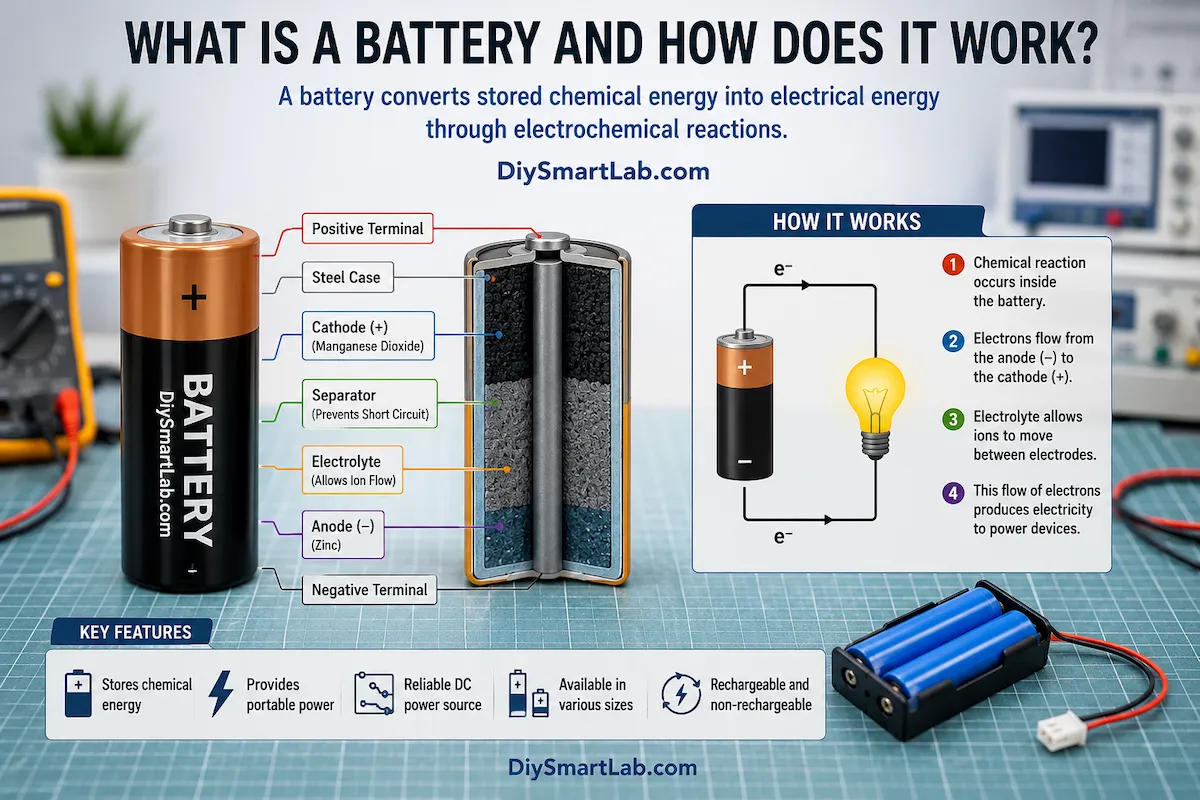
What Is a Battery?
A battery is an electrochemical device that stores energy in chemical form and converts it into electrical energy when needed.
Inside every battery, chemical reactions take place between different materials. These reactions create a flow of electrons through an external circuit, producing electricity.
Simply put, a battery acts as a portable power source.
Simple Definition
A battery is a collection of one or more electrochemical cells that generate electrical energy through chemical reactions.
Main Features of a Battery
- Stores electrical energy in chemical form
- Provides portable power
- Available in different voltages and capacities
- Can be rechargeable or non-rechargeable
- Used in small gadgets and large energy storage systems
- Reliable source of DC power
- Easy to integrate into electronic circuits
History of Batteries
The first practical battery was invented by Alessandro Volta in 1800. His invention was called the Voltaic Pile.
Since then, battery technology has improved significantly. Today, modern batteries such as Lithium-Ion and LiFePO4 offer higher energy density, longer life, and better efficiency.
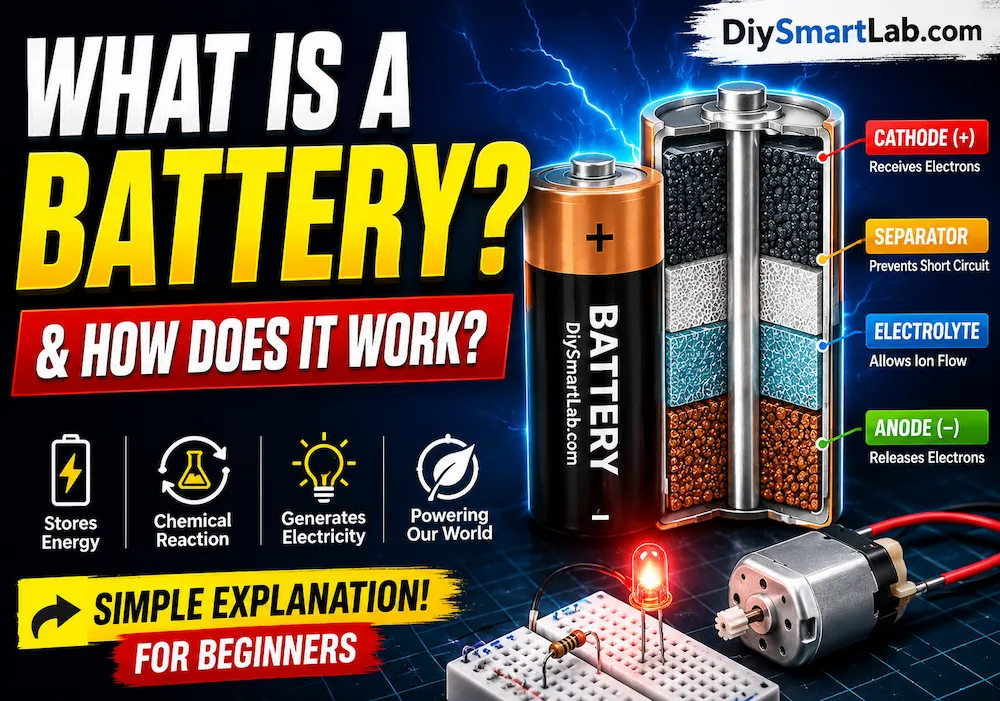
Components Required Inside a Battery
Every battery contains several important components that work together to generate electricity.
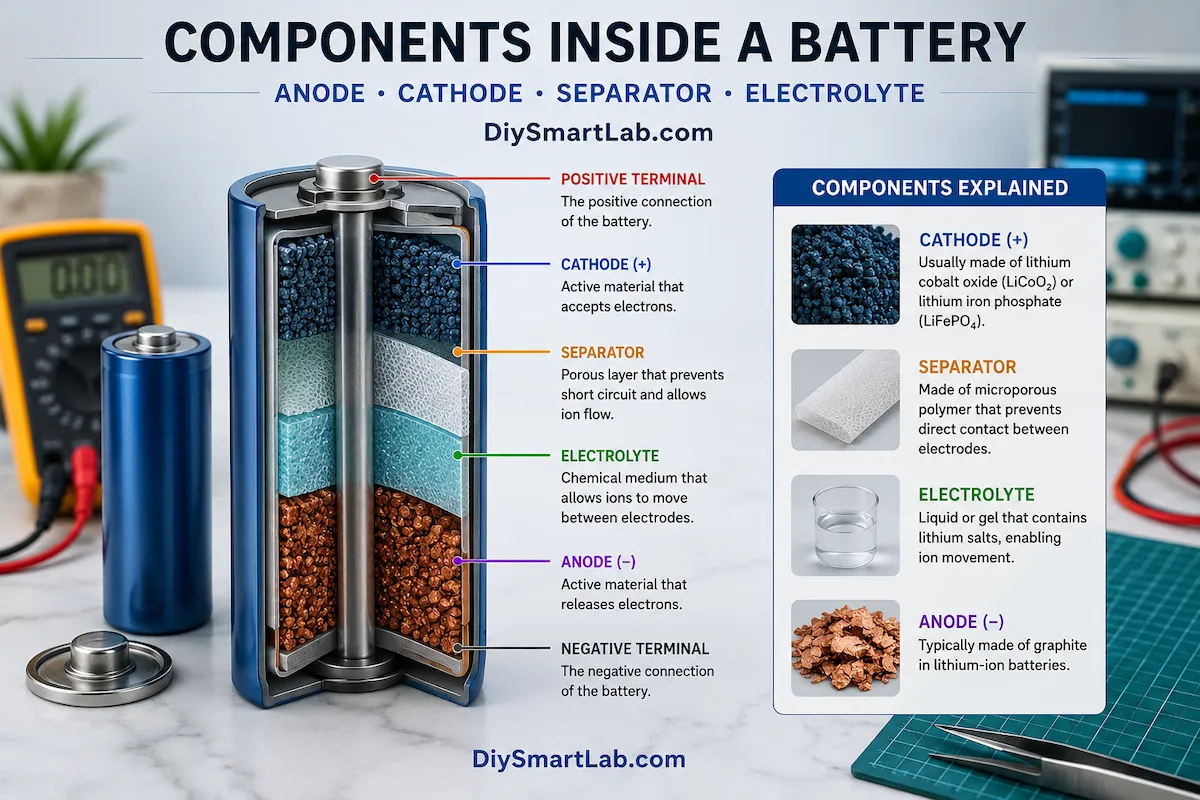
| Component | Function |
|---|---|
| Anode | Negative electrode that releases electrons |
| Cathode | Positive electrode that receives electrons |
| Electrolyte | Allows ion movement between electrodes |
| Separator | Prevents short circuits while allowing ion flow |
| Current Collector | Transfers current to external terminals |
| Battery Case | Protects internal components |
How Does a Battery Work?
The working principle of a battery is based on electrochemical reactions.
When a battery is connected to a load, a chemical reaction starts inside the cell.
This reaction causes electrons to move from the anode to the cathode through the external circuit.
The movement of electrons creates electric current.
Step-by-Step Working Principle
- The battery contains stored chemical energy.
- A load is connected to the battery terminals.
- The anode releases electrons.
- Electrons flow through the external circuit.
- The device uses the electrical energy.
- Electrons reach the cathode.
- Ions move through the electrolyte.
- The chemical reaction continues until energy is depleted.
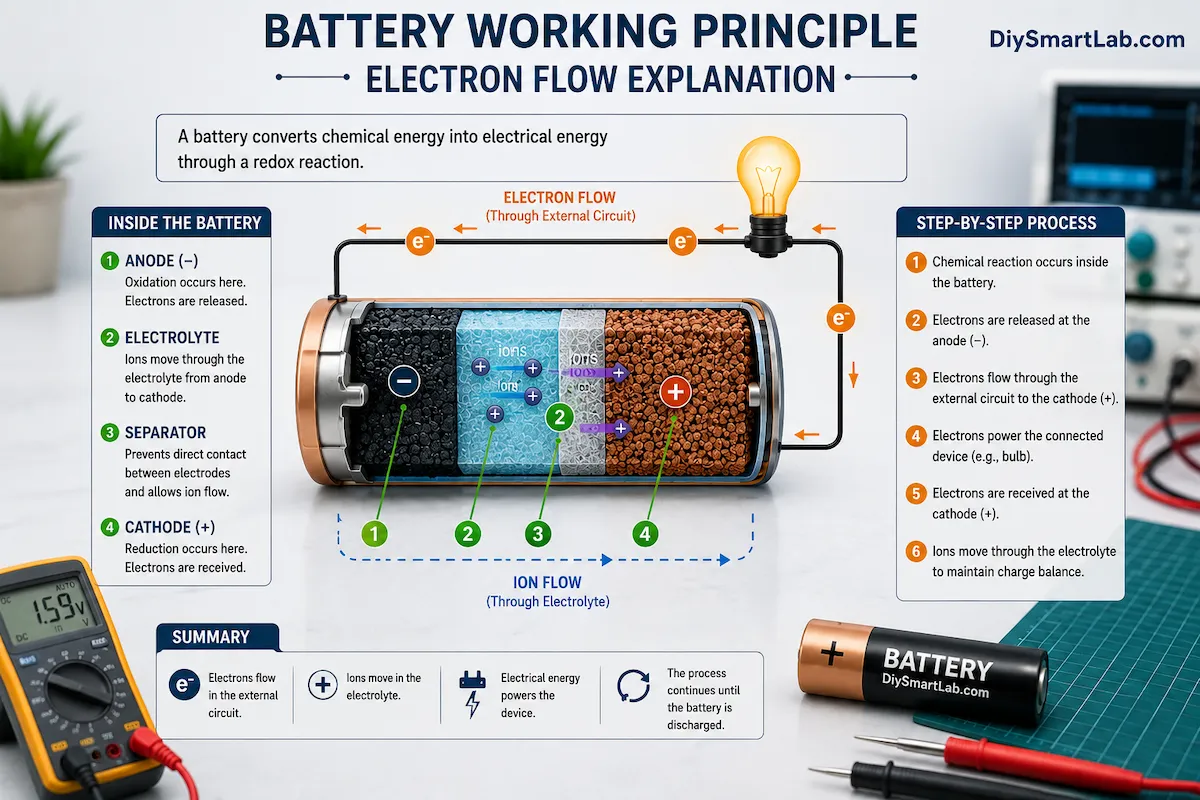
Battery Circuit Explanation
A simple battery-powered circuit consists of:
- Battery
- Switch
- Load (LED, Motor, Bulb, etc.)
- Connecting wires
When the switch is turned ON, the circuit becomes complete.
Current flows from the positive terminal through the load and returns to the negative terminal.
The load converts electrical energy into light, motion, heat, or other useful forms of energy.
Simple Battery Circuit Flow
Battery (+) → Switch → Load → Battery (-)
Types of Batteries
Batteries are generally divided into two categories.
1. Primary Batteries
Primary batteries cannot be recharged after use.
Examples:
- Alkaline Battery
- Zinc Carbon Battery
- Lithium Coin Cell
2. Secondary Batteries
Secondary batteries can be recharged many times.
Examples:
- Lithium-Ion Battery
- LiFePO4 Battery
- Lead Acid Battery
- Nickel Metal Hydride Battery
Common Battery Types Comparison
| Battery Type | Rechargeable | Typical Voltage | Applications |
|---|---|---|---|
| Alkaline | No | 1.5V | Remote Controls |
| Lead Acid | Yes | 2V per Cell | Vehicles, UPS |
| Lithium-Ion | Yes | 3.7V | Phones, Laptops |
| LiFePO4 | Yes | 3.2V | Solar Systems, EVs |
| NiMH | Yes | 1.2V | Toys, Cameras |
Understanding Battery Capacity
Battery capacity indicates how much energy a battery can store.
It is usually measured in:
- mAh (milliampere-hour)
- Ah (ampere-hour)
Example
A 2000mAh battery can theoretically provide:
- 2000mA for 1 hour
- 1000mA for 2 hours
- 500mA for 4 hours
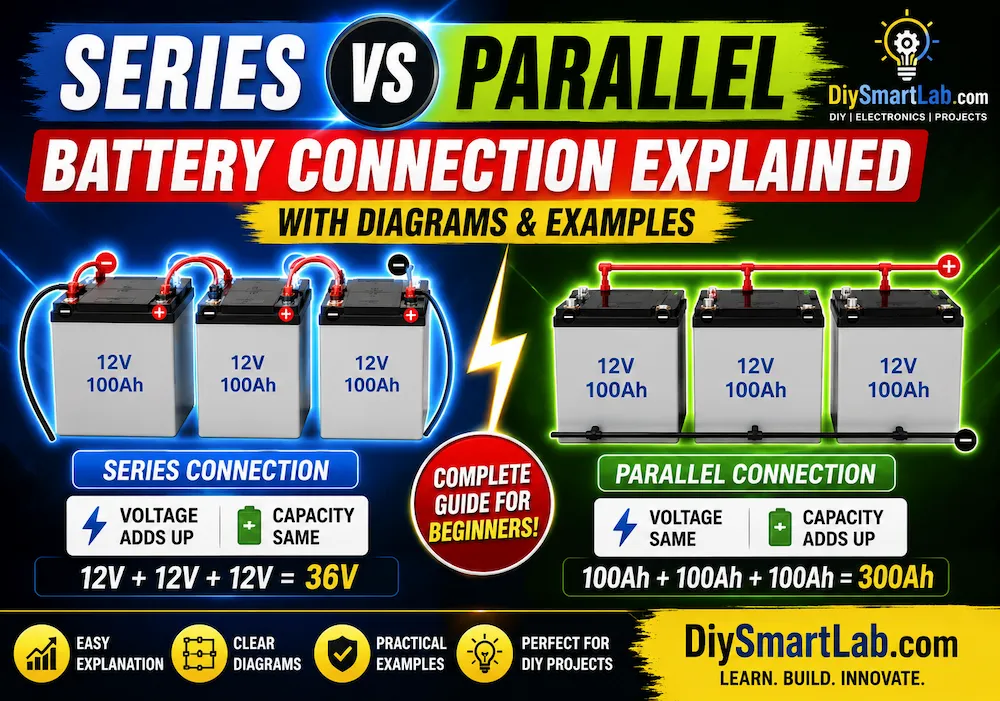
Battery Voltage Explained
Voltage represents the electrical pressure that pushes current through a circuit.
| Battery | Voltage |
|---|---|
| AA Battery | 1.5V |
| Li-Ion Cell | 3.7V |
| LiFePO4 Cell | 3.2V |
| 9V Battery | 9V |
| Car Battery | 12V |
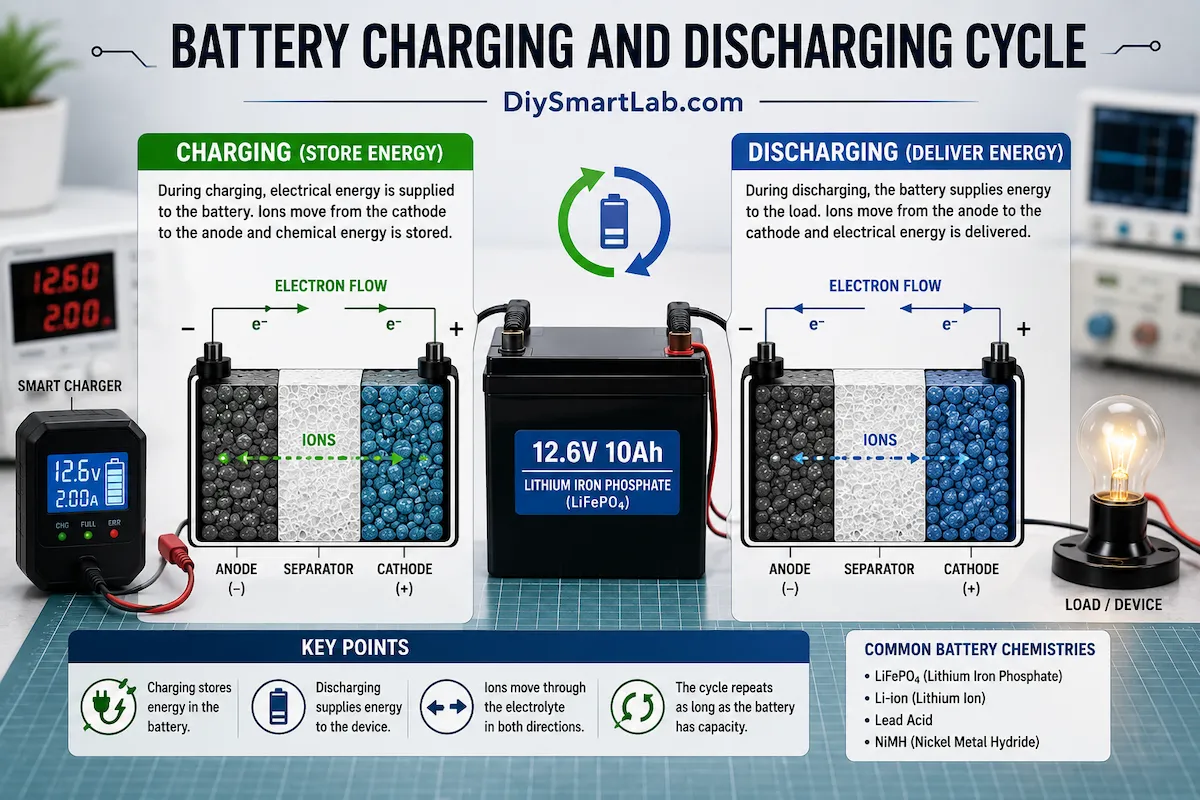
Charging and Discharging Process
Charging
During charging, electrical energy is converted back into chemical energy.
The battery stores energy for future use.
Discharging
During discharging, chemical energy converts into electrical energy.
The stored energy powers external devices.
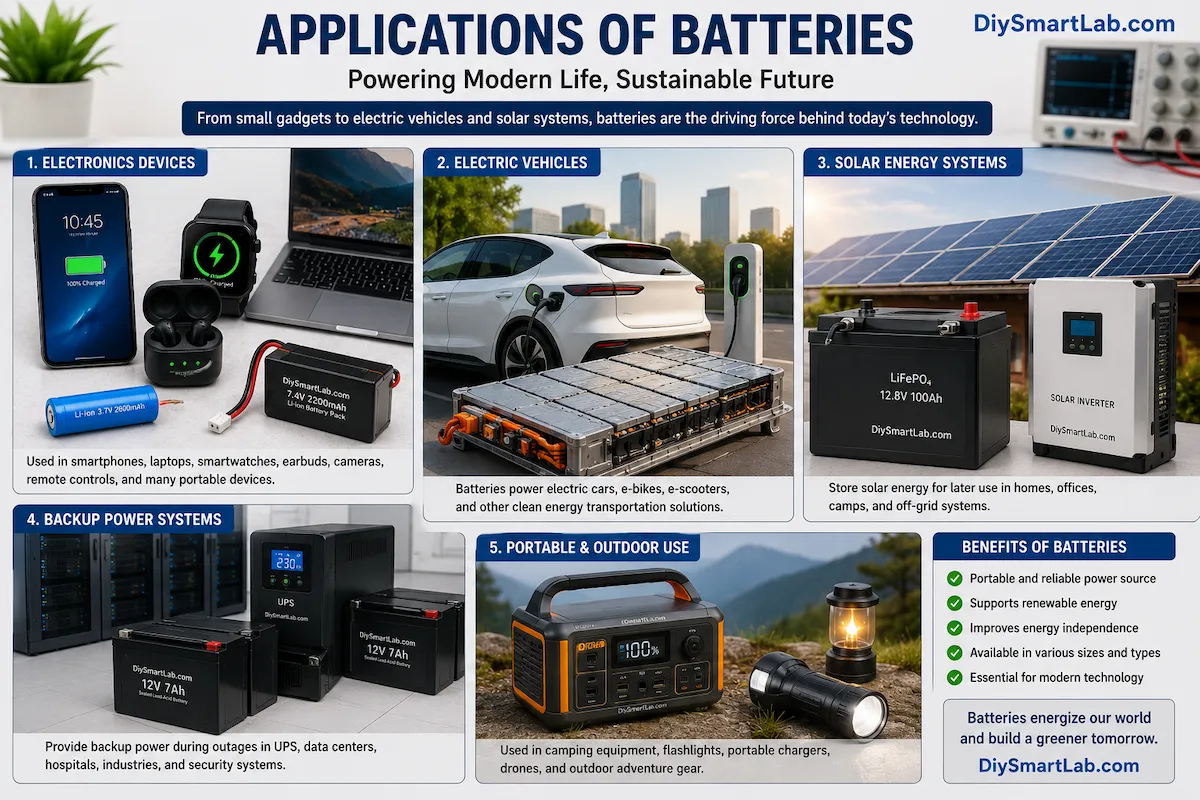
Applications of Batteries
Batteries are used almost everywhere today.
- Smartphones
- Laptops
- Smartwatches
- Wireless headphones
- Remote controls
- Flashlights
- Electric vehicles
- Solar energy storage systems
- UPS backup systems
- Medical equipment
- Arduino projects
- IoT devices
- Robotics projects
Advantages of Batteries
- Portable power source
- Easy to use
- Available in various sizes
- Reliable backup power
- Supports renewable energy storage
- Works without direct electrical connection
- Can power devices during outages
Disadvantages of Batteries
- Limited lifespan
- Performance decreases over time
- Some batteries require maintenance
- Improper disposal can harm the environment
- Rechargeable batteries need charging equipment
- High-capacity batteries can be expensive
Safety Tips When Using Batteries
- Do not short-circuit battery terminals.
- Avoid overcharging rechargeable batteries.
- Store batteries in a cool and dry place.
- Use the correct charger.
- Do not puncture or damage batteries.
- Recycle old batteries properly.
- Keep batteries away from children.
FAQs About Batteries
What is a battery in simple words?
A battery is a device that stores chemical energy and converts it into electrical energy to power electronic devices.
How does a battery produce electricity?
A battery produces electricity through chemical reactions between its electrodes and electrolyte.
Can all batteries be recharged?
No. Only rechargeable batteries such as Lithium-Ion, LiFePO4, and Lead Acid batteries can be recharged.
Which battery is best for solar systems?
LiFePO4 batteries are considered one of the best choices because of their long life and excellent safety.
What is battery capacity?
Battery capacity indicates how much energy a battery can store and deliver over time.
What is the difference between a cell and a battery?
A cell is a single electrochemical unit, while a battery consists of one or more cells connected together.
Conclusion
Now you know what a battery is and how it works.
A battery converts chemical energy into electrical energy through electrochemical reactions. It consists of an anode, cathode, electrolyte, separator, and protective casing.
Whether you are building Arduino projects, learning electronics, or exploring renewable energy systems, understanding battery fundamentals is essential.
At DiySmartLab.com, we regularly publish beginner-friendly electronics guides to help you learn practical technology concepts easily.