

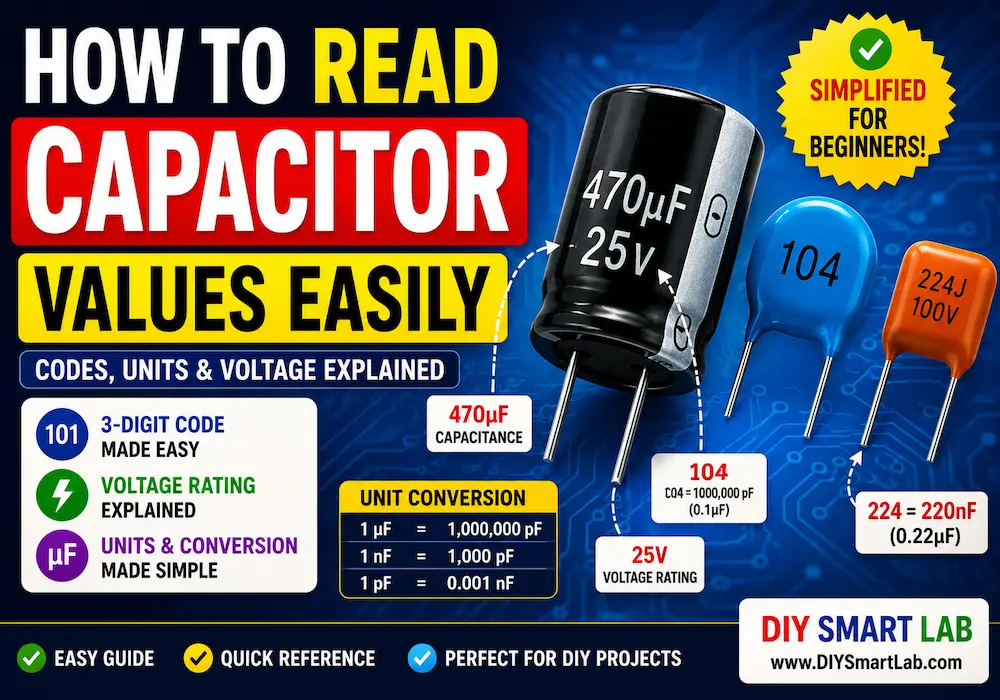

How to Read Capacitor Values Easily
Capacitors are one of the most important electronic components used in DIY electronics projects, Arduino circuits, power supplies, filters, amplifiers, and many other applications. But beginners often get confused when reading capacitor values because the markings are sometimes written in numbers, letters, or color codes.
In this guide, you will learn how to read capacitor values easily, understand capacitor codes, calculate capacitance, and identify voltage ratings without confusion.

What is a Capacitor Value?
The capacitor value represents the amount of electrical charge a capacitor can store. This value is called capacitance and is measured in:
- Farad (F)
- Microfarad (µF)
- Nanofarad (nF)
- Picofarad (pF)
Most capacitors used in DIY electronics are marked in microfarads or picofarads.
Capacitor Unit Conversion Table
| Unit | Value |
|---|---|
| 1 Farad | 1 F |
| 1 Microfarad | 1 µF = 1,000,000 pF |
| 1 Nanofarad | 1 nF = 1,000 pF |
| 1 Picofarad | 1 pF |
How Capacitor Values Are Written
Capacitor values are usually written in three different ways:
- Direct value marking
- Three-digit capacitor code
- Color code marking
1. Direct Value Marking
Large capacitors such as electrolytic capacitors usually have direct values printed on them.
Example:
- 100µF 25V
- 470µF 16V
- 10µF 50V
Here:
- The first value is capacitance
- The second value is maximum voltage rating

2. Three-Digit Capacitor Code
Small ceramic capacitors usually use a three-digit code instead of writing the full capacitance value.
Example codes:
- 101
- 104
- 223
- 472
The first two digits are the main value, and the third digit tells how many zeros to add.
Example: 104 Capacitor
- First two digits = 10
- Third digit = 4
- Add 4 zeros = 100000 pF
- 100000 pF = 100nF = 0.1µF
Common Capacitor Code Table
| Code | Capacitance |
|---|---|
| 101 | 100 pF |
| 102 | 1000 pF = 1nF |
| 103 | 10000 pF = 10nF |
| 104 | 100000 pF = 100nF = 0.1µF |
| 223 | 22000 pF = 22nF |
| 472 | 4700 pF = 4.7nF |
| 473 | 47000 pF = 47nF |

3. Capacitor Tolerance Codes
Some capacitors also include a letter showing tolerance. Tolerance tells how much the actual capacitance can vary from the rated value.
| Letter | Tolerance |
|---|---|
| J | ±5% |
| K | ±10% |
| M | ±20% |
| Z | +80% / -20% |
Example:
- 104K = 100nF with ±10% tolerance
Understanding Capacitor Voltage Rating
Every capacitor has a maximum voltage rating. Exceeding this voltage can damage the capacitor or even cause it to explode.
Common voltage ratings include:
- 10V
- 16V
- 25V
- 50V
- 100V
- 250V
Always choose a capacitor with a voltage rating higher than your circuit voltage.

Polarized vs Non-Polarized Capacitors
Capacitors can be polarized or non-polarized.
Polarized Capacitors
Electrolytic capacitors are polarized and must be connected correctly.
- Positive terminal (+)
- Negative terminal (-)
The negative side is usually marked with a stripe.
Non-Polarized Capacitors
Ceramic capacitors are non-polarized and can be connected in either direction.

Tips to Read Capacitor Values Quickly
- Always check the unit carefully
- Learn common capacitor codes like 104 and 103
- Use a multimeter with capacitance mode for confirmation
- Check voltage rating before using the capacitor
- Identify polarity before connecting electrolytic capacitors
Common Beginner Mistakes
- Confusing pF with µF
- Ignoring voltage ratings
- Connecting polarized capacitors backward
- Using wrong capacitor codes
- Assuming all capacitors use the same markings
Applications of Capacitors
- Power supply filtering
- Arduino circuits
- Audio amplifiers
- Motor starting circuits
- Timing circuits
- Signal coupling and decoupling
- Energy storage
Frequently Asked Questions (FAQs)
What does 104 mean on a capacitor?
104 means 100000 pF, which equals 100nF or 0.1µF.
How do I know capacitor polarity?
Electrolytic capacitors usually have a stripe marking the negative terminal.
Can I use a higher voltage capacitor?
Yes, using a capacitor with a higher voltage rating is generally safe.
What is the most common ceramic capacitor code?
104 is one of the most common ceramic capacitor codes used in electronics projects.
Final Thoughts
Learning how to read capacitor values is an essential skill for every electronics beginner and DIY maker. Once you understand capacitor codes, unit conversions, tolerance markings, and voltage ratings, identifying capacitors becomes very easy.
Whether you are working on Arduino projects, repairing electronics, or building DIY circuits, understanding capacitor values will help you choose the right component confidently.
Tip: Bookmark this capacitor code chart for quick reference during your electronics projects.
You May Also Like
- What is a Capacitor? Working, Types & Applications
- How to Choose the Right Resistor for Your Circuit
- What is a Resistor? Types, Uses & Color Code Explained
- Common Electronic Components Every Beginner Should Know
- What is an IC (Integrated Circuit)? Basics Explained
- What is Ohm’s Law? Explained with Examples