
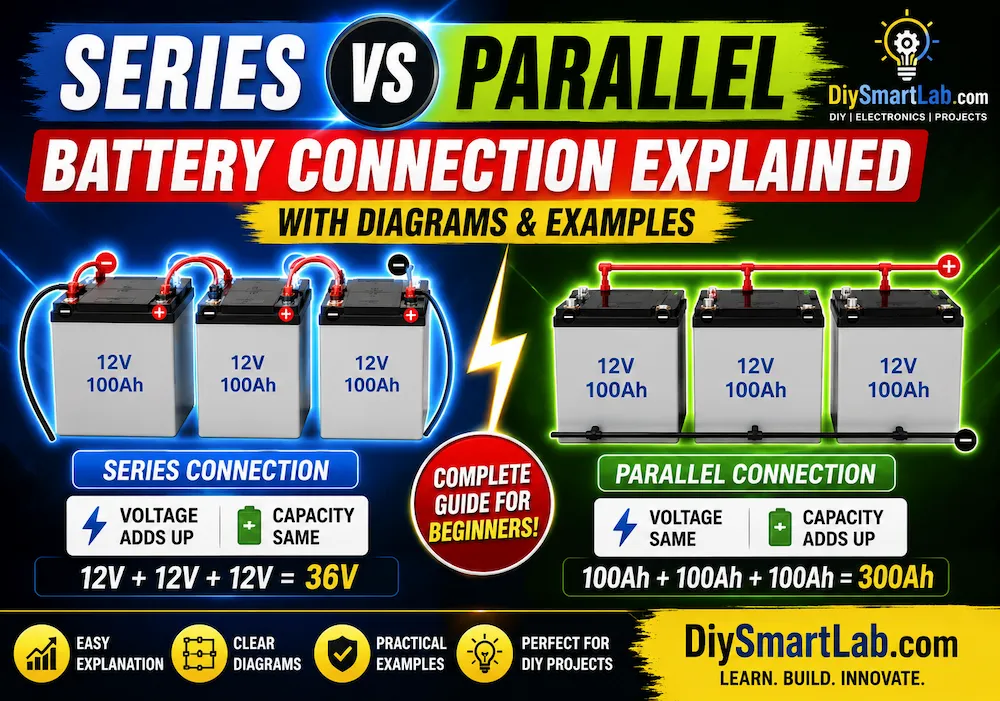
Series vs Parallel Battery Connection Explained for Beginners

Series vs Parallel Battery Connection Explained
Batteries are used in almost every electronic device around us. From flashlights and power banks to solar energy systems and electric vehicles, batteries play a very important role. However, a single battery often cannot provide the required voltage or capacity for a project. Therefore, multiple batteries are connected together.
The two most common methods are series connection and parallel connection. Understanding these methods is essential for anyone interested in electronics, DIY projects, solar systems, or battery-powered devices.
In this detailed guide from DiySmartLab.com, you will learn series vs parallel battery connection explained in a simple and beginner-friendly way.
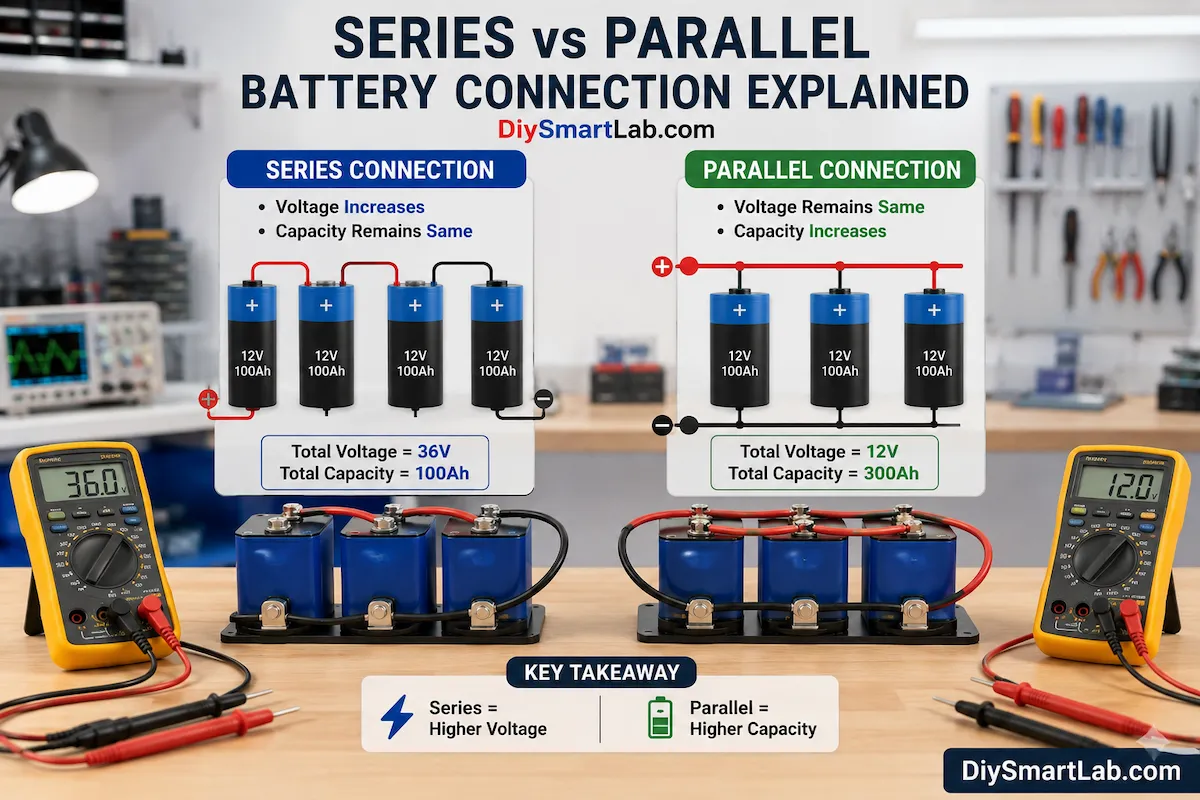
What Is a Battery Connection?
A battery connection refers to the method used to connect two or more batteries together. The purpose of connecting batteries is to increase voltage, increase capacity, or achieve both requirements.
The connection type directly affects how the battery pack performs.
The two main battery connection methods are:
- Series Connection
- Parallel Connection
Each method has different characteristics and applications.
Why Connect Batteries Together?
Many electronic devices require more power than a single battery can provide. Therefore, multiple batteries are connected together to create a battery pack.
Common reasons include:
- Increasing output voltage
- Increasing backup time
- Increasing battery capacity
- Meeting project power requirements
- Building solar battery banks
- Powering electric vehicles
Overview of Series and Parallel Connections
| Parameter | Series Connection | Parallel Connection |
|---|---|---|
| Voltage | Increases | Remains Same |
| Capacity (Ah) | Remains Same | Increases |
| Current Capability | Same | Increases |
| Backup Time | Similar | Longer |
| Main Purpose | Higher Voltage | Higher Capacity |
What Is a Series Battery Connection?
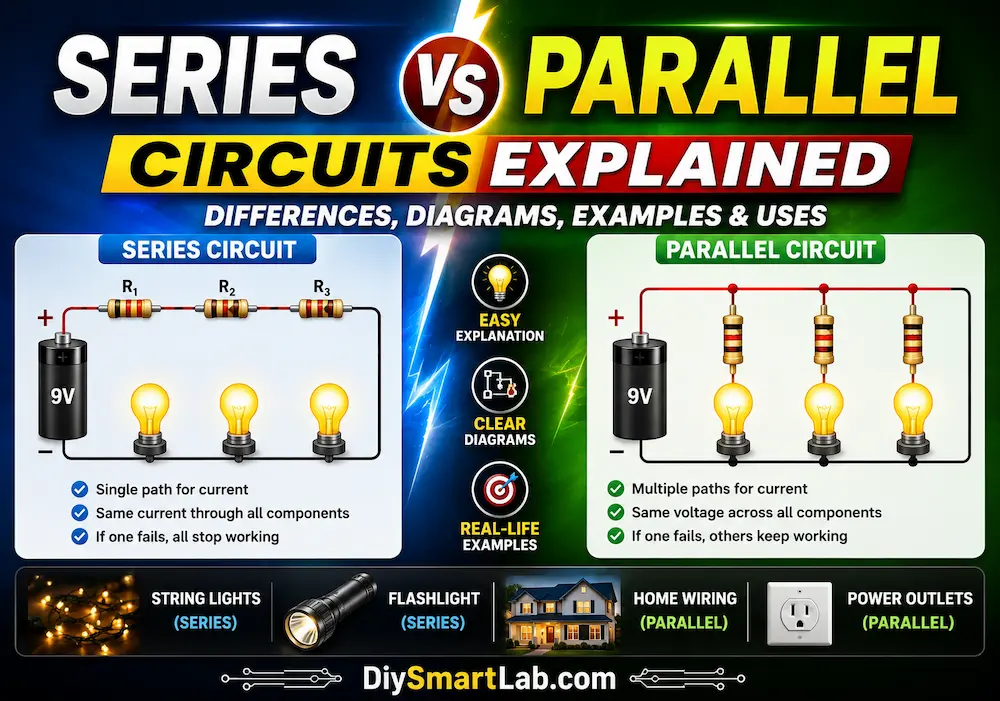
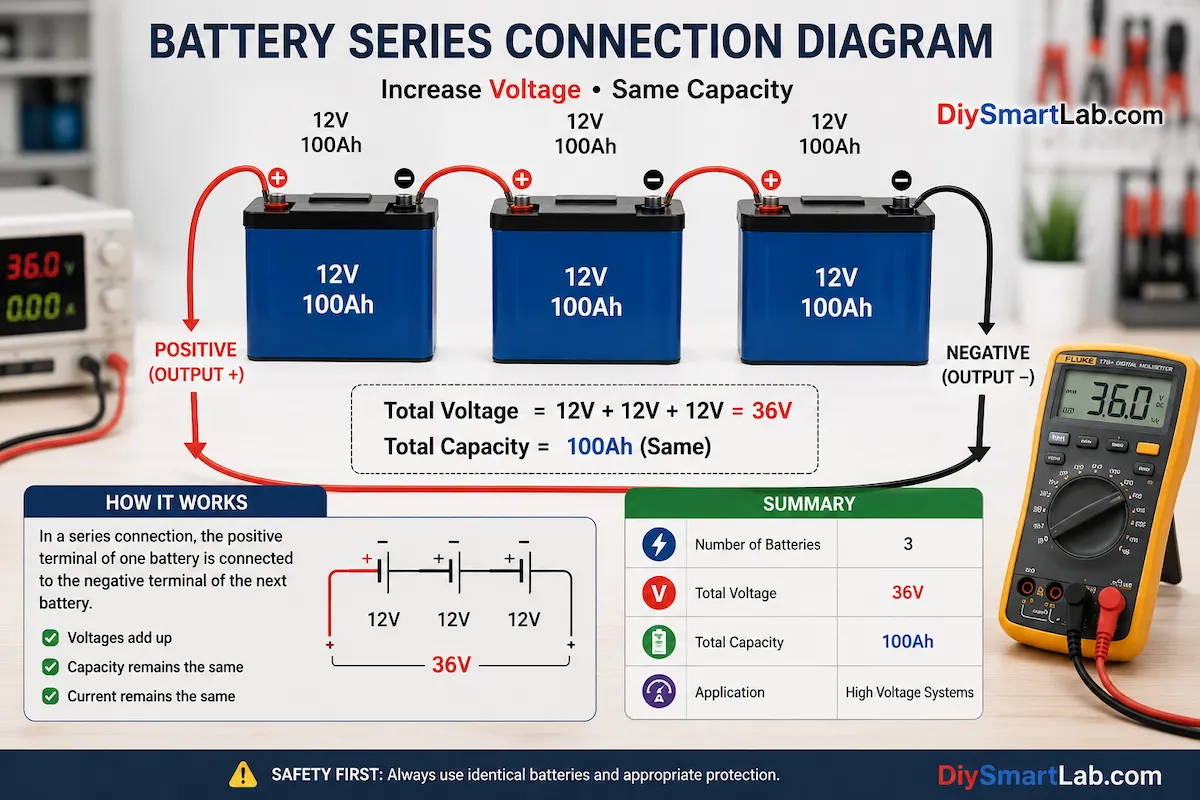
A series battery connection is created when the positive terminal of one battery is connected to the negative terminal of the next battery.
In this arrangement, battery voltages add together while the battery capacity remains unchanged.
Series Connection Diagram
Example:
- Battery 1 = 12V, 100Ah
- Battery 2 = 12V, 100Ah
Connected in Series:
- Total Voltage = 12V + 12V = 24V
- Total Capacity = 100Ah
The voltage doubles, but the capacity remains unchanged.
Series Connection Formula
Total Voltage = V1 + V2 + V3 + …
Total Capacity = Capacity of One Battery
Example 1
| Battery | Voltage | Capacity |
|---|---|---|
| Battery 1 | 3.7V | 2000mAh |
| Battery 2 | 3.7V | 2000mAh |
After Series Connection:
- Total Voltage = 7.4V
- Total Capacity = 2000mAh
Example 2
| Battery | Voltage | Capacity |
|---|---|---|
| Battery 1 | 1.5V | 2500mAh |
| Battery 2 | 1.5V | 2500mAh |
| Battery 3 | 1.5V | 2500mAh |
| Battery 4 | 1.5V | 2500mAh |
Result:
- Total Voltage = 6V
- Total Capacity = 2500mAh
Features of Series Battery Connection
- Voltage increases
- Capacity remains constant
- Current remains the same
- Suitable for high-voltage applications
- Common in solar systems and electric vehicles
- Easy to implement
Working Principle of Series Battery Connection
When batteries are connected in series, electrons flow through each battery one after another.
The voltage of each battery adds together because each battery contributes its electrical potential.
Think of it as stacking multiple water pumps in a pipeline. Each pump increases pressure. Similarly, each battery increases voltage.
As a result, the total voltage becomes higher while the battery capacity stays the same.
Components Required for Series Battery Connection
| Component | Purpose |
|---|---|
| Batteries | Power source |
| Connecting Wires | Electrical connection |
| Battery Holder | Battery mounting |
| Fuse | Safety protection |
| Multimeter | Voltage testing |
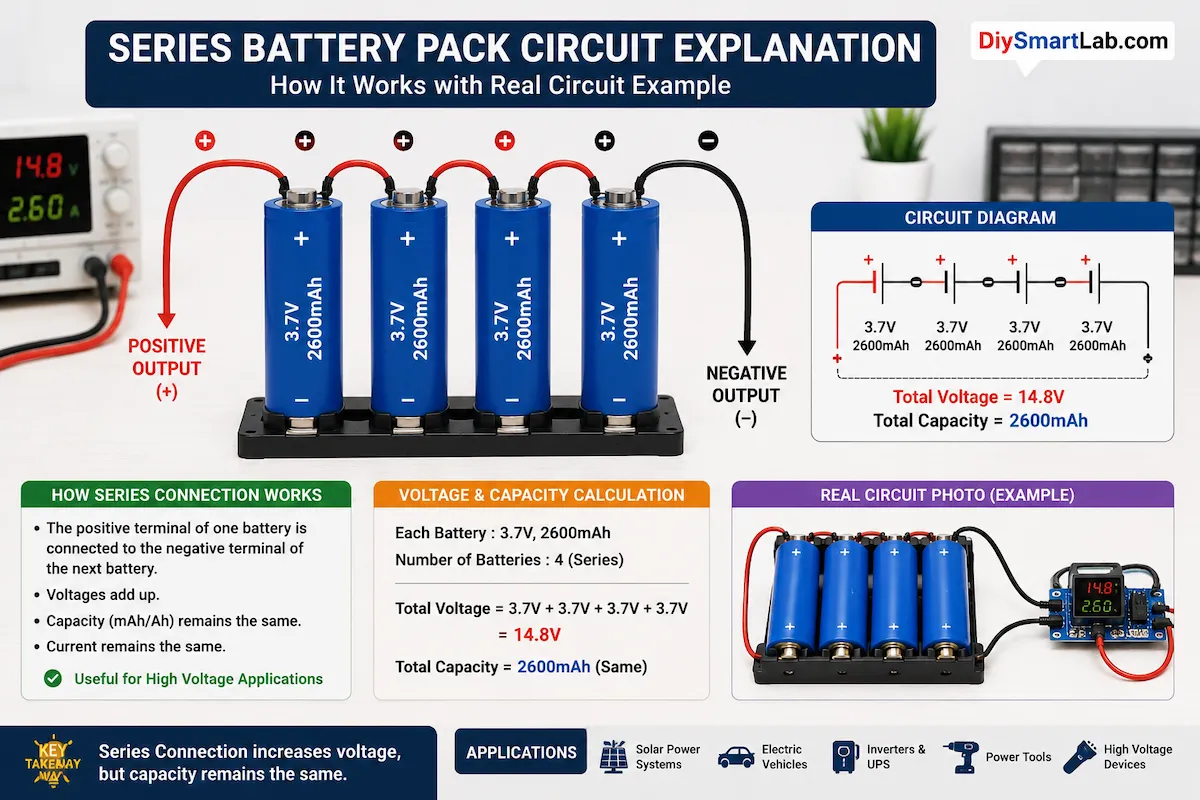
Circuit Explanation of Series Battery Connection
In a series battery circuit:
- Positive terminal of Battery 1 connects to Negative terminal of Battery 2
- Positive terminal of Battery 2 connects to Negative terminal of Battery 3
- The remaining free terminals become the battery pack output
The total output voltage is the sum of all connected batteries.
Applications of Series Battery Connection
- Solar energy storage systems
- Electric bicycles
- Electric vehicles
- UPS systems
- Power tools
- Inverters
- Emergency lighting systems
- Portable electronics
Advantages of Series Battery Connection
- Higher output voltage
- Simple wiring
- Suitable for long-distance power transmission
- Lower current for same power level
- Reduced cable losses
- Widely used in battery packs
Disadvantages of Series Battery Connection
- Capacity does not increase
- One weak battery affects entire pack
- Battery balancing may be required
- Overcharging risks if unmanaged
- Higher voltage requires additional safety precautions
In the next section, we will learn about parallel battery connections, calculations, applications, advantages, disadvantages, comparison tables, FAQs, and practical examples.
What Is a Parallel Battery Connection?
A parallel battery connection is created when all positive terminals are connected together and all negative terminals are connected together.
Unlike a series connection, a parallel connection keeps the voltage the same while increasing the total battery capacity.
This means your device can run for a much longer time without increasing the operating voltage.
Parallel Connection Diagram
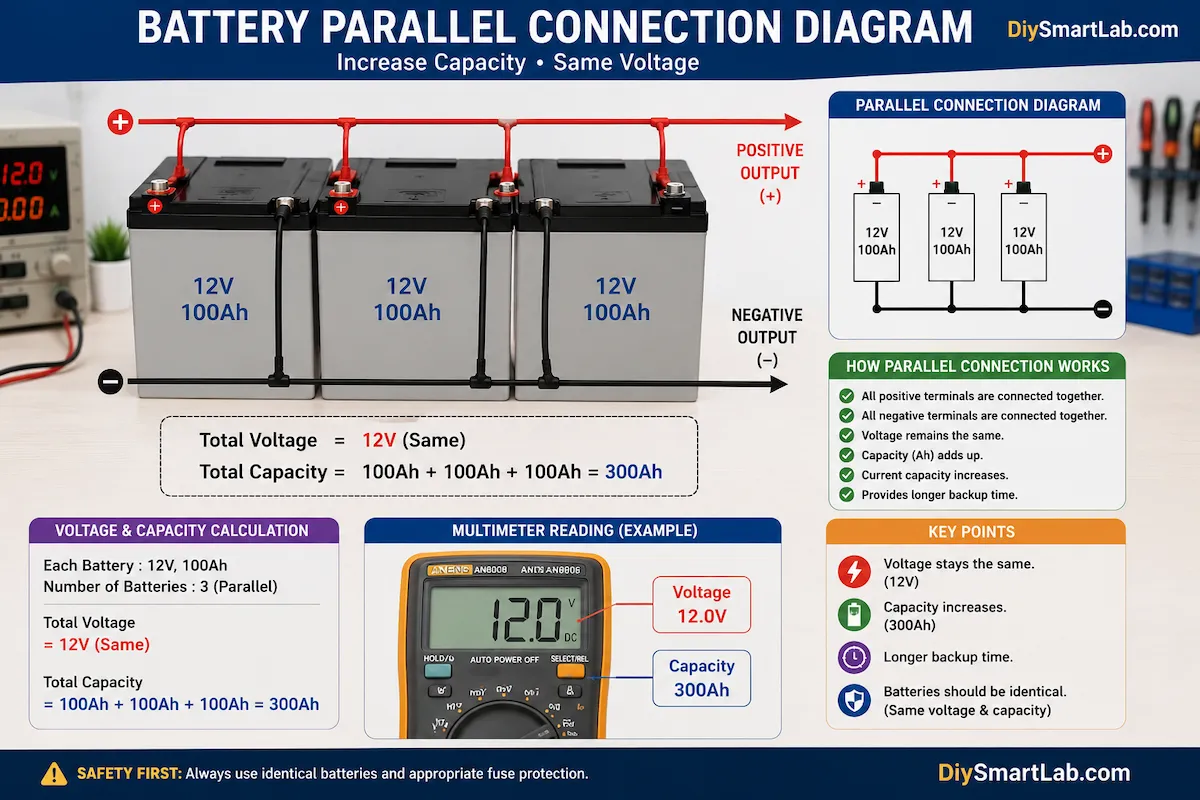
Example:
- Battery 1 = 12V, 100Ah
- Battery 2 = 12V, 100Ah
Connected in Parallel:
- Total Voltage = 12V
- Total Capacity = 200Ah
The voltage remains the same, but the battery capacity doubles.
Parallel Connection Formula
Total Voltage = Voltage of One Battery
Total Capacity = Ah1 + Ah2 + Ah3 + …
Example 1
| Battery | Voltage | Capacity |
|---|---|---|
| Battery 1 | 3.7V | 2000mAh |
| Battery 2 | 3.7V | 2000mAh |
After Parallel Connection:
- Total Voltage = 3.7V
- Total Capacity = 4000mAh
Example 2
| Battery | Voltage | Capacity |
|---|---|---|
| Battery 1 | 12V | 50Ah |
| Battery 2 | 12V | 50Ah |
| Battery 3 | 12V | 50Ah |
Result:
- Total Voltage = 12V
- Total Capacity = 150Ah
Features of Parallel Battery Connection
- Capacity increases
- Voltage remains unchanged
- Longer backup time
- Higher current capability
- Improved runtime for devices
- Popular in solar battery banks
Working Principle of Parallel Battery Connection
When batteries are connected in parallel, all batteries share the load current.
Instead of increasing voltage, the available energy storage increases.
You can think of it as increasing the size of a water tank rather than increasing water pressure.
As a result, devices can operate for a longer period before the batteries need recharging.
Components Required for Parallel Battery Connection
| Component | Purpose |
|---|---|
| Batteries | Power source |
| Battery Connectors | Parallel wiring |
| Fuse | Protection |
| Bus Bar | Current distribution |
| Multimeter | Testing |
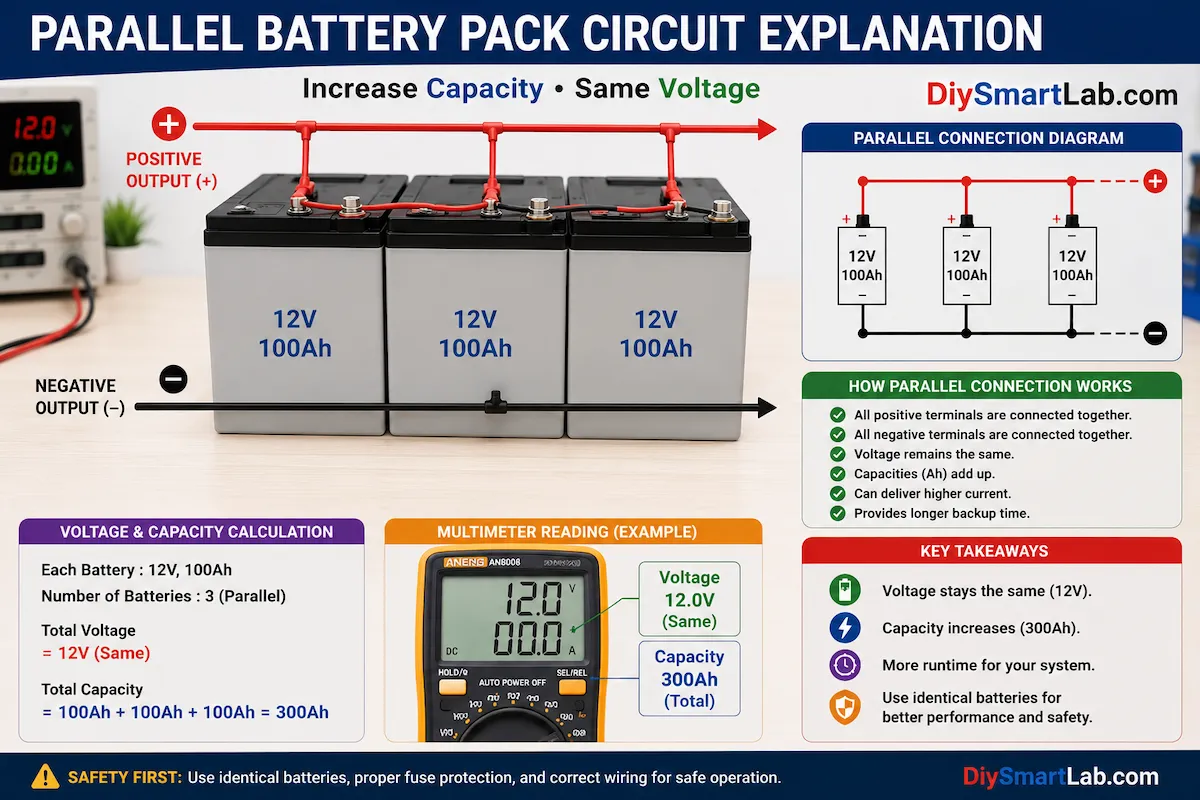
Circuit Explanation of Parallel Battery Connection
In a parallel battery circuit:
- Positive terminal connects to positive terminal
- Negative terminal connects to negative terminal
- The voltage stays constant
- The capacities add together
Each battery contributes current to the load.
Applications of Parallel Battery Connection
- Solar battery banks
- Portable power stations
- Emergency backup systems
- Power banks
- Marine batteries
- Camping power systems
- Home energy storage systems
Advantages of Parallel Battery Connection
- Longer backup time
- Higher current delivery
- Improved battery runtime
- Voltage remains stable
- Easy capacity expansion
- Useful for low-voltage systems
Disadvantages of Parallel Battery Connection
- Voltage cannot be increased
- Requires matched batteries
- Current imbalance may occur
- Large capacity packs need proper protection
- Higher wiring current requires thicker cables
Series vs Parallel Battery Connection Comparison
| Feature | Series Connection | Parallel Connection |
|---|---|---|
| Voltage | Increases | Same |
| Capacity | Same | Increases |
| Backup Time | Normal | Longer |
| Current Output | Same | Higher |
| Main Use | High Voltage | Long Runtime |
| Example | Electric Vehicle | Solar Storage |
Can You Use Different Batteries Together?
No. It is strongly recommended to use identical batteries.
All batteries should have:
- Same voltage
- Same capacity
- Same chemistry
- Same brand if possible
- Similar age and condition
Using mismatched batteries may cause:
- Overheating
- Reduced lifespan
- Charging problems
- Safety risks
- Poor performance
Safety Tips for Battery Connections
- Always verify battery polarity before connecting.
- Use proper fuses and protection circuits.
- Never short-circuit battery terminals.
- Use batteries with identical specifications.
- Monitor battery temperature during charging.
- Use a Battery Management System (BMS) for lithium batteries.
- Inspect wiring regularly.
- Follow manufacturer recommendations.
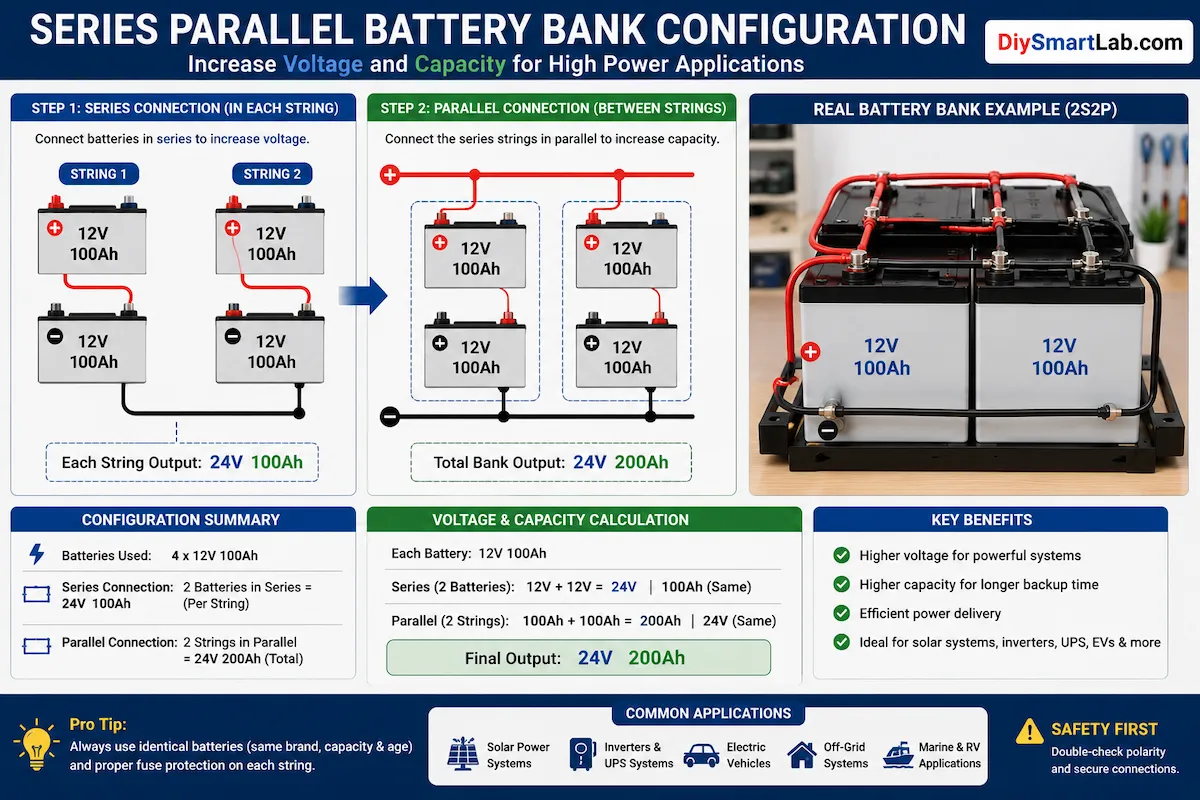
Series-Parallel Battery Connection
Sometimes both higher voltage and higher capacity are required.
In that situation, batteries are connected in a series-parallel configuration.
For example:
- Four batteries rated 12V 100Ah
- Two batteries connected in series create 24V 100Ah
- Another two batteries connected in series create 24V 100Ah
- Both groups connected in parallel create 24V 200Ah
This method is commonly used in solar systems, UPS systems, and electric vehicles.
Frequently Asked Questions (FAQs)
Does series connection increase battery capacity?
No. Series connection increases voltage only. Battery capacity remains unchanged.
Does parallel connection increase voltage?
No. Parallel connection keeps voltage the same and increases capacity.
Which battery connection gives longer backup time?
Parallel connection provides longer backup time because total capacity increases.
Can I connect old and new batteries together?
It is not recommended because performance and charging characteristics may differ.
Why is a BMS important in lithium battery packs?
A Battery Management System protects batteries from overcharging, over-discharging, and cell imbalance.
Which connection is used in electric vehicles?
Most electric vehicles use a combination of series and parallel battery connections.
Conclusion
Understanding series vs parallel battery connection explained is essential for anyone working with batteries, electronics projects, solar systems, or DIY power solutions.
A series connection increases voltage while keeping capacity the same. On the other hand, a parallel connection increases capacity while keeping voltage unchanged.
Choosing the correct battery connection depends on your project requirements. If you need higher voltage, use a series connection. If you need longer runtime, use a parallel connection.
For larger battery banks, a combination of both methods may be the best solution.
At DiySmartLab.com, we always recommend following proper battery safety practices and using matching batteries for reliable and safe operation.
You May Also Like
Real-World Examples of Series and Parallel Battery Connections
Example 1: Flashlight Batteries
Most traditional flashlights use batteries connected in series. For example, four AA batteries rated at 1.5V each are connected in series to produce 6V.
This higher voltage helps power the flashlight bulb or LED driver circuit efficiently.
Example 2: Power Bank Batteries
Many power banks use multiple lithium-ion cells connected in parallel.
Each cell may be rated at 3.7V and 2500mAh. Connecting four cells in parallel creates a battery pack with:
- Voltage = 3.7V
- Capacity = 10000mAh
This provides longer backup time while maintaining the same voltage.
Example 3: Solar Energy Storage System
Solar battery banks often use both series and parallel configurations.
For example:
- Four 12V batteries connected in series create a 48V battery bank.
- Multiple 48V strings can then be connected in parallel to increase capacity.
This arrangement is common in residential solar installations.
Example 4: Electric Vehicles
Electric vehicles require both high voltage and high capacity.
Therefore, thousands of battery cells are connected in series-parallel combinations.
This design provides sufficient voltage for the motor and enough energy for long driving range.
Common Mistakes to Avoid
Beginners often make mistakes when building battery packs. Avoiding these mistakes can improve safety and battery life.
- Connecting batteries with different voltages.
- Mixing old and new batteries.
- Using batteries with different capacities.
- Ignoring fuse protection.
- Reversing battery polarity.
- Using undersized wires.
- Charging lithium batteries without a BMS.
- Connecting damaged batteries.
Battery Connection Troubleshooting Guide
| Problem | Possible Cause | Solution |
|---|---|---|
| Battery pack not working | Incorrect wiring | Check all connections |
| Low voltage output | Weak battery | Test each battery individually |
| Battery overheating | Overload or mismatch | Use matching batteries |
| Short runtime | Reduced capacity | Replace damaged cells |
| Uneven charging | Cell imbalance | Use balancing circuit or BMS |
How to Choose Between Series and Parallel Connection
The correct battery connection depends on your application requirements.
| Requirement | Recommended Connection |
|---|---|
| Need higher voltage | Series |
| Need longer backup time | Parallel |
| Need higher current | Parallel |
| Need both voltage and capacity | Series-Parallel |
| Electric vehicle battery pack | Series-Parallel |
| Portable power bank | Parallel |
| Solar battery bank | Series-Parallel |
Series vs Parallel Battery Connection Explained: Quick Summary
| Feature | Series | Parallel |
|---|---|---|
| Voltage | Increases | Same |
| Capacity | Same | Increases |
| Current | Same | Higher |
| Runtime | Normal | Longer |
| Main Purpose | Higher Voltage | Higher Capacity |
| Difficulty | Easy | Easy |
Final Thoughts
We hope this guide on series vs parallel battery connection explained helped you understand the differences between these two important battery configurations.
Series connections increase voltage, while parallel connections increase capacity. Both methods are widely used in electronics, renewable energy systems, battery-powered tools, and electric vehicles.
Before building any battery pack, always verify battery specifications, use proper protection circuits, and follow safe wiring practices.
Whether you are building a simple DIY electronics project or a large solar battery bank, understanding battery connections is a fundamental skill.
At DiySmartLab.com, our goal is to make electronics and battery technology easy for beginners. Keep exploring our tutorials to learn more about batteries, BMS systems, solar power, Arduino projects, and DIY electronics.