

What are Jumper Wires? Types and Uses
Jumper wires are one of the most important tools in electronics and Arduino projects. They are used to create temporary electrical connections between components on a breadboard, sensors, modules, and microcontrollers like Arduino and Raspberry Pi. Whether you are a beginner learning electronics or an advanced DIY maker building smart projects, jumper wires help you quickly connect circuits without soldering.
In this guide, you will learn what jumper wires are, their different types, how they work, where they are used, and how to choose the right jumper wires for your electronics projects.

What are Jumper Wires?
Jumper wires are small insulated electrical wires with connector pins at their ends. They are mainly used to connect electronic components together during circuit prototyping. These wires allow quick connections without soldering, making them perfect for breadboards and DIY electronics projects.
Jumper wires are commonly used with:
- Arduino boards
- Raspberry Pi
- Breadboards
- Sensors and modules
- LEDs and resistors
- Robotics projects
- IoT circuits
Why are Jumper Wires Important?
Jumper wires make electronics prototyping fast and easy. Instead of soldering components permanently, you can quickly test different circuit designs using jumper wires.
Main advantages of jumper wires:
- Easy to use for beginners
- No soldering required
- Reusable and flexible
- Perfect for testing circuits
- Quick troubleshooting
- Ideal for Arduino and DIY projects

Types of Jumper Wires
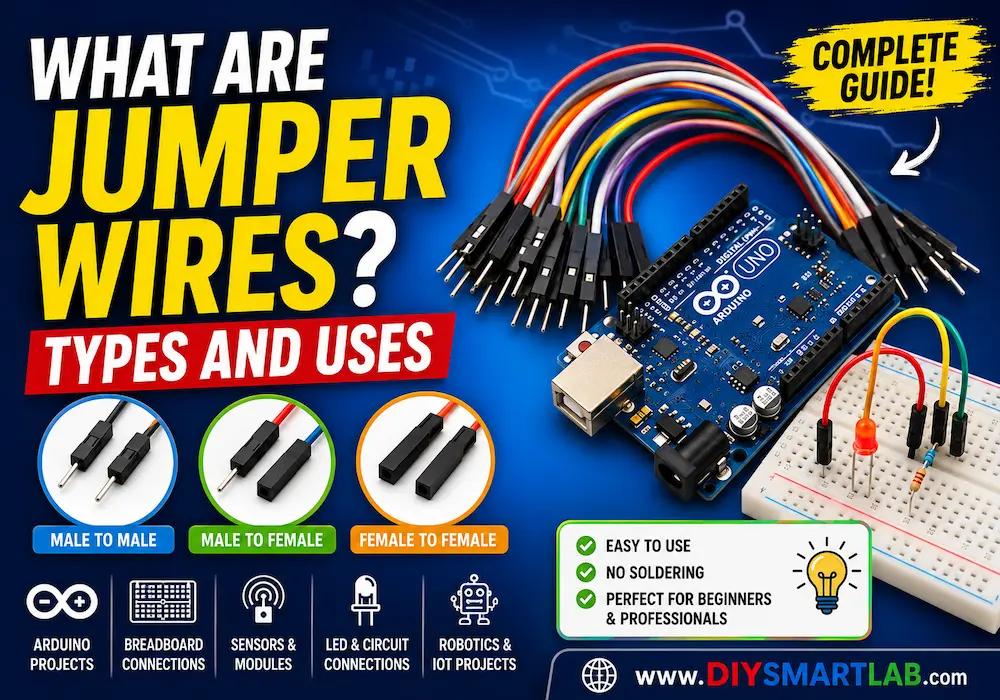
Jumper wires are mainly classified based on their connector types. There are three common types:
1. Male-to-Male Jumper Wires
Male-to-male jumper wires have metal pins on both ends. These are the most commonly used jumper wires for breadboard connections.
Uses:
- Connecting breadboard rows
- Connecting Arduino pins to breadboard
- Simple prototyping circuits
2. Male-to-Female Jumper Wires
These wires have a male pin on one side and a female connector on the other side. They are useful for connecting modules and sensors to Arduino boards.
Uses:
- Connecting sensor modules
- Connecting relay modules
- Arduino to module connections
3. Female-to-Female Jumper Wires
Female-to-female jumper wires have female connectors on both ends. They are mainly used to connect male header pins together.
Uses:
- Module-to-module connections
- Connecting GPIO pins
- Raspberry Pi projects

How Do Jumper Wires Work?
Jumper wires simply carry electrical signals or power from one point to another. The metal conductor inside the wire allows current to flow between connected components.
For example:
- Power from Arduino 5V pin to breadboard
- Signal from sensor output to Arduino input pin
- Ground connection between modules
The insulation around the wire protects the signal and prevents short circuits.
Where are Jumper Wires Used?
Jumper wires are used in almost every electronics prototyping project.
Common applications include:
- Arduino projects
- IoT systems
- Sensor interfacing
- LED circuits
- Robotics projects
- Smart home automation
- Breadboard experiments
- School and college electronics labs

Advantages of Jumper Wires
- Low cost
- Easy circuit modification
- Reusable multiple times
- Perfect for temporary circuits
- Available in different lengths and colors
- Helps organize wiring neatly
Disadvantages of Jumper Wires
- Loose connections may occur
- Not suitable for permanent circuits
- Can create messy wiring in large projects
- Low-quality wires may break easily
How to Choose Good Jumper Wires
When buying jumper wires, consider these factors:
- Flexible and durable insulation
- Strong connector pins
- Different wire lengths
- Color-coded wires for easy identification
- Compatible with breadboards and Arduino
Tips for Using Jumper Wires Properly
- Use different colors for power and ground
- Keep wires short to reduce clutter
- Avoid bending connector pins too much
- Check loose connections during troubleshooting
- Store jumper wires neatly after use
Jumper Wires vs Breadboard Wires
| Feature | Jumper Wires | Breadboard Wires |
|---|---|---|
| Connectors | Male/Female connectors | Solid wire ends |
| Flexibility | Highly flexible | Less flexible |
| Usage | Arduino and modules | Breadboard-only circuits |
| Ease of Use | Very easy | Moderate |
Frequently Asked Questions (FAQs)
What are jumper wires used for?
Jumper wires are used to connect electronic components temporarily during prototyping and testing.
Can jumper wires carry power?
Yes, jumper wires can carry low-voltage power and signals in electronics projects.
Which jumper wire is best for Arduino?
Male-to-male jumper wires are most commonly used with Arduino and breadboards.
Are jumper wires reusable?
Yes, jumper wires are reusable and can be used multiple times if handled carefully.
What colors are used in jumper wires?
Jumper wires come in multiple colors to help identify power, ground, and signal lines easily.
Conclusion
Jumper wires are essential components for electronics beginners, hobbyists, and engineers. They make prototyping simple, fast, and solder-free. Whether you are building Arduino projects, smart home systems, robotics, or sensor circuits, jumper wires help create reliable temporary connections quickly.
Understanding the different types of jumper wires and their uses will help you design cleaner and more efficient electronics projects.