
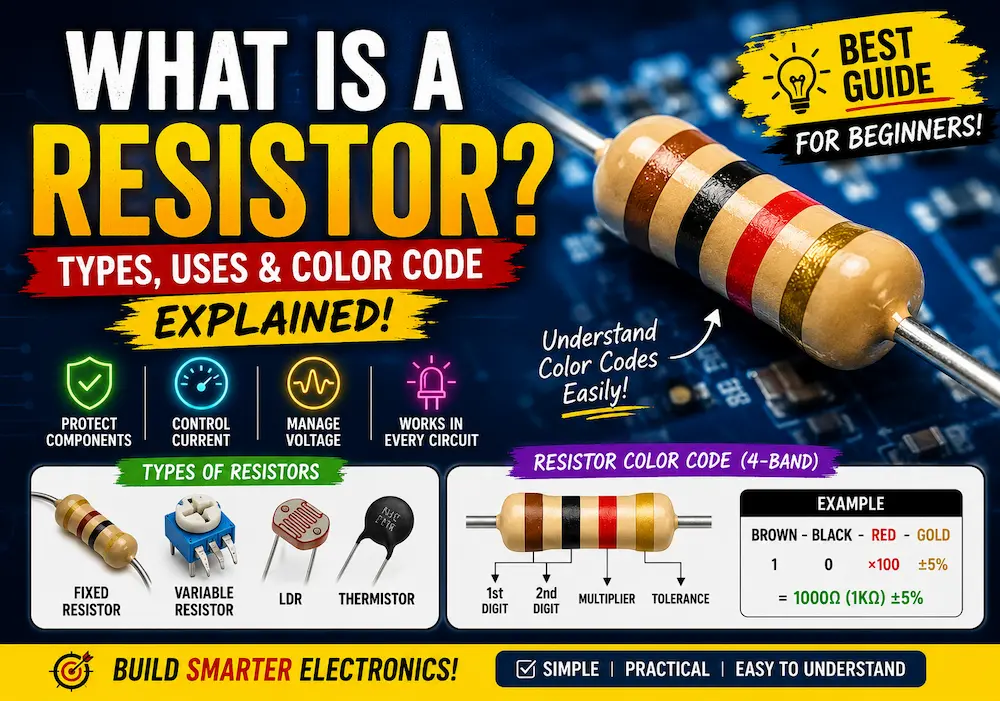
What is a Resistor? Types, Uses & Color Code Guide Explained

What is a Resistor? Types, Uses & Color Code Explained
A resistor is one of the most basic and important electronic components used in almost every circuit. Whether you are building an Arduino project, LED circuit, sensor module, or DIY electronics project, resistors help control current, divide voltage, and protect components from damage.
In this beginner-friendly guide, you will learn what a resistor is, how it works, different types of resistors, common uses, and how to read resistor color codes easily.
What is a Resistor?
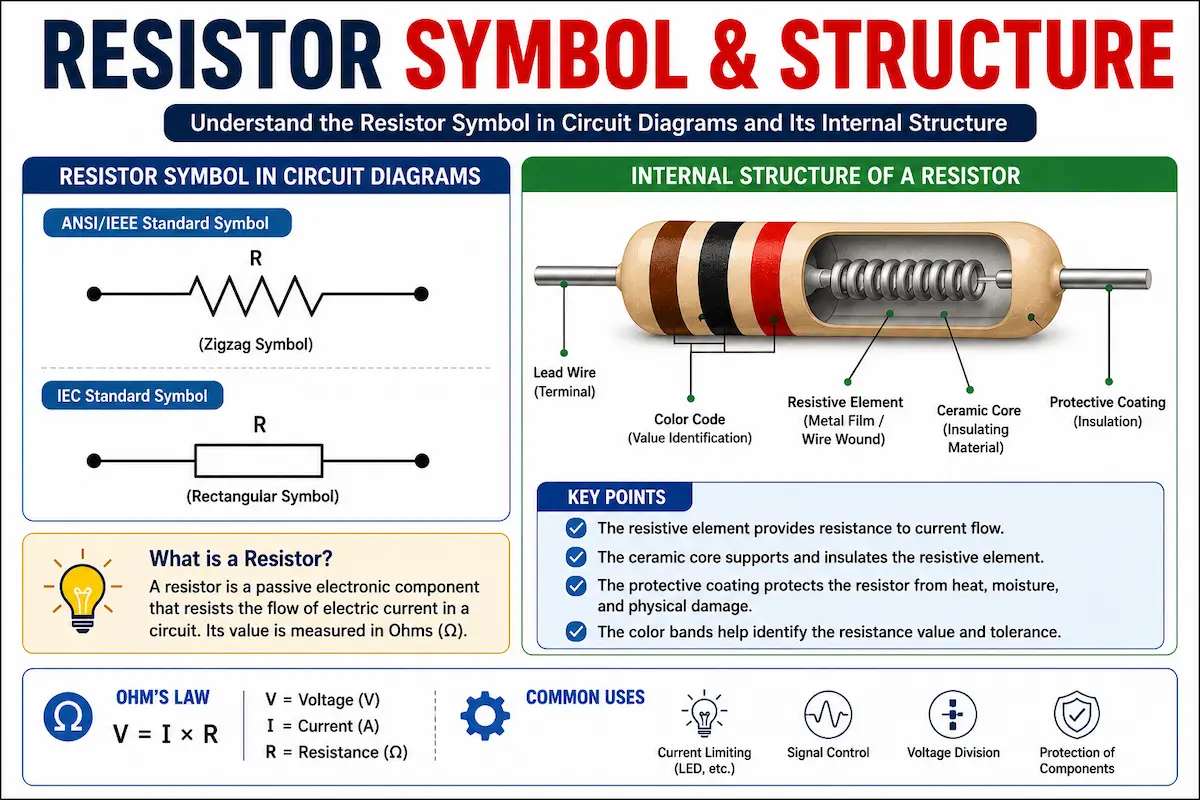
A resistor is a passive electronic component that limits or controls the flow of electric current in a circuit. It provides resistance to current flow and converts some electrical energy into heat.
In simple words:
A resistor is a component that opposes the flow of electric current.
The resistance value of a resistor is measured in Ohms (Ω). Higher resistance means less current will flow through the circuit.
Resistor Symbol
In circuit diagrams, resistors are shown using standard symbols. The most common resistor symbol is a zigzag line or a rectangular box, depending on the standard used.
How Does a Resistor Work?
A resistor works by restricting the movement of electrons in a circuit. When current passes through a resistor, the resistor creates opposition. This opposition reduces current and helps protect sensitive components.
For example, if you connect an LED directly to a battery without a resistor, too much current may flow through the LED and damage it. But when a resistor is connected in series with the LED, it limits the current and keeps the LED safe.
Basic Formula of Resistance
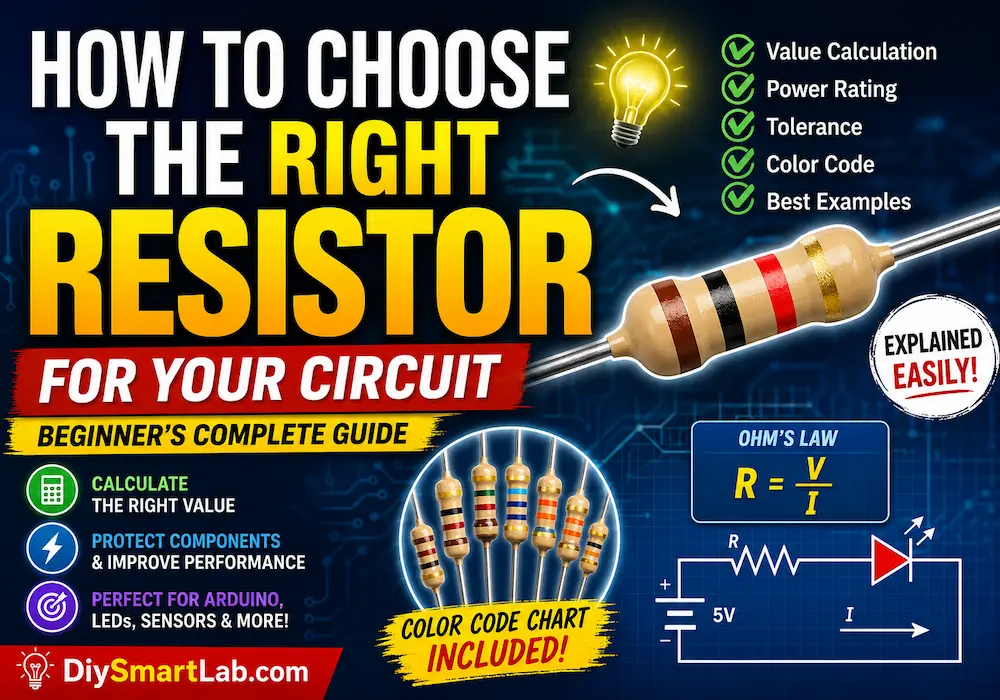
The relationship between voltage, current, and resistance is explained by Ohm’s Law:
V = I × R- V = Voltage in volts
- I = Current in amperes
- R = Resistance in ohms
This formula is very useful when calculating resistor values for LEDs, sensors, and Arduino circuits.
Why Are Resistors Important?
Resistors are small components, but they perform many important functions in electronics. Without resistors, many components can get damaged due to excessive current.
Main Functions of a Resistor
- Limits current flow in a circuit
- Protects LEDs and other components
- Divides voltage into smaller values
- Controls signal levels
- Helps in pull-up and pull-down circuits
- Used in timing, filtering, and sensing circuits
Types of Resistors
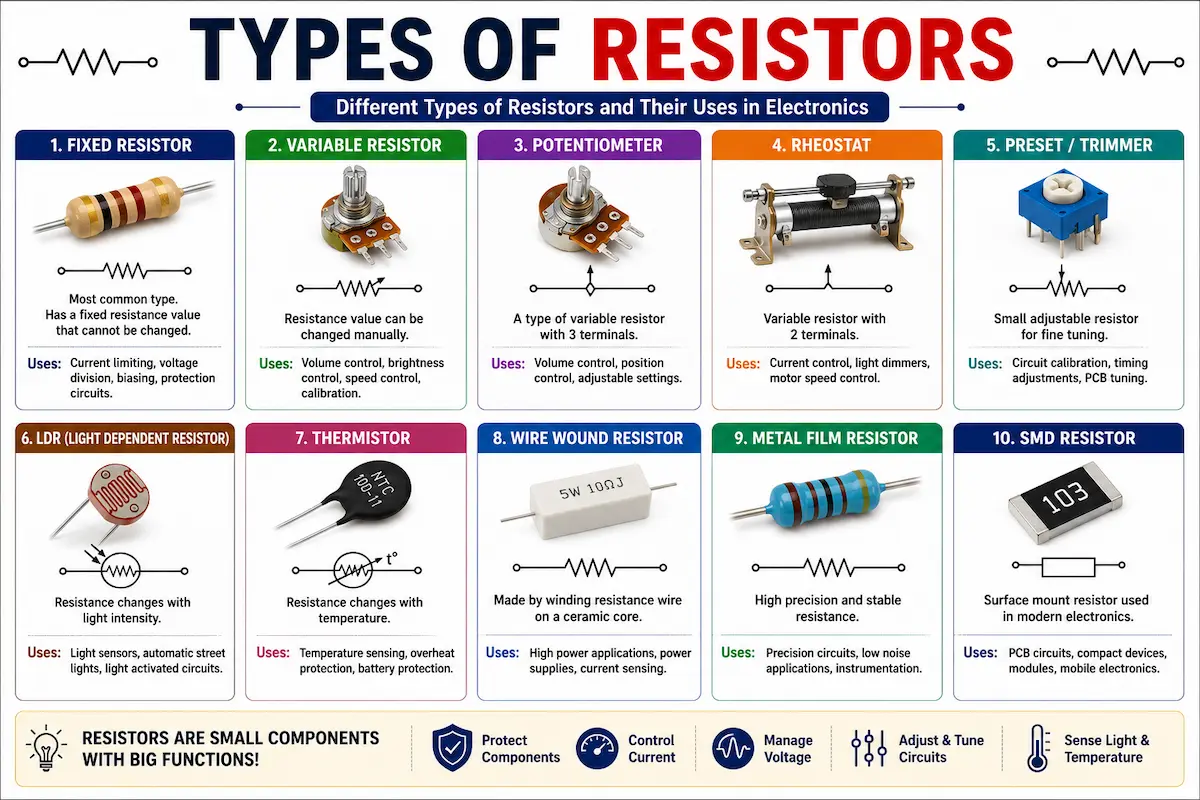
There are many types of resistors used in electronics. Each type is designed for a specific purpose.
1. Fixed Resistor
A fixed resistor has a fixed resistance value that cannot be changed. These are the most common resistors used in basic electronics circuits.
Common examples:
- Carbon film resistor
- Metal film resistor
- Wire wound resistor
Common use: LED circuits, Arduino projects, voltage dividers, and general electronics circuits.
2. Variable Resistor
A variable resistor allows you to change the resistance value manually. It is useful when you need adjustable control in a circuit.
Common examples:
- Potentiometer
- Rheostat
- Preset resistor
Common use: Volume control, brightness control, fan speed control, and sensor calibration.
3. LDR (Light Dependent Resistor)
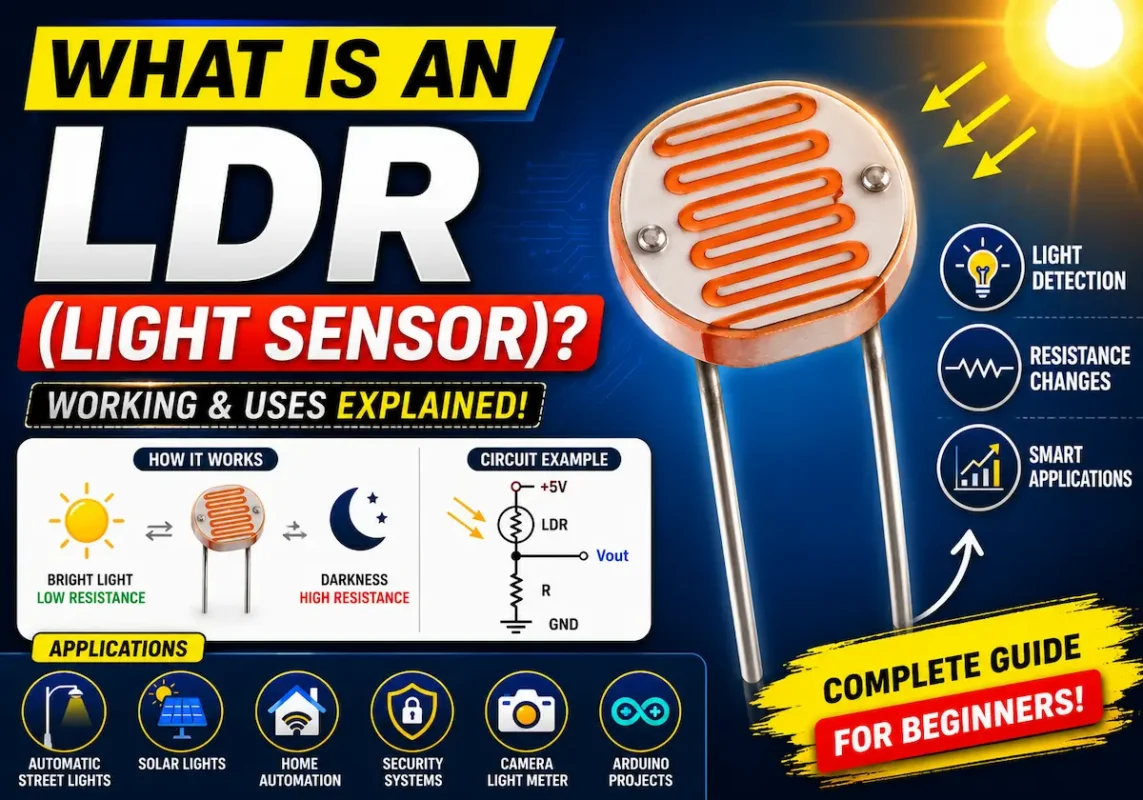
An LDR changes its resistance according to light intensity. Its resistance decreases when light falls on it and increases in darkness.
Common use: Automatic street lights, night lamps, light sensor circuits, and Arduino light detection projects.
4. Thermistor
A thermistor changes resistance according to temperature. It is commonly used for temperature sensing and protection circuits.
Common use: Temperature sensors, battery protection, and heating control systems.
5. SMD Resistor
An SMD resistor is a small surface-mounted resistor used in modern electronic devices. These resistors are found on mobile phones, computers, modules, and compact circuit boards.
Common use: PCB circuits, compact devices, modules, and commercial electronics.
Common Uses of Resistors
Resistors are used in almost every electronic circuit. Here are some common and practical uses.
1. Current Limiting
The most common use of a resistor is to limit current. For example, an LED needs a resistor to prevent excess current from damaging it.
2. Voltage Divider Circuit
Two resistors can be used together to divide voltage. Voltage divider circuits are commonly used with sensors and microcontrollers.
3. Pull-up and Pull-down Resistors
Pull-up and pull-down resistors are used in digital circuits to keep input pins stable. They are very common in Arduino button circuits.
4. Signal Control
Resistors are used in audio circuits, amplifiers, filters, and communication circuits to control signal levels.
5. Protection Circuits
Resistors help protect components from high current and voltage spikes when used correctly in a circuit.
Resistor Color Code Explained
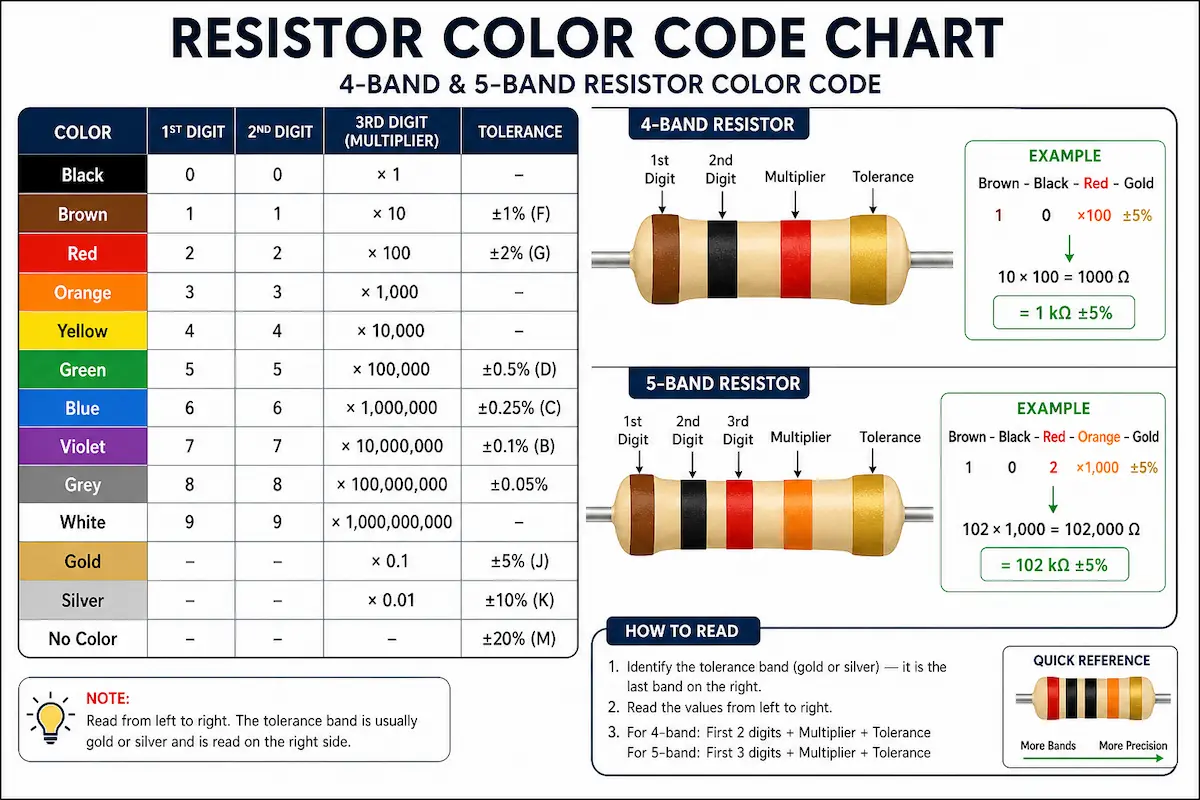
Most through-hole resistors have colored bands printed on their body. These bands represent the resistor value, multiplier, and tolerance.
Instead of printing numbers directly on small resistors, manufacturers use color bands to show resistance values.
4-Band Resistor Color Code
A common resistor has 4 color bands:
| Band | Meaning |
|---|---|
| 1st Band | First digit |
| 2nd Band | Second digit |
| 3rd Band | Multiplier |
| 4th Band | Tolerance |
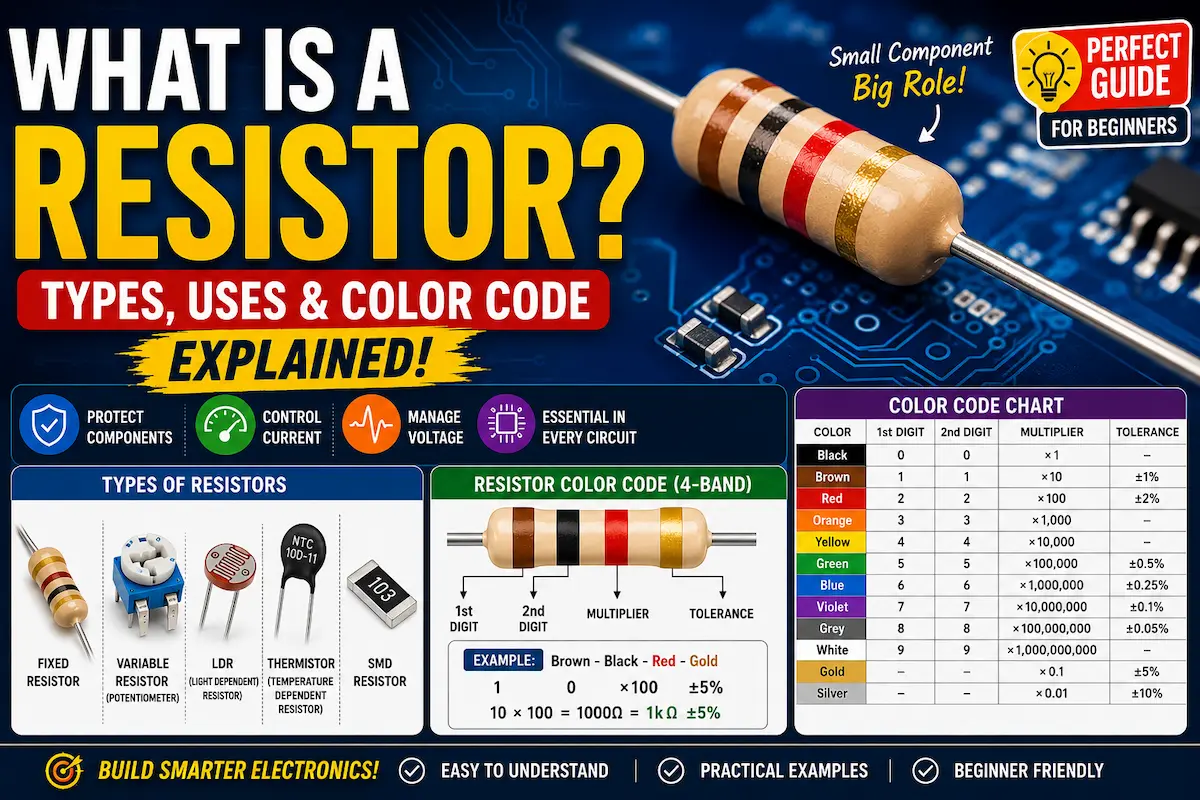
Resistor Color Code Table
| Color | Digit | Multiplier | Tolerance |
|---|---|---|---|
| Black | 0 | ×1 | – |
| Brown | 1 | ×10 | ±1% |
| Red | 2 | ×100 | ±2% |
| Orange | 3 | ×1,000 | – |
| Yellow | 4 | ×10,000 | – |
| Green | 5 | ×100,000 | ±0.5% |
| Blue | 6 | ×1,000,000 | ±0.25% |
| Violet | 7 | ×10,000,000 | ±0.1% |
| Grey | 8 | ×100,000,000 | ±0.05% |
| White | 9 | ×1,000,000,000 | – |
| Gold | – | ×0.1 | ±5% |
| Silver | – | ×0.01 | ±10% |
Example: How to Read a Resistor Color Code
Let’s understand with a common example:
Color bands: Brown – Black – Red – Gold
- Brown = 1
- Black = 0
- Red = ×100
- Gold = ±5% tolerance
So the resistor value is:
10 × 100 = 1000ΩTherefore, the resistor value is:
1000Ω = 1kΩ ±5%
What is Resistor Tolerance?
Tolerance tells how much the actual resistor value may vary from the printed value. For example, a 1kΩ resistor with ±5% tolerance may have an actual value slightly above or below 1kΩ.
Common tolerance bands:
- Gold: ±5%
- Silver: ±10%
- Brown: ±1%
- Red: ±2%
How to Choose the Right Resistor
Choosing the correct resistor depends on your circuit requirements. Before selecting a resistor, check these important points:
- Required resistance value in ohms
- Power rating of the resistor
- Tolerance value
- Application type
- Voltage and current in the circuit
Common Resistor Values for Beginners
| Resistor Value | Common Use |
|---|---|
| 220Ω | LED current limiting |
| 330Ω | LED protection |
| 1kΩ | General signal control |
| 4.7kΩ | Pull-up resistor |
| 10kΩ | Arduino input pull-up/pull-down |
| 100kΩ | Sensor and timing circuits |
Resistor in LED Circuit
One of the most common beginner circuits is an LED with a resistor. The resistor is connected in series with the LED to limit current.
Without a resistor, the LED may receive too much current and burn out.
Battery Positive → Resistor → LED → Battery NegativeThis simple circuit is useful for learning current limiting and basic circuit protection.
Advantages of Resistors
- Simple and low-cost component
- Easy to use in circuits
- Available in many values
- Protects sensitive components
- Useful in almost every electronics project
Disadvantages of Resistors
- Wastes some energy as heat
- Incorrect value can affect circuit performance
- Power rating must be selected carefully
- Can burn if overloaded
Common Mistakes Beginners Make with Resistors
- Using the wrong resistor value
- Ignoring resistor power rating
- Reading color bands from the wrong side
- Using no resistor with LEDs
- Confusing kilo-ohm and mega-ohm values
Conclusion
A resistor is a basic but very important electronic component. It limits current, divides voltage, protects components, and helps circuits work correctly. If you are learning DIY electronics or Arduino projects, understanding resistors is one of the first steps toward building safe and successful circuits.
Once you understand resistor types, uses, and color codes, you can easily select the right resistor for your electronics projects.
Frequently Asked Questions
1. What is the main function of a resistor?
The main function of a resistor is to limit or control current flow in an electronic circuit.
2. What is the unit of resistor?
The unit of resistance is Ohm, represented by the symbol Ω.
3. Are resistors polarized?
No, normal resistors are not polarized. You can connect them in any direction.
4. Why is a resistor used with an LED?
A resistor is used with an LED to limit current and prevent the LED from burning out.
5. What does the gold band on a resistor mean?
The gold band usually represents ±5% tolerance.
6. What is a 1k resistor?
A 1k resistor means the resistor has a value of 1000 ohms.
You May Also Like
SEO Keywords
Main keyword: What is a resistor
Related keywords: resistor types, resistor uses, resistor color code, resistor color code chart, how to read resistor color code, resistor explained, fixed resistor, variable resistor, resistor in electronics, resistor for LED circuit