

What is an IR Sensor? Working and Applications

What is an IR Sensor? Working and Applications
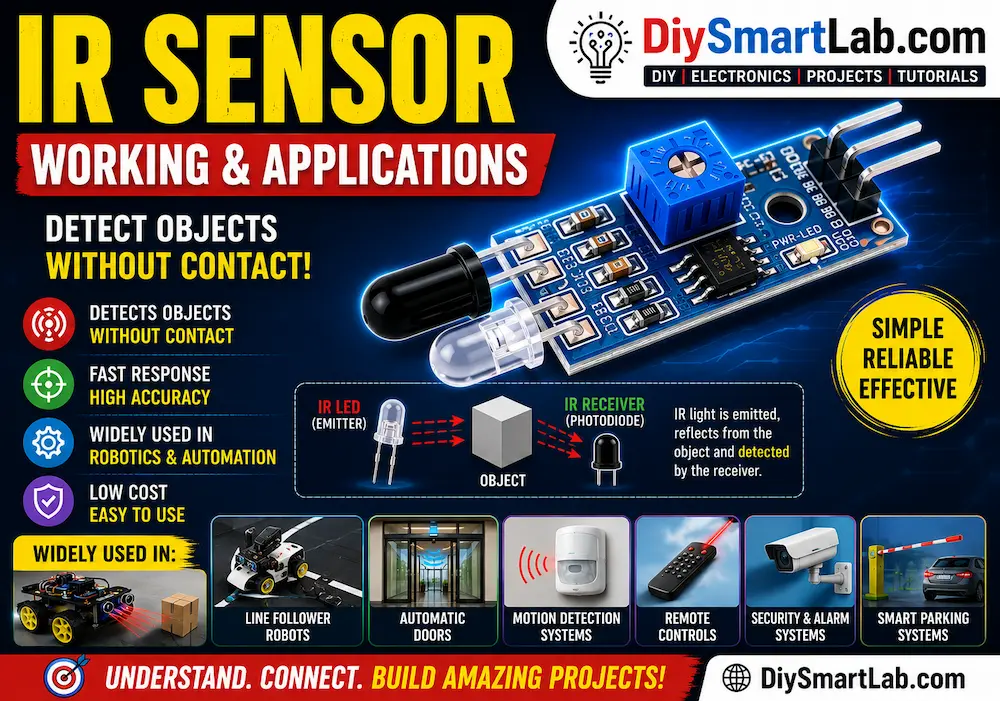
IR Sensor (Infrared Sensor) is one of the most commonly used electronic sensors in automation, robotics, and smart DIY projects. It can detect objects, measure distance, sense motion, and even identify obstacles without physical contact. IR sensors are widely used in Arduino projects, automatic doors, line follower robots, obstacle detection systems, and home automation devices.
In this beginner-friendly guide, you will learn what an IR sensor is, how it works, its types, applications, advantages, disadvantages, and how to use it in electronics projects.

What is an IR Sensor?
An IR sensor is an electronic device that detects infrared radiation emitted or reflected by objects. Infrared light is invisible to the human eye because its wavelength is longer than visible light.
An IR sensor generally consists of two main parts:
- IR LED (Emitter) – emits infrared light
- Photodiode or IR Receiver – detects reflected infrared light
When an object comes near the sensor, the emitted IR light reflects back and gets detected by the receiver. This allows the sensor to detect the presence of objects.
IR Sensor Symbol and Structure
The structure of a typical IR sensor module contains:
- IR Transmitter LED
- IR Receiver Photodiode
- Comparator IC
- Sensitivity Adjustment Potentiometer
- Power and Output Pins

How Does an IR Sensor Work?
The working principle of an IR sensor is very simple and based on infrared light reflection.
- The IR LED emits infrared radiation continuously.
- When an object comes in front of the sensor, the IR light reflects back.
- The IR receiver detects the reflected light.
- The sensor circuit generates an output signal.
- The microcontroller or circuit uses this signal for detection or automation.
If no object is present, very little or no infrared light reaches the receiver.

Types of IR Sensors
There are different types of infrared sensors used in electronics and automation.
1. Active IR Sensor
Active IR sensors contain both an IR transmitter and receiver. They emit infrared light and detect reflections from nearby objects.
Examples: Obstacle detection sensors, line tracking sensors
2. Passive IR Sensor (PIR Sensor)
Passive IR sensors do not emit infrared light. Instead, they detect infrared radiation emitted naturally by warm objects like humans and animals.
Examples: Motion detection systems, automatic security lights

IR Sensor Pin Configuration
Most IR sensor modules used with Arduino have three pins:
- VCC – Power supply (3.3V or 5V)
- GND – Ground
- OUT – Digital output signal
Some advanced IR modules may also include analog output pins.
Applications of IR Sensors
IR sensors are widely used in many electronic devices and smart automation systems.
- Obstacle detection robots
- Line follower robots
- Automatic doors
- Motion detection systems
- TV remote controls
- Security alarm systems
- Object counting machines
- Smart parking systems
- Industrial automation
- Touchless switches and dispensers

Advantages of IR Sensors
- Low cost and easily available
- Simple to use
- Compact size
- Low power consumption
- Fast response time
- Ideal for automation projects
Disadvantages of IR Sensors
- Short detection range
- Affected by sunlight and ambient light
- Performance depends on object color and surface
- Cannot accurately measure long distances
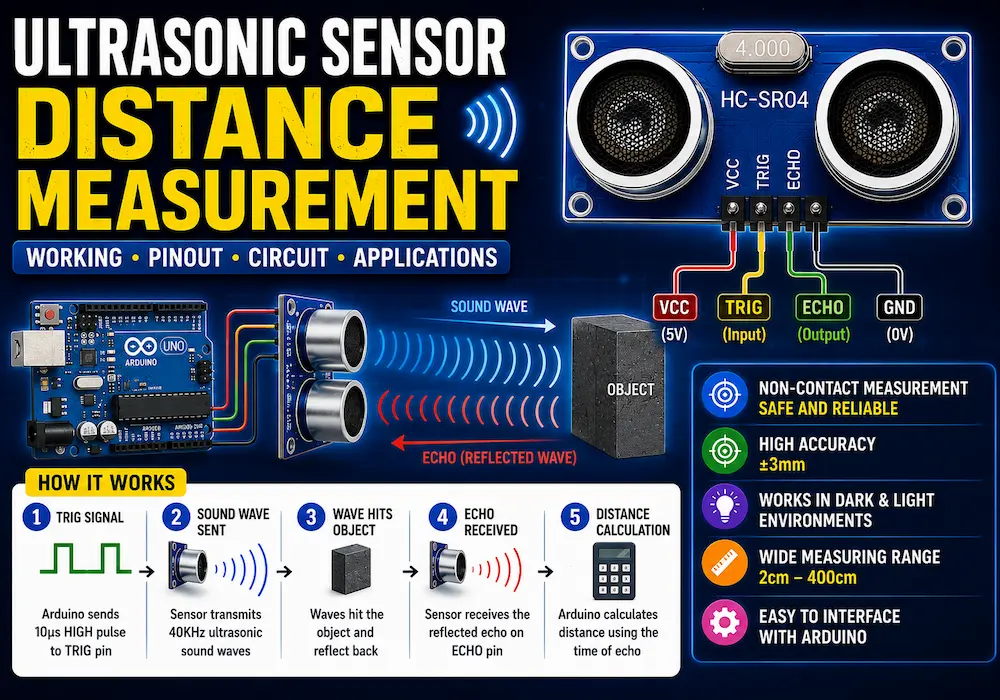
IR Sensor vs Ultrasonic Sensor
| Feature | IR Sensor | Ultrasonic Sensor |
|---|---|---|
| Working Principle | Infrared light reflection | Ultrasonic sound waves |
| Cost | Low | Moderate |
| Range | Short | Longer |
| Accuracy | Moderate | High |
| Sunlight Effect | Yes | No |
How to Use an IR Sensor with Arduino
Connecting an IR sensor with Arduino is very easy.
- Connect VCC to 5V
- Connect GND to Ground
- Connect OUT pin to Arduino digital pin
The Arduino reads HIGH or LOW signals from the sensor and performs actions like stopping a robot or turning on LEDs.

Frequently Asked Questions (FAQs)
What is the use of an IR sensor?
IR sensors are used for object detection, motion sensing, obstacle avoidance, remote controls, and automation systems.
Can IR sensors detect humans?
Yes, PIR sensors can detect humans by sensing body heat emitted as infrared radiation.
What is the range of an IR sensor?
Most IR obstacle sensors work within a range of 2 cm to 30 cm depending on the module.
Is an IR sensor analog or digital?
IR sensors can be analog or digital depending on the sensor module design.
Conclusion
IR sensors are simple, affordable, and highly useful electronic components for DIY electronics and automation projects. They work by detecting infrared radiation and are commonly used for obstacle detection, motion sensing, and remote control applications.
If you are learning Arduino, robotics, or home automation, understanding how IR sensors work is very important because they are one of the most widely used sensors in beginner and advanced electronics projects.
2 thoughts on “What is an IR Sensor? Working and Applications”