
What is an LDR (Light Sensor)? Working & Uses

What is an LDR (Light Sensor)? Working Principle & Uses
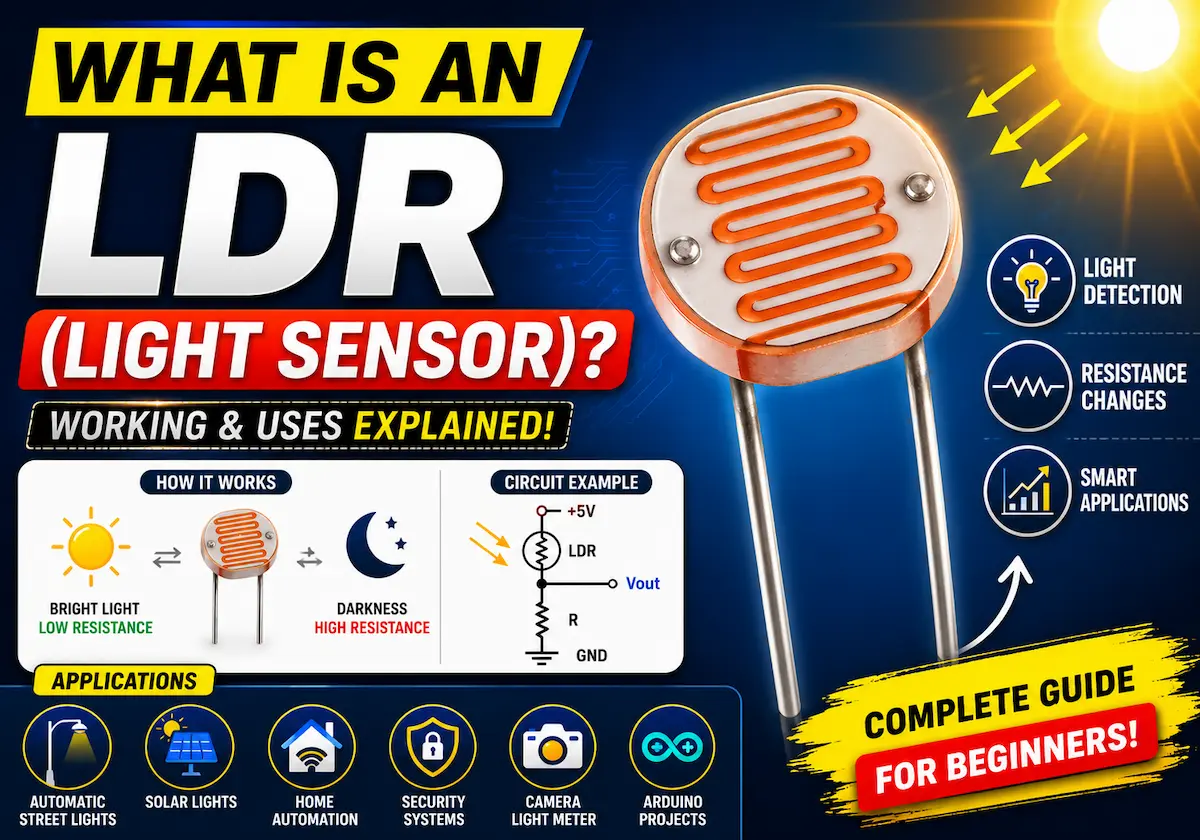
An LDR is a simple light sensor used in electronic circuits. LDR stands for Light Dependent Resistor.
It changes its resistance when light falls on it. In bright light, its resistance becomes low. In darkness, its resistance becomes high.
Because of this feature, LDR sensors are used in automatic lights, security alarms, smart home systems, and Arduino projects.

What is an LDR?
An LDR is a resistor that depends on light. It is also called a photoresistor or light sensor.
The resistance of an LDR changes with light intensity. This makes it useful for detecting bright and dark conditions.
- Bright light: Low resistance
- Low light: High resistance
- Darkness: Very high resistance
LDR Symbol and Internal Structure
The LDR symbol looks like a resistor with arrows pointing toward it. These arrows show light falling on the sensor.

Inside the LDR, there is a light-sensitive semiconductor track. This track is usually made in a zig-zag shape.
The zig-zag shape increases the light-sensitive area. As a result, the LDR can respond better to light.
How Does an LDR Work?
An LDR works on the principle of photoconductivity.
When light falls on the LDR, photons hit the semiconductor material. These photons release free electrons.
More free electrons allow more current to flow. Therefore, the resistance of the LDR decreases.
In darkness, very few photons hit the material. So, fewer free electrons are available. As a result, the resistance becomes high.

LDR Resistance in Light and Darkness
| Light Condition | LDR Resistance | Result |
|---|---|---|
| Bright Light | Low | More current flows |
| Normal Light | Medium | Medium current flows |
| Darkness | High | Less current flows |
This simple behavior makes the LDR useful in automatic switching circuits.
LDR Pin Configuration
An LDR has two terminals. It does not have positive or negative polarity.
So, you can connect it in any direction in a circuit.
- Terminal 1: Connects to power or resistor
- Terminal 2: Connects to ground or output
Simple LDR Circuit Example
The most common LDR circuit is a voltage divider circuit. It uses one LDR and one fixed resistor.
In this circuit, the output voltage changes when the light level changes.

Here is how the circuit works:
- The LDR senses the light level.
- The fixed resistor forms a voltage divider.
- The output voltage changes with light.
- A microcontroller can read this voltage.
Applications of LDR Sensor
LDR sensors are used in many real-life electronic devices. They are useful where automatic light detection is needed.

- Automatic street lights
- Solar garden lights
- Automatic night lamps
- Security alarm systems
- Camera light meters
- Light intensity meters
- Brightness control circuits
- Smart home automation projects
- Arduino light sensor projects
Advantages of LDR
- It is low cost.
- It is easy to use.
- It has good light sensitivity.
- It consumes low power.
- It is perfect for beginner circuits.
Disadvantages of LDR
- It has a slow response time.
- It is not ideal for fast circuits.
- Temperature can affect its performance.
- It is less accurate than a photodiode.
LDR vs Photodiode
| Feature | LDR | Photodiode |
|---|---|---|
| Response Speed | Slow | Fast |
| Cost | Low | Higher |
| Output | Resistance change | Current change |
| Best Use | Light detection | Fast optical sensing |
| Beginner Friendly | Yes | Medium |
How to Use an LDR with Arduino
You can easily connect an LDR to an Arduino. For this, use a voltage divider circuit.
- Connect one side of the LDR to 5V.
- Connect the other side to analog pin A0.
- Connect a 10kΩ resistor between A0 and GND.
- Read the analog value using Arduino code.
After that, Arduino can detect whether the room is bright or dark.
Common LDR Project Ideas
- Automatic night lamp
- Smart street light
- Light intensity meter
- Sunlight tracking system
- Arduino room light controller
- Smart home lighting system
Frequently Asked Questions
What does LDR stand for?
LDR stands for Light Dependent Resistor.
What is the main use of an LDR?
The main use of an LDR is to detect light intensity in a circuit.
Does an LDR have polarity?
No. An LDR does not have polarity. You can connect it in any direction.
Is an LDR analog or digital?
An LDR is an analog sensor because its resistance changes gradually with light.
Can we use LDR with Arduino?
Yes. You can use an LDR with Arduino by connecting it to an analog pin through a voltage divider circuit.
Conclusion
An LDR is one of the easiest light sensors for beginners. It changes resistance according to light intensity.
In bright light, its resistance becomes low. In darkness, its resistance becomes high.
Because of this simple working principle, LDR sensors are used in automatic lights, alarms, smart homes, and Arduino projects.